Finding Yourself Again: A Gay Men's Retreat for Midlife Reflection in the Redwoods of Northern California
There's a particular kind of exhaustion that shows up for a lot of queer men somewhere in their 40s or 50s. It's not quite burnout. It's more like you've been running hard for a long time and suddenly you're not entirely sure the route you're on is the one you actually chose. A gay men's retreat built specifically around that experience, one that centers real coaching and honest conversation over spa treatments and passive relaxation, is harder to find than it should be. The Midlife Men's Retreat 2026 is exactly that kind of offering. Running Thursday, October 29 through Sunday, November 1, 2026, in Mendocino, California, it's four days designed not to fix you but to give you the space, the tools, and the community to figure out what you actually want from the next chapter. Browse the full Spirit Camp retreat calendar to see everything coming up this year.
A Curated Weekend for Queer Men in Midlife Who Are Ready to Go Deeper
The Midlife Men's Retreat 2026 is built for anyone who identifies as a queer man in midlife and wants more than a passive weekend away. The programming is deliberately substantive: group circle conversations, one-on-one coaching sessions with certified coaches, morning movement and meditation, unstructured time in the redwoods, and farm-to-table vegetarian meals shared around a communal table. These aren't extras layered on top of a schedule. They are the architecture of the whole experience.
The group is capped at a maximum of 15 participants, and that number is intentional. At that size, every person in the room actually gets seen. Conversations don't stay at the surface. You're not one of fifty people in a conference hall doing a guided journaling exercise. You're in a circle with a small group of men at a similar stage of life, having honest conversations about things that actually matter: how to navigate change skillfully, how to find meaning in your career and beyond it, how to get what you need in your relationships, and how to build genuine community with other queer men that has nothing to do with dating apps.
Couples and friends are welcome to attend together, though the experience is structured around individual reflection and honest self-inquiry rather than shared experience as a pair. The weekend is yours.
"If you're looking to experience genuine connection with other gay men who are in the same stage of life as you, this retreat is that. Jeff and Andrew are incredible, thoughtful facilitators and this retreat far exceeded my expectations." - Past Participant
Reserve your spot and learn more at the Midlife Men's Retreat 2026 retreat page. Browse all upcoming retreats at spirit.camp/retreats.
The Roots of Men's Work and Group Coaching
Men's work as a contemporary practice has a longer history than most people realize. Its modern form emerged most visibly in the 1980s and 1990s through the mythopoetic men's movement, a loosely organized cultural response to the question of what it meant to be a man in a rapidly changing society. Thinkers like Robert Bly, whose 1990 book Iron John became a touchstone of the era, and Michael Meade drew on mythology, poetry, and ritual to argue that men had lost access to meaningful rites of passage and were paying a real psychological cost for it. The movement convened men in nature-based gatherings, circles, and retreats centered on emotional depth, storytelling, and honest self-examination. While some aspects of that early movement have since been critiqued, particularly its lack of racial and sexual diversity, the core insight that men benefit from intentional community with other men has proven to be genuinely durable.
Over the following decades, men's work evolved considerably. Practitioners, researchers, and community organizers expanded the container to include men of color, queer men, trans men, and others who had been largely absent from those early gatherings. The underlying practices, including circle work, facilitated conversation, somatic awareness, and reflective inquiry, drew from therapeutic traditions, Indigenous council practices, and coaching methodologies to become something more rigorous and more inclusive than their origins. Today, men's group coaching and facilitated men's circles operate across a wide range of contexts, from corporate leadership development to community wellness programs to retreat settings like this one.
Group coaching differs meaningfully from both individual coaching and therapy. Individual coaching is a one-to-one relationship focused on goals, growth, and accountability over time. Therapy typically addresses mental health, past experiences, and clinical concerns with a licensed professional. Group coaching sits in a distinct space, using the tools of coaching inside a group container where participants learn not only from their own process but from witnessing others. The group becomes a kind of mirror. Hearing another man articulate something you've never quite been able to put into words can unlock your own clarity faster than any solo session.
Circle conversation specifically creates the conditions for that kind of depth. A well-facilitated circle operates on a simple agreement: everyone gets to speak, no one speaks over anyone else, and what's shared in the room stays in the room. That structure, as straightforward as it sounds, creates psychological safety that's genuinely rare in adult life. Most men don't have environments where they can say something true and uncertain and be met with curiosity rather than advice or judgment. For queer men in midlife, that kind of space carries particular weight. The lived experience of navigating identity, community, and purpose inside a culture that has historically pushed queer life to the margins creates a specific set of challenges, and a specific kind of relief when you're finally in a room full of men who share that context. Research on group-based interventions consistently demonstrates their value for improving self-awareness, reducing isolation, and building social support. A queer-affirming container doesn't just add a layer of inclusion to that picture. It changes the whole dynamic.
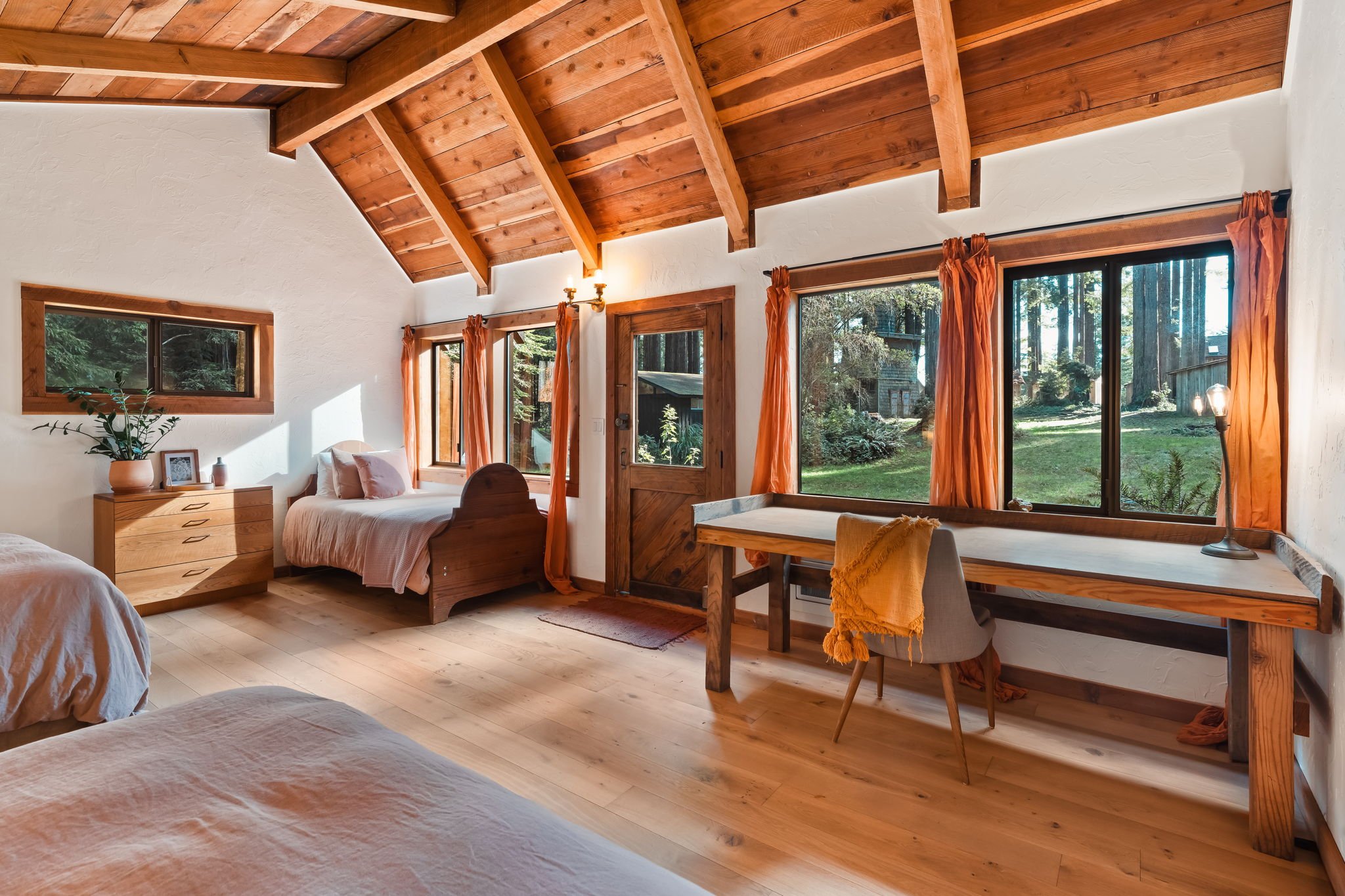
Photo of Deer Haven, one of the our many unique cabin spaces. This cabin has three beds. Cabins have between 1 to 8 beds each and provide several different sleeping arrangements for Gay men's retreat. All cabin spaces are included in redwood retreat for men.
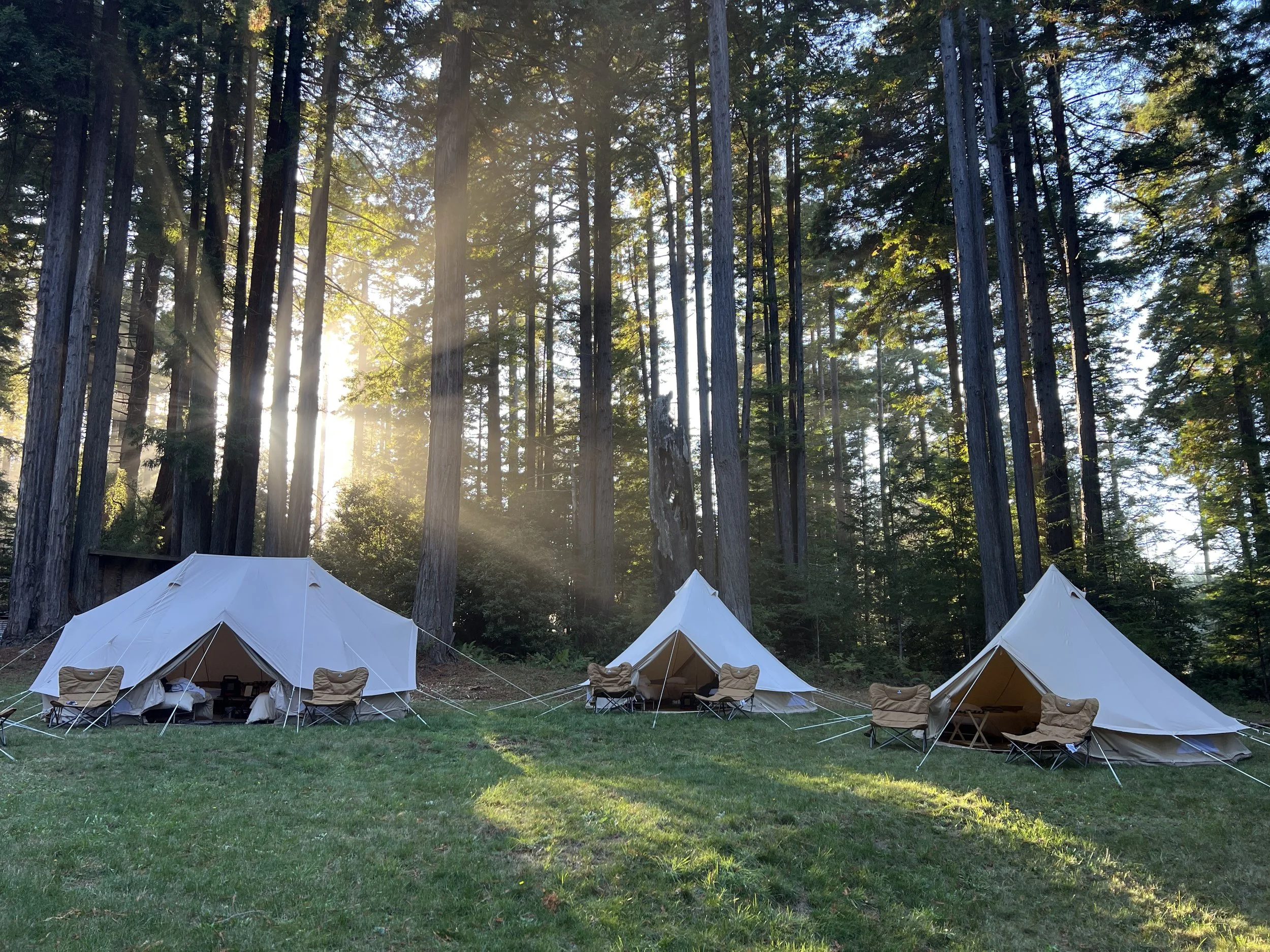
Photo of Group Glamping Tents Setup in Sunset Meadow. We have 10 Glamping Structures that can be added with 1to 3 beds each. This can increase bed capacity of campus to 50 guests across 20 unique accommodation spaces.
Meet the Facilitators: Jeff Sun and Andrew Blotky
Jeff Sun and Andrew Blotky are longtime friends, certified executive coaches, and the co-creators of the Midlife Men's Retreat. Together they bring more than 1,500 hours of coaching and group facilitation experience, accumulated across hundreds of engagements with leaders in a wide range of industries and life stages. Jeff is based in San Francisco and Andrew is based in New York City. Both have spent years as both participants and leaders in retreat settings, which means they understand this experience from both sides of the circle.
What sets them apart as facilitators isn't only their credentials. Both Jeff and Andrew identify as gay men in midlife. They're not facilitating a retreat about an experience they've read about. They're living it alongside the men who come. Their approach reflects that: no performance of certainty, no scripted answers, no sense that the weekend is about delivering content at you. The room they create is one where each person can show up from exactly where they are, bring what they actually have, and be met with respect rather than pressure.
"A few sentences can't do justice to the profound growth and connection I felt this weekend. Andrew and Jeff made a space for each individual to show up from where he was, find a respectful and non-judgmental space to work through insecurities and fears, and ultimately grow in ways that I believe were exactly what every man needed for himself." - Past Participant
A note worth reading: Jeff and Andrew are certified coaches, not licensed therapists. Many participants find this retreat deeply meaningful, and that's a natural outcome of intentional group work done well. That said, this is not a recovery program, and the group programming is not designed for deep individual trauma processing. If that's the kind of support you're looking for right now, they'd be glad to point you toward therapists or trauma-informed programs, and would still love to welcome you here when the time feels right.
Where Redwood Wilderness Meets Community: The Spirit Camp Experience
Spirit Camp is a transformational retreat center set on 27 acres of second-growth redwood wilderness on the Mendocino Coast. The campus was originally a youth summer camp, and something of that spirit, the sense of possibility, of stepping outside ordinary life, of genuine play, has been intentionally preserved alongside the substantial upgrades that now make it a world-class retreat destination.
The Redwood Lodge is the social and culinary center of campus. Built from redwood lumber harvested onsite decades ago, it features six skylights that keep the interior bright even on overcast coastal mornings, a stone fireplace large enough to serve as an informal gathering point, and communal tables that seat up to 70 for meals. This is where group circles convene, where morning movement sessions happen when the weather calls for it, and where informal conversation continues long after dinner has ended.
The Sanctuary is a different kind of space entirely. Designed by the late architect Paul Tay, it features a copper roof with a central skylight and 20-foot south-facing windows that flood the interior with natural light year-round. It's intimate and ideal for the kind of quiet reflection that sometimes needs a room that feels set apart from the rest of the day. The Magic Meadow, meanwhile, is a small clearing where the redwood canopy parts to allow sunlight to reach the forest floor. Two fire pits here become natural gathering points for evening conversation and, on clear nights, stargazing that's genuinely hard to replicate anywhere near a city.
Farm-to-table vegetarian meals are prepared by Chef James Sant, using locally sourced ingredients designed to nourish without weighing participants down during a weekend of active reflection and presence. Past participants mention the food consistently alongside the facilitation, which says something.
Spirit Camp is queer-owned and operated by Nathaniel Reagan and Julian Cressman, a gay couple who built the space with inclusion, authenticity, and body positivity at its foundation. For a queer men's retreat, that's not a small detail. It's a meaningful layer of the container.
Mendocino, Northern California: Where Fall Feels Like It Was Made for This
Spirit Camp sits on the Mendocino Coast, approximately 150 miles north of San Francisco, roughly a three-hour drive. It's accessible from San Francisco International Airport (SFO) and Oakland International Airport (OAK), both about three hours away, and from Santa Rosa Airport, approximately two hours out. For anyone coming from the Bay Area, whether you're in Oakland, Berkeley, Marin County, Palo Alto, or Sonoma County, this is a single tank of gas and a scenic drive through some of Northern California's most beautiful landscape.
The camp sits just ten minutes from the charming town of Mendocino, where you'll find good coffee, local groceries, independent boutiques, and easy access to coastal trails above the Pacific. October in Mendocino is a genuinely different experience from summer. The tourist crowds have thinned. The light through the redwood canopy turns golden in a way that's almost theatrical. The air is crisp and cool without being cold. For a weekend of reflection and inward work, it's close to ideal.
The facilitators are happy to help Bay Area participants coordinate carpooling from San Francisco and surrounding areas. Reach out when you book.
See all upcoming retreats at spirit.camp/retreats.
Top Transformational Retreat Experiences for Queer Men in Northern California
If you're searching for a gay men's retreat in Northern California that actually goes somewhere, one that combines professional coaching, genuine community, and an environment that actively supports the work, the options are narrower than you'd expect. Most wellness retreats are built for broad audiences and the depth of facilitation varies widely. What the Midlife Men's Retreat offers is a specific combination: small group size, certified coaches with lived experience as queer men in midlife, a queer-owned venue that holds the right values, and programming that treats participants as capable adults who deserve real substance. That's a meaningful distinction.
Frequently Asked Questions
Do I need prior experience with yoga, meditation, or coaching to attend?
None at all. Morning movement and meditation sessions are explicitly designed to be accessible to anyone, regardless of prior experience. The programming is designed to meet participants where they are, not where a fitness or meditation instructor might want them to be.What is included in the retreat fee, and what accommodation options are available?
The retreat fee covers lodging, all farm-to-table vegetarian meals prepared by Chef James Sant, all group programming, and group and one-on-one coaching sessions, plus exclusive use of Spirit Camp's 27-acre campus. Accommodation options range from private queen cabins ($2,500) to shared queen rooms ($2,000 per person) to bunk room spots ($1,600 per person). All rooms include luxury linens. Bathrooms are communal and a short walk from each accommodation option. Financial hardship accommodations are available confidentially by reaching out to Jeff or Andrew directly.Is this retreat only for gay men, or is it open to all queer men?
The retreat is open to anyone who identifies as a queer man in midlife. The language used by the facilitators is inclusive of the full spectrum of queer male identity.
A Walk Worth Taking: Russian Gulch State Park
Russian Gulch State Park sits just a few miles north of the town of Mendocino and offers some of the most varied coastal and forest terrain in the county. The park's canyon trail winds through a narrow, densely forested redwood canyon with a seasonal stream running alongside it, leading to a waterfall that's particularly striking in fall when water levels begin to rise again after the dry season. The full loop to the waterfall is approximately four miles round trip, manageable in an afternoon and genuinely beautiful in a way that feels earned rather than handed to you.
The park also features coastal bluff trails that look directly out over the Pacific, where you can watch sea birds work the updrafts and, if you're quiet and patient, spot harbor seals on the rocks below. It's the kind of walk that does something real to your nervous system. The forest canopy gives way to open ocean sky, and somewhere in that transition, the pace of your thinking tends to shift. If you're arriving a day early or leaving a day late, Russian Gulch is worth the detour.
Ready to Find Your People?
Midlife doesn't have to be something you navigate on your own, and it's a lot richer when you do it alongside other queer men who are in the same season of life. Space is limited to 15 participants, and given how quickly past retreats have filled, early booking matters. Reserve your spot at the Midlife Men's Retreat 2026 and explore more transformational experiences at spirit.camp/retreats.
TOPICS:
gay men's retreat, queer men's retreat, midlife men's retreat, gay men's wellness, intentional living for gay men, queer community retreat, men's group coaching, gay men connection, redwood retreat Northern California, gay men midlife challenges, queer men midlife Northern California, gay men's retreat Mendocino