Embodiment Retreat in Northern California: Awakening Presence Through Yoga, Breathwork, and Redwood Wisdom
What does it mean to truly inhabit your body—not as a vehicle you control, but as the very ground of your lived experience? This question sits at the heart of Mary Paffard's Summer Retreat 2026, a five-night embodiment retreat unfolding July 2-7, 2026 (Thursday through Monday) in the ancient redwood forest of Mendocino County, Northern California. At this transformative retreat, experienced practitioners gather at Spirit Camp to explore somatic yoga practices that bridge the perceived gap between mind and body, weaving active and restorative asana with breathwork, meditation, poetry, and eco-inquiry. This isn't about achieving perfect poses or following rigid sequences—it's about awakening to the intelligence that lives in your tissues, bones, and breath, allowing the Redwood forest's quiet presence to teach you about rootedness, interconnection, and what it means to be fully here. If you've been practicing yoga for some time and feel ready to explore the deeper dimensions of embodied awareness, Mary's approach—infused with her Buddhist Eco-Chaplain wisdom and decades of teaching experience—offers a rare invitation to come home to yourself. Discover more opportunities for somatic healing and body-centered spiritual exploration at the Spirit Camp retreats calendar.
Coming Home to Your Body: An Embodiment Retreat for Seasoned Practitioners in California's Redwood Coast
Five Nights of Somatic Integration Through Active and Restorative Yoga Infused with Eco-Inquiry and Poetic Reflection
Mary Paffard returns to Spirit Camp for her second year hosting this beloved summer gathering, continuing a tradition that stretches back more than two decades. What makes this embodiment retreat distinctive is its emphasis on fully inhabiting physical experience—not through force or willpower, but through cultivating the kind of receptive awareness that allows you to sense your body from the inside out. Each day includes long asana sessions combining active practices that build heat, strength, and cardiovascular capacity with restorative postures that invite deep release and nervous system regulation. This rhythm of activation and rest mirrors the natural world's cycles and teaches your system how to move fluidly between effort and ease, expansion and contraction, doing and being.
Mary's signature approach weaves poetry and imagery throughout the somatic yoga practices, engaging your imagination as a doorway to deeper embodiment. When she invites you to feel your spine as a river of energy or your pelvis as a bowl holding precious contents, these aren't mere metaphors—they're invitations to experience your anatomy through fresh perception, breaking free from habitual patterns of holding and moving. The eco-inquiry dimension connects your personal embodiment journey to the larger-than-human world: how do the Redwoods' family root systems model interconnection? What can you learn about resilience from trees that bend in storms rather than breaking? This body-centered spiritual retreat recognizes that we are nature, not separate from it, and that coming into right relationship with our bodies inherently deepens our ecological awareness.
The retreat's structure supports this deep work thoughtfully. Mornings until lunch are typically held in silence, allowing the somatic insights from practice to settle into your tissues without the distraction of social conversation. This embodied meditation approach extends awareness beyond formal sitting practice into every activity—walking to the bathhouse, eating meals, moving between spaces—inviting you to discover how presence can infuse all of life. Daily breathwork sessions unlock patterns held in the respiratory system and nervous system, expanding your capacity to feel and process stored emotions or energetic constriction. Optional evening offerings include mandala creation workshops and yoga philosophy discussions that provide context for your embodied experiences.
This isn't a beginner's retreat—it's designed for practitioners who already have some foundation in yoga and feel comfortable with extended practice periods and silence. Partial registrations aren't possible, as the five-night continuity allows the group energy to deepen and the somatic processes to unfold at their own pace. Many participants return year after year, drawn by both Mary's masterful teaching and the supportive community that forms when people commit to this level of authentic exploration together. Located just three hours North of San Francisco and easily accessible from Oakland, San Jose, and throughout the Bay Area, this embodiment retreat offers world-class somatic healing without the need for international travel to distant wellness destinations.
The Philosophy of Embodiment: Understanding Somatic Awareness as a Gateway to Wholeness
From Descartes to Contemporary Somatics—How Body-Centered Practices Revolutionize Personal Transformation
Western philosophy has long grappled with what's known as Cartesian dualism—the idea, famously articulated by René Descartes in the 17th century, that mind and body exist as fundamentally separate entities. This split created a cultural inheritance that privileges mental activity while treating the body as mere machinery to be controlled, disciplined, or transcended. The consequences of this separation ripple through modern life: we live increasingly in our heads, disconnected from bodily sensations, often only noticing our physical selves when pain or illness demands attention. Embodiment practices directly challenge this fragmentation, proposing instead that consciousness doesn't exist separately from physicality but rather emerges through it, that intelligence lives throughout our entire organism, not just in the brain.
Somatic awareness—the practice of sensing your body from within rather than observing it from without—invites you to develop what researchers call interoception (awareness of internal bodily states like heartbeat, breath, or gut sensations), proprioception (sense of your body's position and movement in space), and kinesthetic intelligence (the felt sense of how you move and organize yourself). These capacities aren't abstract concepts but lived skills that transform how you navigate the world. When you can feel subtle tension building in your shoulders before it becomes chronic pain, when you notice your breath shortening in response to stress, when you sense groundedness through your feet or opening across your chest, you gain access to information that supports wiser choices and more authentic self-expression. This body-centered awareness becomes a compass guiding you toward what genuinely nourishes versus what depletes.
The field of somatics emerged in the 20th century through the pioneering work of teachers like Moshe Feldenkrais (Feldenkrais Method), F.M. Alexander (Alexander Technique), Ida Rolf (Structural Integration), and numerous body-centered psychotherapists who recognized that trauma, emotion, and life experience literally shape our physical structure and movement patterns. These modalities share a core insight: by bringing gentle, curious attention to how we organize ourselves physically—our habitual postures, movement sequences, breathing patterns—we can access and transform psychological material that talk therapy alone might miss. When someone releases chronic tension in their jaw, they might suddenly access grief they've been holding. When another person discovers fuller breathing capacity, they may experience a corresponding expansion in their emotional range and life possibilities.
Yoga represents an ancient embodiment practice that predates Western somatics by thousands of years, offering sophisticated techniques for cultivating the union (the literal meaning of yoga) between all aspects of ourselves. Rather than using asana to control or perfect the body, Mary's approach recognizes each pose as an opportunity to practice being present with whatever arises—discomfort, ease, restlessness, clarity—without immediately trying to change it. This patient, accepting attention is profoundly healing because it reverses the common pattern of treating our bodies as problems to be fixed. Explore contemporary somatic psychology research to understand how embodied practices support psychological health and resilience.
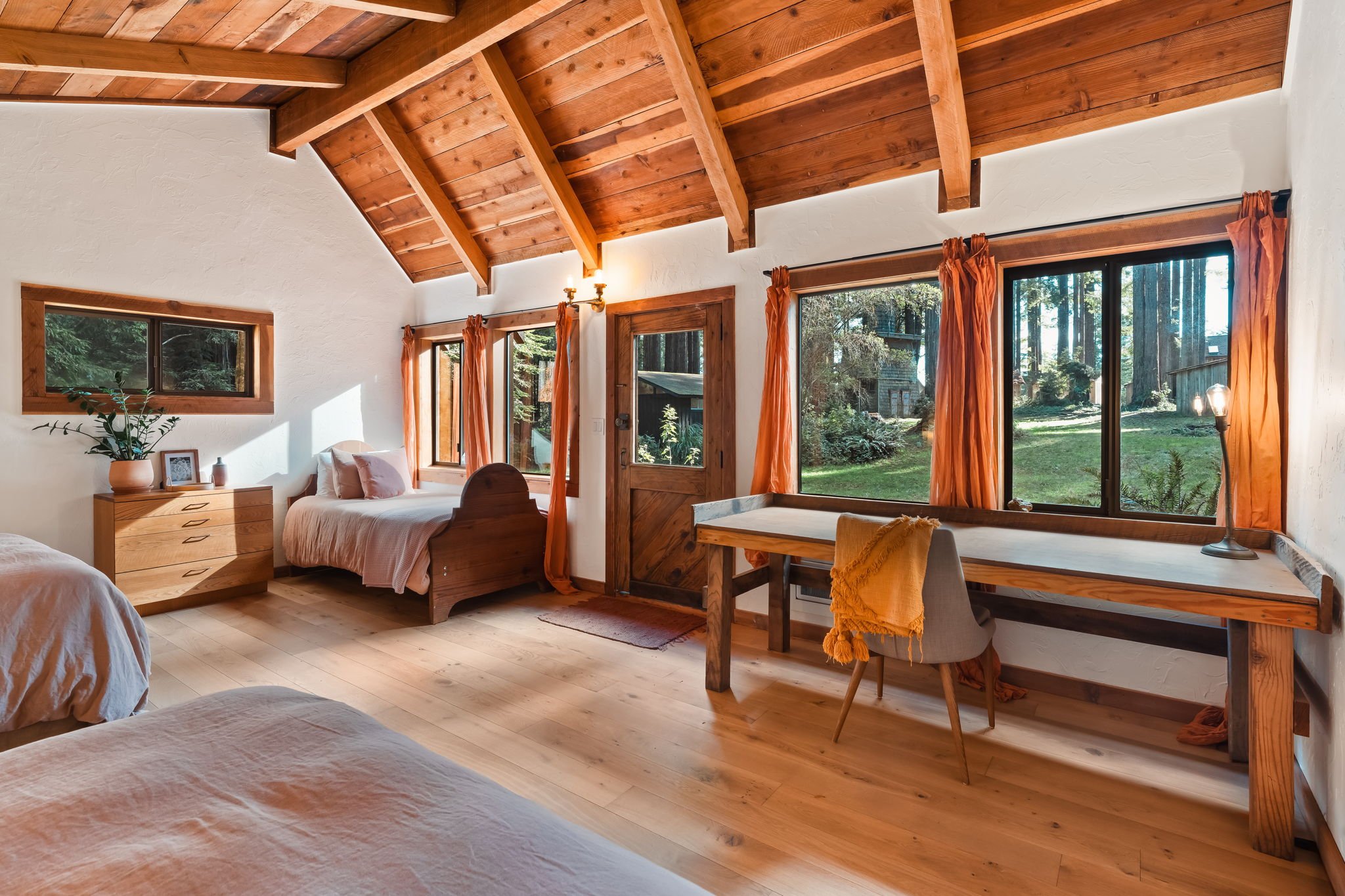
Photo of Deer Haven, one of the our many unique cabin spaces. This cabin has three beds. Cabins have between 1 to 8 beds each and provide several different sleeping arrangements for Embodiment retreat. All cabin spaces are included in Somatic yoga retreat California.
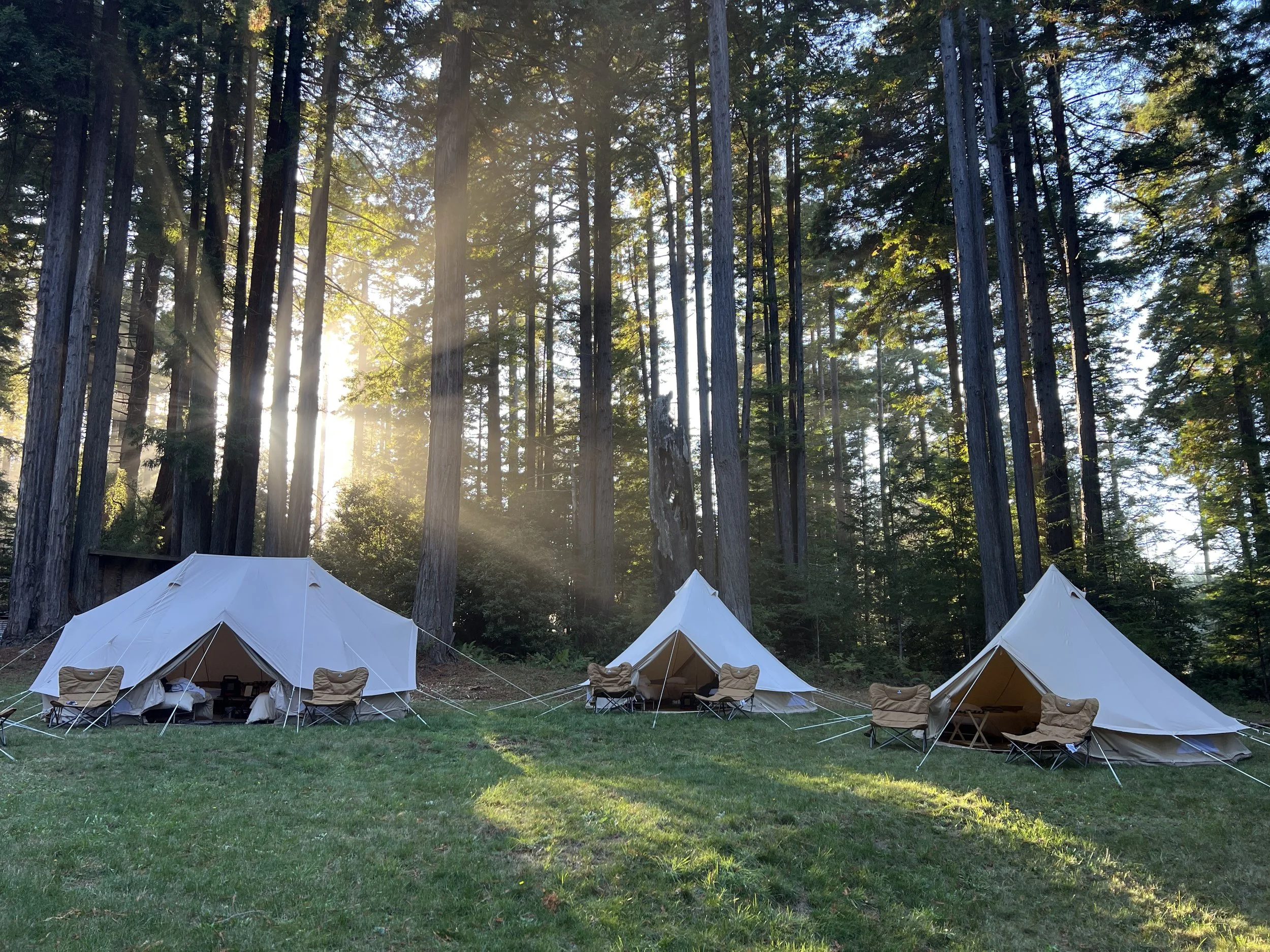
Photo of Group Glamping Tents Setup in Sunset Meadow. We have 10 Glamping Structures that can be added with 1to 3 beds each. This can increase bed capacity of campus to 50 guests across 20 unique accommodation spaces.
Mary Paffard: A Teacher Who Embodies What She Teaches
Four Decades of Practice Shape an Educator Committed to Creative, Engaged, and Grounded Yoga
You can't separate Mary Paffard's teaching from how she lives. Since the mid-1980s, she's been cultivating a yoga practice that refuses to compartmentalize—her commitment to embodiment extends from the mat into every dimension of daily life on her off-grid collective apple farm in Mendocino County. There, she tends the land, navigates the practical challenges of sustainable living, and participates in the kind of cooperative decision-making that requires both groundedness and flexibility. This isn't romanticized back-to-the-land idealism; it's the gritty, beautiful work of actually inhabiting ecological principles rather than just talking about them. When Mary teaches about interconnection or root systems or seasonal cycles, she's drawing from lived experience, not abstract philosophy.
Her credentials trace a path of deep commitment: serving as Director of Teacher Training at Yoga Mendocino from 2000 to 2010, co-founding that nonprofit studio that became a cornerstone of the local yoga community, and contributing to teacher training faculties at Piedmont Yoga and other recognized programs throughout California, Mexico, and Costa Rica. But what distinguishes Mary's teaching isn't just her technical expertise—it's the way she brings together seemingly disparate threads into a coherent, embodied approach. As a Buddhist Eco-Chaplain, she integrates meditation traditions that emphasize present-moment awareness with ecological spirituality that recognizes the sacred in all life forms, including our own animal bodies.
Perhaps her most remarkable work involves the educational exchanges she's led with yoga and meditation communities in Cuba since 1998 through Yogava (yogava.org)—volunteer efforts that demonstrate how embodied practices can bridge cultural and political divides. This international dimension reflects Mary's understanding that yoga isn't about individual self-improvement in isolation, but about recognizing our fundamental interconnection with all beings and ecosystems. She teaches yoga on Vipassana retreats, bringing the precision of somatic awareness into seated meditation and the stillness of meditation into physical movement, creating a seamless integration that serves practitioners at all levels.
Mary describes herself as an "active grandma," and there's something powerful about studying with a teacher who brings decades of practice and the wisdom that only comes from living fully into one's years. She limits herself to just three in-person retreats annually, making this summer gathering at Spirit Camp her most treasured offering—a testament to both the quality of the experience and her genuine affection for this particular sangha in this particular Redwood setting. Her teaching embodies the creative, engaged practice she champions: technically rigorous yet spacious enough for poetry and play, rooted in tradition yet responsive to contemporary needs, serious about transformation yet infused with joy.
Embodied Living at Spirit Camp: Where Communal Spaces and Redwood Energy Support Somatic Awakening
Experience the Magic Meadow's Fire Circles, The Sanctuary's Sunlit Serenity, and Healing Meals That Nourish Body and Spirit
The environment you practice in profoundly shapes the embodiment journey, and Spirit Camp offers spaces specifically designed to support somatic awareness and communal connection. Magic Meadow holds a special place in the retreat experience—this small clearing where the Redwood canopy parts to allow year-round sunlight features two fire pits large enough to gather 40-50 people in circle. Evening gatherings here become powerful containers for embodied presence: you feel the heat of flames warming your face and hands, hear the crackle and pop of burning wood, watch sparks spiral upward toward stars visible through the Redwood silhouettes, sense the proximity of other bodies breathing beside you. Fire circle conversations often go deeper than daytime exchanges, perhaps because the darkness and warmth create a kind of safety that invites vulnerability. You might share insights from your practice, sit in companionable silence, or simply allow your nervous system to regulate in the presence of ancient elements—fire, forest, community.
The Sanctuary offers a contrasting embodied experience. This architectural marvel, designed by the late Paul Tay, features a copper roof with central skylight and 20-foot south-facing windows that flood the space with natural light even on foggy days. The interior invites you to settle into cozy floor cushions, back-jack chairs, or soft couches arranged to support various body positions—whether you need to lie fully prone during restorative practice, sit upright for meditation, or curl into a semi-reclined position with blankets and pillows. The wood-burning stove provides warmth on cooler mornings, while the copper roof creates a distinctive sound when rain falls—a gentle patter that many participants describe as deeply soothing to the nervous system. Between formal sessions, the Sanctuary becomes a refuge for personal embodied practices: journaling, somatic self-inquiry, or simply resting while absorbing the peaceful energy.
Nourishment extends beyond yoga classes to include the simple, healing meals created by local chef James Sant (plantfoodculinary.com). His vegetarian cuisine emphasizes organic, farm-to-table ingredients that support your somatic work rather than weighing you down—easy to digest yet satisfying, beautiful to behold yet unpretentious. Eating becomes another opportunity for embodiment: noticing the textures and flavors on your tongue, feeling the warmth of food entering your belly, observing how your energy shifts after meals. Dining together in the Redwood Lodge or garden spaces fosters the kind of relaxed conversation that helps integrate intensive practice periods.
The communal bathhouse experience deserves mention in any discussion of embodiment at Spirit Camp. With five toilets and four showers (plus a sixth toilet under the water tower), these renovated facilities provide privacy and modern comfort while maintaining the authentic camp atmosphere that actually supports somatic awareness. There's something grounding about the daily rhythms of walking to the bathhouse in your sandals, feeling morning air on your skin, navigating the simple routines of personal care in a shared space. This isn't luxury spa culture—it's more authentic than that, inviting you to be present with your actual body in its actual needs without shame or self-consciousness. Many participants report that the communal living aspect helps them release perfectionism and embrace their human animality.
Accommodation options range from private cabins with oak floors and electric heaters to shared cabins perfect for traveling friends, from nostalgic bunkhouse spaces to glamping setups in Sunset Meadow where you fall asleep hearing owls and wake to morning light filtering through canvas. Wherever you rest, you're cradled by the Redwood grove—these ancient trees creating a kind of energetic container that participants consistently describe as supportive, grounding, and quietly transformative. The embodiment work doesn't stop when formal sessions end; it continues through forest wanderings, sauna sessions, informal conversations, and the countless small moments when you choose to bring awareness to sensation rather than getting lost in mental loops.
The Mendocino Redwood Bioregion: A Living Landscape That Teaches Embodiment
Situated in California's Coastal Forest North of San Francisco, Where Ancient Trees Model Deep-Rooted Presence
Spirit Camp's location within Mendocino County's coastal Redwood ecosystem offers more than scenic beauty—it provides direct teaching about embodiment and interconnection. The property spans 27 acres of second-growth Redwoods, fern-filled gullies, ephemeral streams, and distinct microclimates, bordered by hundreds of acres of undeveloped forest. These Redwood groves aren't collections of individual trees competing for resources; they're family structures growing from shared root systems that distribute water, nutrients, and even chemical signals between organisms. When a Redwood falls, its stump often continues living for decades, supported by nutrients flowing through roots from neighboring trees. This ecological reality mirrors the somatic principle that we're not isolated individuals but inherently relational beings—our nervous systems co-regulate with those around us, our physical health depends on connection, our deepest healing happens in community.
Walking Spirit Camp's private hiking trails offers direct embodied learning. As you cross wooden bridges over seasonal streams, wind through fern canyons, and navigate the subtle topography of ridge and gully, you're practicing proprioception and kinesthetic awareness—feeling how your weight shifts, how your breath adjusts to inclines, how your gaze naturally softens in the dappled light. The forest invites slower pacing, deeper sensing, fuller presence. You might notice banana slugs (remarkable hermaphroditic creatures in various colors—green, yellow, brown, spotted) demonstrating adaptation and diversity. The spotted owls calling from Redwood canopy, the ravens spiraling overhead, the hummingbirds visiting red-flowering currant—all model different ways of being embodied in this particular place.
The broader Mendocino County bioregion sits at the intersection of forest and ocean, creating the unique conditions that support coastal Redwood ecosystems. Located approximately three hours North of San Francisco, Oakland, San Jose, and other Bay Area cities, Spirit Camp remains accessible from major airports (SFO and Oakland about three hours away, Santa Rosa just two hours distant) while feeling genuinely remote. This is Northern California's hidden coastal gem—a region where fog drifts in from the Pacific to nourish the forest, where the ridge line creates warm sun pockets alongside cool Redwood shade, where you can practice yoga among ancient trees in the morning and walk dramatic coastal bluffs in the afternoon.
Just 12 minutes from Spirit Camp, downtown Mendocino offers coffee shops, art galleries, grocery stores, and access to spectacular beaches and headlands. About two hours south lies Sonoma County with its rolling vineyards and agricultural abundance. The accessibility means you don't need to fly to Bali, Costa Rica, or Hawaii to experience transformative embodiment practices in a stunning natural setting—it's right here on California's dramatic West Coast, where ancient Redwoods create their own microclimate and the Pacific Ocean moderates temperatures year-round. This landscape teaches embodiment simply by being itself: rooted, adaptive, interconnected, resilient, and quietly powerful. Ready to explore what other somatic healing experiences await in this magical bioregion? Visit the Spirit Camp retreats calendar to discover offerings throughout the year.
Frequently Asked Questions About Embodied Practice at This Retreat
How physically demanding are the yoga sessions?
Mary's embodiment retreat includes long asana sessions—typically 90 minutes or more—that combine both active and restorative elements. The active portions build strength, stamina, and heat through flowing sequences, standing poses, and sometimes more challenging postures that invite you to explore your edges. The restorative components use props to support deep release in poses held for several minutes, allowing your nervous system to downregulate and your tissues to soften. This isn't gentle yoga in the sense of being easy or unchallenging, but Mary's approach emphasizes listening to your body's intelligence rather than pushing through pain or competing with others. She offers modifications throughout, and the somatic focus means you're always invited to find the variation that serves your particular body on this particular day. That said, this retreat requires intermediate or higher yoga experience—you should be comfortable spending extended time on the mat and working with intensity when it arises. If you're uncertain about your readiness, contact Mary directly to discuss your background and any concerns.What does "infused with eco-inquiry" mean?
Eco-inquiry is Mary's term for the practice of connecting your embodied experience to observations and insights from the natural world. This might take several forms during the retreat: she might invite you to spend time sitting quietly with a particular Redwood, noticing its qualities and considering how they relate to your own life (what does it mean to grow slowly? to stand tall while remaining flexible?). During asana practice, she often weaves imagery from nature—feeling your feet root like tree bases, imagining your spine as a river of energy, sensing your breath moving like wind through leaves. Some sessions might include silent walks where you're invited to notice your sensory experience and the embodiment of other forest creatures. The inquiry dimension means you're not just moving your body mechanically, but engaging curiosity about the relationship between your physical self and the larger-than-human world. This approach deepens both somatic awareness and ecological consciousness, helping you recognize yourself as nature rather than separate from it.Can I participate if I'm working through physical limitations?
Many participants arrive with various physical considerations—past injuries, chronic conditions, age-related changes in flexibility or strength, or simply bodies that don't match the yoga magazine ideal. Mary's embodiment approach actually makes this retreat especially suitable for working skillfully with limitations because the emphasis is on listening to your body's intelligence rather than forcing predetermined shapes. She offers modifications throughout and encourages you to adapt practices to your needs. That said, the long sessions and extended periods of silence require a certain baseline capacity—you need to be able to spend substantial time on the mat (even if you're frequently resting in child's pose), move between sitting and standing, and generally care for your own physical needs. The retreat's supportive community also matters here; many participants return year after year, creating an atmosphere of acceptance where different bodies and abilities are normalized rather than judged. If you have specific concerns about whether this retreat suits your situation, reach out to Mary directly through her website to have a conversation about your needs and the retreat's structure.
Two Embodied Experiences in Mendocino County to Complement Your Retreat
Ground Your Practice Further Through Coastal and Forest Exploration
Van Damme State Park: Walking Among Ancient Miniatures in the Pygmy Forest
Located just south of Mendocino town, Van Damme State Park offers a truly unique embodied experience through its famous Pygmy Forest—an ecological wonder where ancient trees remain permanently miniature due to specific soil conditions. Walking among cypress and pine trees that may be 100 years old yet stand only a few feet tall creates a sense of entering a different world, one that teaches profound lessons about adaptation and resilience. How do these trees thrive in conditions that would defeat others? What does it mean to grow in the form that circumstances allow rather than the form you imagined? These questions naturally arise as you move slowly through this distinctive landscape, making the Pygmy Forest ideal for continued somatic inquiry and embodied meditation.
The park also features the Fern Canyon Trail, which follows Little River through lush forest rich with sword ferns, lady ferns, and five-finger ferns creating a verdant understory beneath towering Redwoods and Douglas firs. This gentle trail invites the kind of embodied walking meditation you've been practicing at Spirit Camp—coordinating breath with footsteps, feeling how your weight transfers through your feet, noticing how your body naturally adjusts to uneven terrain. The sound of water moving over rocks, the play of light through multiple canopy layers, the cool dampness that lingers even on warm days—all engage your senses and ground you in present-moment somatic awareness. Many retreat participants visit Van Damme on their departure day, using the hike as a bridge between the intensive container of retreat life and the return to everyday rhythms, allowing the forest to continue teaching about embodiment, adaptation, and the many forms that flourishing can take.
Jug Handle State Natural Reserve: An Embodied Journey Through Ecological Time
Jug Handle State Natural Reserve features one of California's most remarkable hiking experiences: the "Ecological Staircase," a trail that ascends five distinct marine terraces, each representing a different stage of ecological succession spanning thousands of years. Beginning at sea level with coastal scrub vegetation, you climb through progressively older terraces—each lifted by tectonic activity and weathering—passing through Bishop pine forest, transitioning into mature Redwood groves, and ultimately reaching the pygmy forest at the highest terrace. This physical journey through space becomes a journey through deep time, offering a visceral understanding of how landscapes evolve and ecosystems mature.
For embodiment practitioners, the Ecological Staircase provides perfect integration work. Each terrain shift requires subtle adjustments in how you move: the open coastal section might feel expansive and windy, inviting longer strides and fuller breathing; the Redwood sections shelter you and quiet your system, perhaps slowing your pace and softening your gaze; the pygmy forest at the top asks you to become more compact, bending to navigate among miniature trees. Noticing these somatic responses—how different environments literally shape how you inhabit your body—extends the awareness cultivated during retreat sessions. The trail isn't particularly strenuous (about 2.5 miles round trip with gentle elevation gain), making it accessible for various fitness levels while still offering enough variation to keep your attention engaged. Consider hiking slowly, pausing frequently to really sense each ecological zone, perhaps even spending a few minutes in embodied meditation at each terrace to notice how the landscape's energy feels in your body. This kind of somatic exploration in nature often yields insights that surprise you—about your own adaptability, about finding your appropriate form in different circumstances, about the patient unfolding that real transformation requires.
Ready to Experience Profound Embodiment in the Ancient Redwood Forest?
Embodiment isn't a destination you arrive at; it's an ongoing practice of coming home to the body you already have, right here, right now. Mary Paffard's Summer Retreat 2026 offers seasoned practitioners five nights to explore this homecoming in depth—supported by Redwood forest energies, nourished by healing food, held by a community of fellow seekers, and guided by a teacher whose four decades of practice inform every instruction. From long somatic yoga sessions that build both heat and deep release, to daily breathwork that unlocks patterns held in your nervous system, to optional evening mandala workshops and philosophy discussions that provide context for your embodied experiences, this retreat delivers transformation rooted in body wisdom rather than mental concepts.
The ancient Redwoods of Mendocino County wait to teach you about rootedness, interconnection, and what it means to stand tall while remaining flexible. The Magic Meadow fire circles, the sunlit Sanctuary, the communal rhythms of camp life—all conspire to support your somatic awakening. Whether you're a yoga teacher seeking to deepen your understanding of embodiment principles, or simply a dedicated practitioner hungry for the kind of integration that happens when you give yourself permission to fully inhabit your animal body, this retreat offers rare medicine in a world that constantly pulls us into our heads and away from sensation.
Join Mary and the welcoming sangha July 2-7, 2026 for this beloved summer tradition. Learn more and reserve your space at the Summer Retreat 2026 page, or explore other body-centered spiritual experiences throughout the year at Spirit Camp Retreats. Your body already knows the way home—this retreat simply creates the conditions for you to remember.
TOPICS:
Embodiment retreat, Somatic yoga retreat California, Embodied meditation retreat, Body-centered spiritual retreat Northern California, Embodiment practices retreat West Coast, Somatic healing retreat Mendocino, Embodied yoga retreat, Body awareness retreat, Somatic awareness practices, Redwood forest embodiment, North of San Francisco retreat, Bay Area somatic retreat