Mindful Movement and Meditation Retreat North of San Francisco: Integrating Body and Mind in California's Redwood Sanctuary
How often do you experience yoga and meditation as separate practices—physical class in one time slot, sitting practice in another, never quite connecting the two? Mary Paffard's Summer Retreat 2026, taking place July 2-7, 2026 (Thursday through Monday) at Spirit Camp in Mendocino County, Northern California, offers experienced practitioners something increasingly rare: genuine integration where movement becomes meditation, where mindfulness infuses physical practice, and where the false boundary between body and mind dissolves through sustained exploration. This transformative retreat doesn't compartmentalize asana and sitting practice but rather weaves conscious awareness through every dimension—from vigorous yoga sessions where you observe how mental patterns affect physical capacity, to formal meditation periods that deepen body awareness, to morning silence that allows mindfulness to permeate meals and forest walks, to optional evening offerings that connect practice to poetry, imagery, and eco-inquiry. Over five nights among ancient Redwoods that themselves model the integration you're seeking (reaching skyward while rooting deeply, engaging constant activity within apparent stillness), you'll discover what becomes possible when mindful movement and seated meditation support rather than compete with each other. This yoga and mindfulness retreat welcomes practitioners ready for depth work rather than surface-level exercise, people comfortable with extended silence and self-reflection, and anyone seeking the kind of body-mind unity that traditional practices actually aimed toward. Explore the full calendar of contemplative offerings at Spirit Camp Retreats.
Where Movement Becomes Meditation: Five Days of Integrated Practice for Mind-Body Unity
Experience How Mary Paffard Bridges the False Divide Between Physical Asana and Sitting Meditation Through Poetry, Eco-Inquiry, and Conscious Awareness
The integration Mary brings to this retreat emerges from her unique background teaching yoga on Vipassana meditation retreats—she's literally worked within Buddhist contemplative contexts where the relationship between movement and stillness gets explored with precision and care. This experience shapes how she structures the five days: yoga sessions aren't just physical preparation for "real" meditation, and sitting practice isn't just recovery time between active sequences. Instead, each dimension informs and deepens the other. When you practice asana with full mindfulness—observing how your mind creates narratives about difficulty, noticing how breath quality reflects emotional state, feeling how habitual holding patterns manifest in tissues—movement itself becomes profound meditation practice that accesses insights sitting alone might miss.
The long yoga sessions (90+ minutes combining active and restorative elements) consciously cultivate this mindful quality. Mary doesn't just instruct shapes; she guides awareness within shapes. You might hold Warrior II while she invites you to notice: Where does your mind go when the pose becomes challenging? Do you brace and harden, or can you maintain softness while also being strong? What stories arise about your capability? How does your breath respond to intensity? This inquiry transforms yoga from exercise into self-study, revealing patterns that operate far beyond the mat. The restorative portions teach different lessons—in fully supported poses held for extended periods, you observe how difficult it can be to simply receive support, how the mind resists stillness, how emotions surface when you're not constantly moving to avoid them.
Formal sitting meditation periods throughout each day anchor everything in present-moment awareness. Many meditation traditions, including the Vipassana practice Mary teaches within, work extensively with body sensation as primary object of attention. You learn to observe physical experience—tingling, temperature, pressure, pulsation, the touch of clothing, the sensation of breath—without immediately reacting or analyzing. This body-based mindfulness often proves more accessible than trying to "watch" thoughts, and it develops the embodied intelligence that then enriches yoga practice. When you return to asana after sitting meditation, you bring heightened sensitivity to subtle sensations, improved capacity for non-reactive observation, and clearer recognition of when you're forcing versus finding appropriate effort.
Morning silence until lunch—a hallmark of Mary's teaching—supports this integration beautifully. When you move from morning yoga directly into silent breakfast, then perhaps a quiet forest walk or personal meditation before lunch, you maintain the thread of mindfulness rather than fragmenting back into ordinary consciousness through constant conversation. This continuity allows practice to deepen in ways weekend workshops can't provide—by day three or four, many participants report that the distinction between "formal practice" and "regular activity" starts dissolving as mindful awareness becomes more continuous. Optional evening offerings including mandala creation workshops and yoga philosophy discussions extend integration into creative expression and intellectual understanding, showing how contemplative practice enriches all dimensions of being.
The target audience for this retreat includes experienced practitioners seeking genuine integration rather than superficial variety—people who've perhaps practiced yoga for years but want to deepen the meditation dimension, or longtime meditators wanting to explore embodied practice, or anyone recognizing that the mind-body split characterizing modern life requires healing through sustained integrative work. The five-night commitment provides necessary time for this healing to unfold. This retreat qualifies for Yoga Alliance CEUs, making it valuable for teachers wanting to understand integration not theoretically but experientially. Located just three hours North of San Francisco, Oakland, and the Bay Area, Spirit Camp offers accessible yet profound mindful movement training without distant travel.
The Philosophy of Mindful Movement: Understanding Yoga as Meditation in Motion
From Patanjali's "Sthira Sukham Asanam" to Thich Nhat Hanh's Walking Meditation—Exploring How Presence Transforms Physical Practice
Mindful movement as spiritual practice has deep roots across contemplative traditions. Patanjali's Yoga Sutras, the classical text outlining the eight-limbed path, defines asana with the pithy phrase "sthira sukham asanam"—steady and comfortable (or stable and easeful). This deceptively simple definition reveals that postures aren't ultimately about achieving complex shapes or extreme flexibility but rather about cultivating quality of presence characterized by both alertness (sthira) and relaxation (sukha). Any shape—even simple sitting or standing—becomes yoga when inhabited with this quality of steady, easeful awareness. Conversely, the most impressive physical accomplishment remains mere gymnastics if performed with scattered attention and internal struggle.
Traditional yoga understood all eight limbs as meditation practices preparing the mind for samadhi (absorption, union). The ethical guidelines (yama and niyama) train attention through conscious relationship with others and self. Asana and pranayama (breath control) work with the body's energy to create stable foundation for inner focus. Pratyahara (sense withdrawal) teaches attention to disengage from external stimulation. Dharana (concentration) and dhyana (meditation) refine attention's quality until the final stage of samadhi becomes possible. Physical postures were never meant as ends in themselves but rather as embodied meditation developing the attention stability, body awareness, and energetic balance necessary for deeper contemplative work.
Buddhist traditions, particularly as interpreted by teachers like Thich Nhat Hanh, explicitly frame all activity as potential meditation practice. His teachings on mindful walking emphasize coordinating breath with footsteps, feeling each contact between foot and earth, maintaining awareness of body moving through space—transforming ordinary activity into profound practice. This approach recognizes that for many people (perhaps most), body-based mindfulness proves more accessible than seated meditation. When attention wanders during sitting practice, practitioners often struggle with abstract instruction to "return to the present moment." But when movement provides concrete sensory feedback—the stretch in a hamstring, the balance required in tree pose, the rhythm of walking—attention has clearer anchor for returning from distraction.
Contemporary research increasingly validates body-based contemplative practices. Studies on yoga show measurable improvements in interoceptive awareness (sensing internal bodily states), which correlates with emotional regulation, empathy, and reduced anxiety. Somatic meditation approaches demonstrate that working with body sensation can access and transform trauma held in tissues in ways that cognitive therapies alone might miss. The growing field of embodied cognition shows that mind and body aren't separate entities but rather deeply integrated systems—how you hold your body affects your thoughts and emotions, while mental patterns literally shape physical structure over time. Explore research on mindfulness and body-based awareness to understand the documented benefits of integrative contemplative practices.
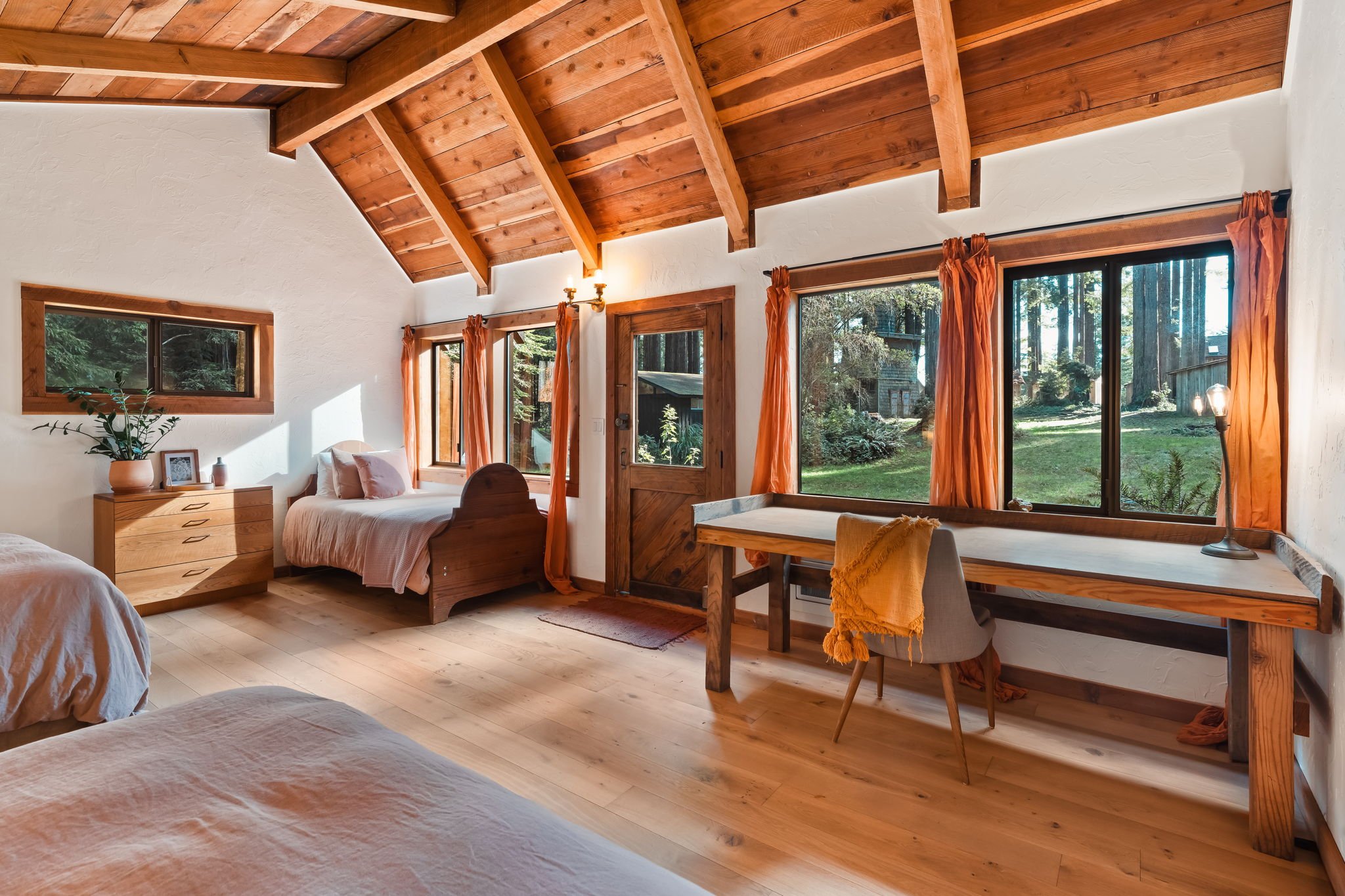
Photo of Deer Haven, one of the our many unique cabin spaces. This cabin has three beds. Cabins have between 1 to 8 beds each and provide several different sleeping arrangements for Yoga and mindfulness retreat. All cabin spaces are included in Mindful yoga retreat California.
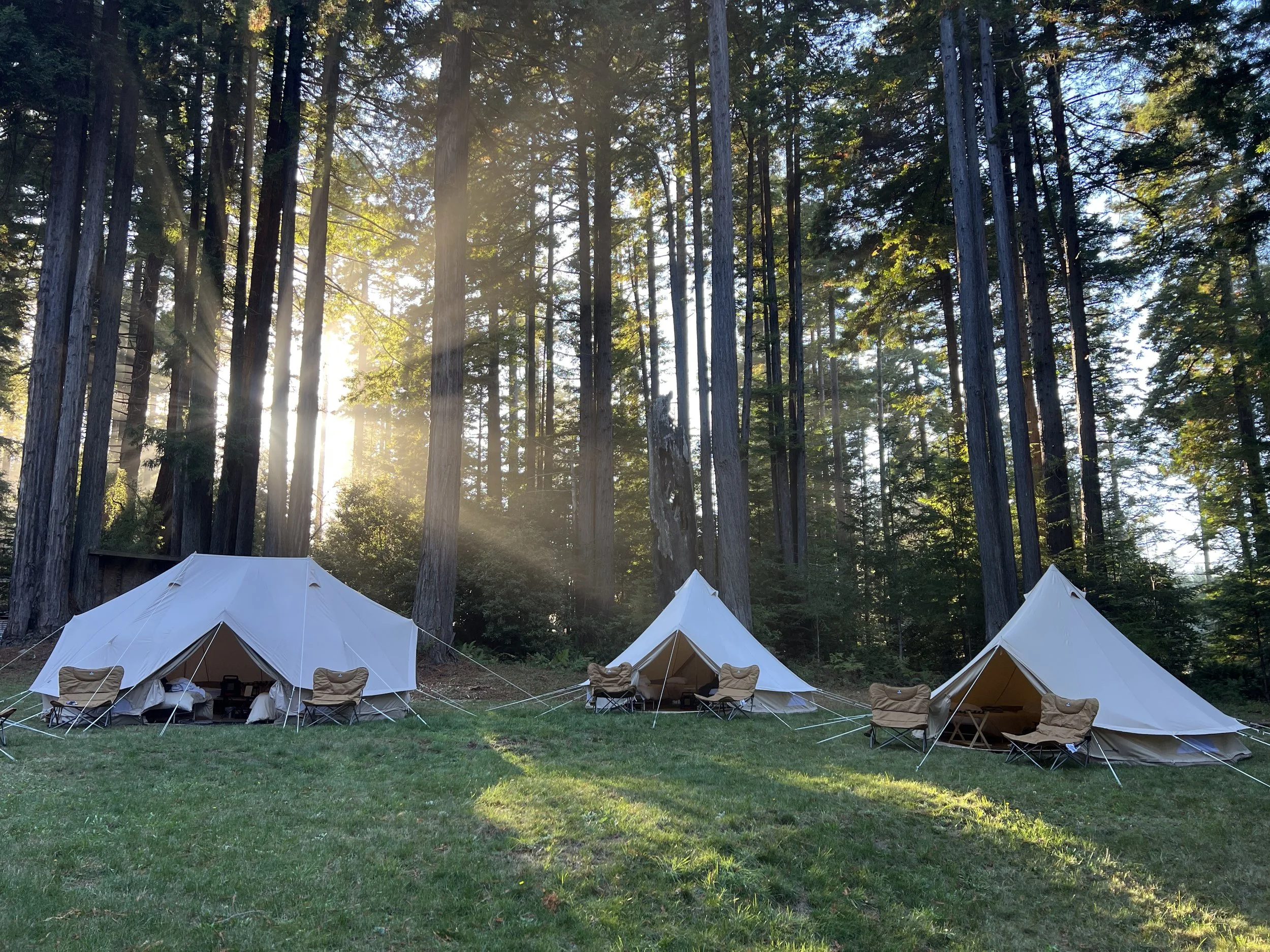
Photo of Group Glamping Tents Setup in Sunset Meadow. We have 10 Glamping Structures that can be added with 1to 3 beds each. This can increase bed capacity of campus to 50 guests across 20 unique accommodation spaces.
Mary Paffard: A Bridge Between Yoga and Meditation Traditions
Four Decades of Practice Including Vipassana Retreat Teaching Create Rare Expertise in Genuine Mind-Body Integration
Mary Paffard's work teaching yoga on Vipassana retreats represents unusual expertise that directly qualifies her for guiding integrative practice. Vipassana (meaning "clear seeing" or "insight") retreats in the tradition of S.N. Goenka and other teachers typically maintain complete silence while practitioners alternate between sitting and walking meditation for days or weeks, developing the capacity to observe reality directly without the filter of conceptual overlay. Some Vipassana retreats incorporate yoga to support sitting practice—helping bodies manage the physical demands of extended meditation, releasing tension that impedes concentration, and teaching embodied mindfulness that complements seated work. Mary's role teaching within these contexts means she understands integration not theoretically but through direct experience of how movement and stillness genuinely support each other.
Her Buddhist Eco-Chaplain credentials reflect formal training in contemplative practices beyond typical yoga teacher education. This depth of meditation training—combined with her four decades teaching yoga since the mid-1980s and her decade directing comprehensive Teacher Training at Yoga Mendocino (2000-2010)—creates rare combination of embodied practice skill and contemplative depth. She's not a yoga teacher who dabbles in meditation or a meditation teacher who adds some stretching; she's genuinely fluent in both languages and skilled at translation between them. Her continued involvement with recognized training programs throughout California, Mexico, and Costa Rica demonstrates ongoing commitment to refinement rather than resting on past accomplishments.
The signature elements of Mary's teaching—infusing practice with poetry, imagery, and eco-inquiry—create bridges between physical sensation, mental/emotional awareness, and broader connection to environment. She might guide you to feel your exhale as "releasing into earth's gravitational embrace" (connecting body awareness to ecological relationship), or invite you to observe thoughts during challenging pose as "weather patterns moving through the sky of mind" (using poetic imagery to create non-reactive relationship with mental activity). These bridges help practitioners access integrative experience rather than staying trapped in compartmentalized understanding where body is "over here" and mind is "over there."
Her life on an off-grid collective farm in Mendocino County embodies this integration daily: mindful physical work (tending orchards, managing infrastructure, participating in collective labor), meditation practice sustaining awareness through both ease and difficulty, and earth-based living requiring constant adaptation and presence. When Mary teaches about integration, she's not offering abstract philosophy but lived wisdom earned through decades of actually practicing what she teaches. This retreat represents her favorite of three annual offerings, suggesting her deep care for the particular integration it cultivates and the community that gathers around this work.
Spirit Camp's Contemplative Design: Spaces That Support Both Dynamic Movement and Deep Stillness
From the Sanctuary's Meditation-Perfect Quietude to the Lodge's Spacious Movement Area—Every Corner Invites Integrated Practice
Spirit Camp offers physical spaces specifically designed to support both movement and stillness, active practice and receptive rest. The Sanctuary exemplifies this integrative design: created by the late Paul Tay with copper roof featuring central skylight and 20-foot south-facing windows, the space floods with natural light year-round while maintaining the hushed quality that invites inward attention. The floor covered with cushions, back-jack chairs, and soft couches accommodates both seated meditation and gentle movement practices—you might practice restorative yoga here, or seated meditation, or slow mindful movement sequences that explore the space between stillness and motion. The acoustics support both silence and sound: the Redwood-beam ceiling creates warmth when you practice breath awareness or gentle chanting, while the copper roof produces distinctive patter when rain falls that many describe as nature's meditation bell.
The Redwood Lodge provides different but complementary environment: 1,500 square feet of open space with stone fireplace that can serve as teaching focal point, creating natural mandala where students arrange themselves in circle. The wood-burning stove and six skylights ensure brightness and warmth even during cool Mendocino mornings, while the space allows freedom for vigorous asana sequences, mindful walking meditation circles, or spontaneous dance when movement wants to arise without predetermined form. The Lodge also functions as communal heart where meals become opportunities for mindful eating practice—paying attention to tastes and textures, noticing hunger and satiety cues, practicing the presence that transforms ordinary activity into meditation.
Outdoor practice opportunities extend integration into relationship with living landscape. Magic Meadow—where Redwood canopy parts to allow sunlight year-round—provides space for movement under open sky, practicing yoga while literally breathing the same air as surrounding trees, feeling how your body's movement participates in larger choreography of wind, growth, and seasonal change. The private hiking trails offer perfect terrain for walking meditation: narrow paths winding through fern-filled gullies invite single-file progression at contemplative pace, wooden bridges over seasonal streams require attention to footing that naturally focuses awareness, and the overall environment invites the slow, deliberate walking that transforms ordinary hiking into mindful movement practice.
The gardens surrounding the Lodge and Sanctuary create yet another integrative environment: you might practice seated meditation here surrounded by buzzing pollinators and birdsong, or gentle yoga on grass, or simply sit observing how the dynamic ecosystem models the very integration you're cultivating—countless organisms each doing their work while contributing to collective flourishing. Even the 27 acres of Redwood forest become practice space when approached with contemplative attention: you can practice tree pose while actually communing with a tree, observe your own breath alongside the forest's photosynthetic exchange, embody stillness while witnessing the dynamic yet patient life cycles operating all around you at scales from moss to mushrooms to ancient Redwoods.
Mendocino's Meditative Landscape: A Geography That Naturally Cultivates Presence
Three Hours North of San Francisco's Urban Rush Into Ancient Forest That Teaches the Integration We Seek
Spirit Camp's location in Mendocino County offers inherent support for integrative practice through both practical and subtle dimensions. The geography sits approximately three hours North of San Francisco, Oakland, Berkeley, and other Bay Area centers—this distance creating essential psychological transition from doing-mode to being-mode, from the fragmented multitasking that characterizes urban life to the unified attention that contemplative practice develops. The drive itself becomes threshold experience: leaving behind freeways and density, winding through increasingly wild landscapes, arriving in a bioregion where human development thins and natural systems dominate. By the time you reach Spirit Camp, your nervous system has already begun the shift toward integration.
The Redwood ecosystem itself functions as teacher about the very integration the retreat explores. These ancient trees demonstrate perfect balance of yang and yin, active and receptive: their massive trunks reach skyward toward sunlight with apparent effortless verticality (dynamic, active, expansive) while simultaneously their root systems spread horizontally through soil, often intertwining with neighboring trees in collaborative networks that share water and nutrients (grounded, receptive, interconnected). The trees engage constant photosynthetic activity—converting light into sugar, transpiring water, exchanging gases—yet appear serenely still, modeling how profound activity can happen within apparent quietude. Observing Redwoods teaches body-wisdom about integration that intellectual understanding alone can't provide.
The microclimate's natural rhythms further support integrative practice. Morning fog that frequently blankets Mendocino County's coast creates inward quality perfect for early meditation and movement practice—the soft light and muted sounds naturally draw attention toward subtlety and interior experience. As fog burns off to reveal afternoon sunshine, the energy shifts outward: Magic Meadow and gardens become inviting for more active practice or social connection, the warmth supporting extroverted expression. Cooling evenings naturally draw energy back to center as you gather for fire circles or evening meditation, completing a daily arc from yin (morning) through yang (afternoon) back to yin (evening) that mirrors the larger seasonal cycle and teaches your system about balance through direct experience rather than concept.
The proximity to both forest (grounding, earthy, contained) and ocean (expansive, cleansing, infinite) within Mendocino County allows participants to work with different energetic qualities. You might practice yoga in the enclosed Redwood grove feeling supported and held, then visit the coast where vast Pacific horizon invites the spacious awareness that meditation cultivates, recognizing that genuine integration includes both groundedness and expansion, both boundaries and openness. Accessibility remains straightforward: major airports including SFO and Oakland International sit about three hours away, Santa Rosa Airport just two hours distant. The journey north becomes mindfulness practice in itself—consciously transitioning from one state to another, maintaining awareness during movement, arriving ready for the deeper work ahead. Ready to explore more mindful movement experiences? Visit the Spirit Camp retreats calendar to discover additional integrative offerings throughout the year.
Frequently Asked Questions About Integrated Movement and Meditation
Do I need meditation experience beyond yoga class?
Intermediate yoga experience is recommended—you should feel comfortable spending extended time on the mat and working with both active and restorative practices. Formal sitting meditation experience proves helpful but isn't strictly required; Mary's skilled instruction meets you where you are and guides the integration process regardless of your starting point. What matters most is genuine interest in exploring the relationship between movement and stillness rather than staying in your comfort zone of one or the other. Some participants arrive with strong yoga backgrounds but minimal sitting practice; others come from meditation communities wanting to explore embodied contemplative work. The emphasis throughout is on integration rather than expertise in either discipline alone—learning how physical practice deepens meditation capacity and how meditation enriches movement quality. Mary's unique background teaching yoga on Vipassana retreats means she understands both languages fluently and can translate between them for practitioners coming from either direction. The five-night duration provides time to develop competence you might lack initially, with each day building on previous understanding as the integration deepens.How much time will we spend in seated meditation versus movement?
The retreat balances both dimensions throughout the five days, though the exact ratio varies based on what the group needs and how practices unfold organically. You can expect substantial time in long yoga sessions (90+ minutes combining active and restorative elements) AND dedicated sitting meditation periods (typically 30-45 minutes, sometimes longer). But the real answer goes deeper than time allocation: the integration Mary facilitates means mindfulness becomes present in all activities, not just formal practice sessions. When you eat meals in silence, that's meditation practice. When you walk forest trails with full awareness, that's meditation practice. When you hold challenging pose while observing your mind's reactions, that's meditation practice. By mid-week, many participants report that the distinction between "practice time" and "regular time" starts dissolving as mindful awareness becomes more continuous. The morning silence until lunch particularly supports this integration—you maintain contemplative quality from wake-up through several hours of activities rather than fragmenting with constant conversation. Evening offerings provide space for both movement (like mandala creation workshops engaging hands and creative expression) and discussion (philosophy explorations connecting practice to understanding). The overall rhythm creates comprehensive integration rather than compartmentalized segments.What if I find sitting meditation physically uncomfortable?
Physical discomfort during sitting meditation is extremely common and actually provides valuable practice material rather than being an obstacle. Spirit Camp offers abundant props—cushions, blankets, blocks, back-jack chairs, benches—allowing you to find positions that support extended sitting without overwhelming pain. Mary's experience means she can guide modifications including: sitting in chairs rather than floor, using wall support for your back, lying down for some meditation periods (though this requires care to avoid simply falling asleep), or alternating between sitting and standing during longer sessions. Importantly, the yoga practices throughout each day actually prepare your body for sitting by releasing hip and hamstring tension, strengthening core stability, and improving overall body awareness that helps you adjust positioning skillfully.
The discomfort itself becomes meditation teacher: when your knee aches or back tightens, you practice observing sensation without immediately reacting—learning to discern between signals requiring adjustment (sharp pain, numbness) and simply uncomfortable sensations you can be with (dull ache, restlessness). This capacity to stay present with discomfort without either forcing through inappropriately or immediately escaping proves valuable far beyond meditation cushion—it's life skill for working with difficulty generally. Many participants discover that what felt unbearable on day one becomes manageable by day four as both body and mind adapt, and as you develop trust in your capacity to navigate intensity skillfully.
Two Destinations Near Spirit Camp for Continuing Your Integration Practice
Extend Your Mindful Movement Through Mendocino's Walking Meditation Landscapes
Mendocino Coast Botanical Gardens: Walking Meditation Through Diverse Landscapes
The Mendocino Coast Botanical Gardens, situated on 47 acres of coastal bluff and canyon just south of Mendocino town, offer over three miles of winding trails perfect for extended mindful walking practice. The varied landscapes invite continuous awareness of changing environments: you might begin in cultivated gardens where human design creates specific aesthetic effects, transition into native plant areas showcasing California coastal flora, descend into lush canyon filled with ferns and moisture-loving species, then emerge onto dramatic coastal bluff where Pacific winds shape vegetation into sculptural forms. Each transition provides opportunity to notice how different environments affect your body, breath, and mind—the gardens themselves becoming meditation teacher about impermanence, adaptation, and the countless ways that life expresses itself.
Specific practices naturally arise in this setting: slow walking noting each footfall and the changing terrain beneath your feet, pausing to truly see individual flowers rather than scanning broadly (practicing concentration and detail-oriented awareness), listening meditation while standing still in different garden zones to notice how soundscapes shift from bird calls to wind to distant ocean, observing how your body responds to moving from exposed coastline (activating, energizing) to sheltered canyon paths (calming, containing). The accessibility and beauty of the gardens make this ideal for practitioners wanting to maintain the integrative quality cultivated during retreat while also enjoying visual delight and botanical education. Many participants visit on a free afternoon or departure morning, using the gardens as bridge between retreat's intensive container and return to everyday life—a place where contemplative practice continues while gradually reengaging with broader world. Pack water and perhaps a journal; allow several hours to fully explore without rushing; notice how the integration of movement and mindfulness shifts from guided practice during retreat to self-directed exploration in this beautiful setting.
Little River to Van Damme Beach Trail: Rhythmic Walking Beside Moving Water
This relatively flat coastal trail following Little River from its confluence with the ocean offers perfect terrain for extended walking meditation practice—approximately 2 miles of well-maintained path with minimal elevation change, allowing attention to stay with meditation rather than being pulled into navigation of difficult terrain. The trail begins where freshwater meets saltwater, an ecological edge zone rich with bird life and plant diversity, then follows the river upstream through riparian forest before eventually connecting to Van Damme State Park's beach access. The consistent rhythm of walking beside flowing water creates natural pacing for various breathwork practices: you might coordinate steps with breath (four steps inhaling, four steps exhaling), or simply maintain open awareness of body moving through space while water sounds provide ambient accompaniment.
The sensory experience supports integrative practice beautifully: river sounds gradually giving way to ocean waves as you reverse direction and head back toward the coast, forest shade opening intermittently to reveal sky and light, the constant of your body's movement providing stable anchor while environment shifts around you. When you reach the beach at trail's end (or beginning, depending on which direction you choose), the opportunity arises to transition from walking to seated meditation—finding a spot on driftwood or smooth stones, allowing your heart rate to settle, bringing the same quality of mindful awareness to stillness that you maintained during motion. This complete cycle of movement and rest, activity and stillness, mirrors the integration that the retreat cultivates and demonstrates how contemplative practice can infuse all activities when approached with appropriate attention. The return walk offers chance to notice how the same landscape feels different moving in opposite direction—a meditation on perspective and the reality that our experience always involves both objective environment and subjective mind bringing interpretation to sensation.
Ready to Experience Yoga and Meditation as Unified Practice Rather Than Separate Disciplines?
The mind-body split that characterizes modern life—treating physical health and mental wellbeing as unrelated concerns, compartmentalizing exercise and meditation, living increasingly in heads while barely inhabiting bodies—requires healing through sustained integrative practice rather than quick fixes. Mary Paffard's Summer Retreat 2026 offers experienced practitioners five nights to explore genuine integration where movement becomes meditation, where mindfulness infuses physical practice, and where the false boundary between body and mind dissolves through patient, skilled work.
From yoga sessions where poetry and imagery create bridges between sensation and meaning, to sitting meditation that develops the attention quality enriching all movement, to morning silence allowing practice to permeate waking hours, to forest environment modeling the very integration you seek—every element conspires to support the healing of fragmentation into wholeness. Mary's four decades of teaching, her unique background on Vipassana retreat faculties, and her genuine embodiment of integrative practice through her off-grid farm life create conditions where transformation becomes possible.
Join Mary and the welcoming sangha July 2-7, 2026 for this integrative journey among the ancient RedwoodsNorth of San Francisco. Learn more and secure your place at the Summer Retreat 2026 page, or explore other mindful movement and contemplative experiences at Spirit Camp Retreats. Integration awaits.
TOPICS:
Yoga and mindfulness retreat, Mindful yoga retreat California, Movement meditation retreat Northern California, Body-mind integration retreat Mendocino, Mindfulness asana retreat West Coast, Conscious movement retreat, Yoga mindfulness immersion, Integrated contemplative practice, Mind-body unity retreat, Somatic meditation retreat, North of San Francisco mindful yoga, Embodied mindfulness retreat