Silent Meditation and Yoga Retreat North of the Bay Area: Discovering Inner Stillness Among California's Ancient Redwoods
When was the last time you experienced genuine silence—not just absence of noise, but the presence of deep listening, spaciousness, and the subtle inner voice that emerges only when external chatter subsides? Mary Paffard's Summer Retreat 2026, taking place July 2-7, 2026 (Thursday through Monday) at Spirit Camp in Mendocino County, Northern California, offers experienced practitioners a rare opportunity to explore silence as transformative practice. This contemplative retreat structures mornings until lunch in noble silence—creating a container where awareness can settle, continuity deepens, and you discover what emerges when you're not constantly narrating experience through words. This isn't five days of total silence (conversation is welcomed during communal meals and optional evening gatherings), but rather strategic use of silence to support the intensive yoga, breathwork, and meditation practices that form the retreat's core. Over five nights surrounded by ancient Redwoods whose own quiet presence models patient stillness, you'll work with long asana sessions combining active and restorative elements, all infused with poetry, imagery, and eco-inquiry that Mary's teaching brings. If you're an experienced practitioner comfortable with extended silence and ready to discover the clarity, creativity, and deep rest that contemplative practice offers, this retreat delivers medicine for our overstimulated, perpetually chattering times. Explore more retreats with silence and contemplative offerings at Spirit Camp Retreats.
The Transformative Power of Silence: A Five-Day Retreat Where Morning Stillness Deepens Your Practice
Join Experienced Practitioners in a Sacred Container of Silence, Yoga, and Mindful Connection This July in Mendocino County
The silence practice at Mary's Summer Retreat isn't arbitrary or dogmatic—it emerges from deep understanding of how contemplative containers actually work. By maintaining silence from waking through lunch each day, you create continuity that allows awareness to build and deepen rather than fragmenting with every conversational exchange. When you wake, practice morning yoga, eat breakfast, wander forest trails, and perhaps journal or rest—all without speaking—you stay in intimate contact with your inner landscape. Thoughts, emotions, sensations, insights, and resistances all become more vivid when you're not constantly externalizing experience through talking. This morning silence until lunch honors the quality of consciousness that meditation and yoga cultivate, allowing it to infuse your entire morning rather than ending abruptly when practice sessions conclude.
The afternoons and evenings balance this contemplative depth with connection and community. Lunch often becomes the first speaking opportunity of the day, and participants consistently report how differently they relate to food and conversation after hours of silence—eating with more presence, speaking more carefully, listening more fully. Optional evening events including mandala creation workshops and yoga philosophy discussions provide opportunities for verbal exchange, questions, and the kind of dharma conversations that deepen understanding. Fire circles in Magic Meadow invite sharing insights, though participants always have the choice to simply listen if that serves their practice. This rhythm—silence supporting depth, conversation supporting connection—creates optimal conditions for the transformation that happens when contemplation and community interweave.
The retreat structure includes long asana sessions (90 minutes or more) combining active sequences that generate heat, strength, and energy with restorative postures that allow profound release and nervous system regulation. Daily breathwork practices work directly with your autonomic nervous system, while meditation periods cultivate the mental stillness that silence naturally enhances. Throughout all practices, Mary infuses her signature approach: poetry engaging your imagination, imagery creating fresh relationship to familiar movements, and eco-inquiry connecting personal experience to the natural world surrounding you. The Redwood forest itself becomes teacher—these ancient trees modeling the kind of rooted, patient presence that silence invites us to embody.
This isn't a beginner's retreat but rather designed for experienced practitioners who already have foundation in yoga and feel comfortable with extended silence periods. Some people find silence liberating from the first moment; others encounter discomfort, restlessness, or the constant mental urge to comment on everything. Both responses are welcome here—silence isn't about achieving perfect stillness but about practicing with whatever arises, developing capacity to be with yourself without constant external validation or distraction. Partial registrations aren't possible; the full five nights allow processes to unfold and the group container to deepen organically. Many participants return year after year, drawn by both Mary's skillful teaching and the particular magic that arises when committed practitioners gather in silence among Redwoods.
Located just three hours North of the Bay Area—including San Francisco, Oakland, Berkeley, and San Jose—Spirit Camp offers accessible yet profound contemplative practice without requiring international travel. This is California's coastal silent meditation retreat ground, where ancient forests hold space for inner exploration and modern seekers rediscover timeless practices.
The Practice of Noble Silence: Historical Roots and Contemporary Applications in Meditation Traditions
From Buddhist Vipassana Retreats to Contemplative Christian Monasticism—Understanding Silence as a Profound Practice, Not Absence
Noble silence (ariya mauna in Pali) represents a foundational practice in Buddhist meditation traditions, particularly within Vipassana retreats where practitioners maintain complete silence for days or weeks while developing insight into the nature of mind and reality. This silence isn't merely refraining from speech—it's active cultivation of presence, deep listening, and what teachers describe as "non-reactive awareness." When you're not constantly commenting, questioning, or seeking validation through conversation, you develop capacity to simply be with experience as it unfolds: the discomfort of a challenging pose, the beauty of morning light through Redwoods, the subtle shifts in emotional tone, the thoughts that arise and pass like clouds. Noble silence transforms ordinary activities—walking, eating, washing—into opportunities for awareness rather than automatic behaviors performed while mentally somewhere else.
Silence as spiritual practice extends far beyond Buddhist traditions. Christian contemplatives from the Desert Fathers and Mothers of the 3rd century through contemporary Trappist monks have understood silence as essential for prayer, self-examination, and opening to divine presence. The Carthusian order maintains near-complete silence as permanent lifestyle, while Benedictine communities balance periods of silence with communal work and worship. Quaker meetings sit in silence until someone feels moved by Spirit to speak, recognizing that truth often emerges from spaciousness rather than constant activity. Indigenous vision quests across many cultures involve extended silence and solitude in nature, creating conditions for insight, healing, and connection to something larger than individual ego. The universality of silence practices across traditions suggests deep human need for periodic withdrawal from the noise—both external and internal—that fragments attention and prevents genuine self-knowledge.
Contemporary neuroscience and psychology increasingly validate what contemplative traditions have always known about silence's benefits. Research shows that silence reduces stress hormone levels, lowers blood pressure and heart rate, and allows the brain's default mode network to activate—the neural circuits associated with self-reflection, imagination, and consolidation of learning. Constant noise and stimulation keep us in reactive mode, while silence permits the nervous system to genuinely rest and reset. Extended silence also enhances what researchers call interoceptive awareness—your capacity to sense internal bodily states—which correlates with emotional regulation, empathy, and psychological wellbeing. Perhaps most remarkably, studies on meditation retreats with silence components show structural changes in brain regions associated with attention, emotional processing, and self-awareness, suggesting that silence practice literally reshapes neural architecture over time.
Mary Paffard's background teaching yoga on Vipassana retreats uniquely qualifies her to guide practitioners through **silence-**integrated practice. She understands contemplative containers not theoretically but experientially, having spent extensive time in noble silence herself and witnessing how it deepens every dimension of practice. Her approach recognizes silence not as grim discipline but as gift—permission to stop performing, explaining, justifying, and instead simply be present with the raw reality of each moment. Explore research on silence and contemplative practice to understand the documented benefits of meditation and silence on brain function and wellbeing.
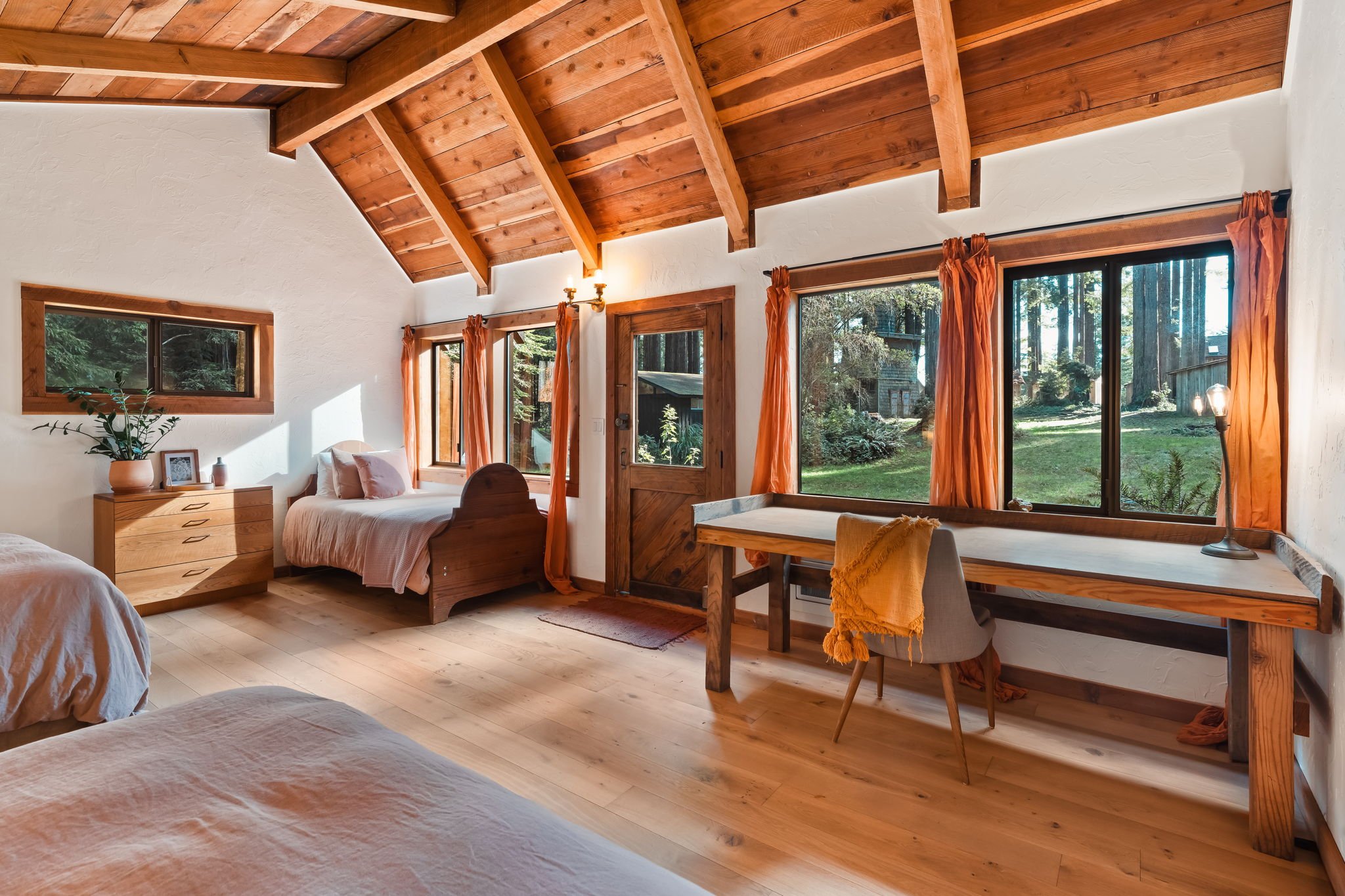
Photo of Deer Haven, one of the our many unique cabin spaces. This cabin has three beds. Cabins have between 1 to 8 beds each and provide several different sleeping arrangements for Retreats with silence. All cabin spaces are included in Silent yoga retreat California.
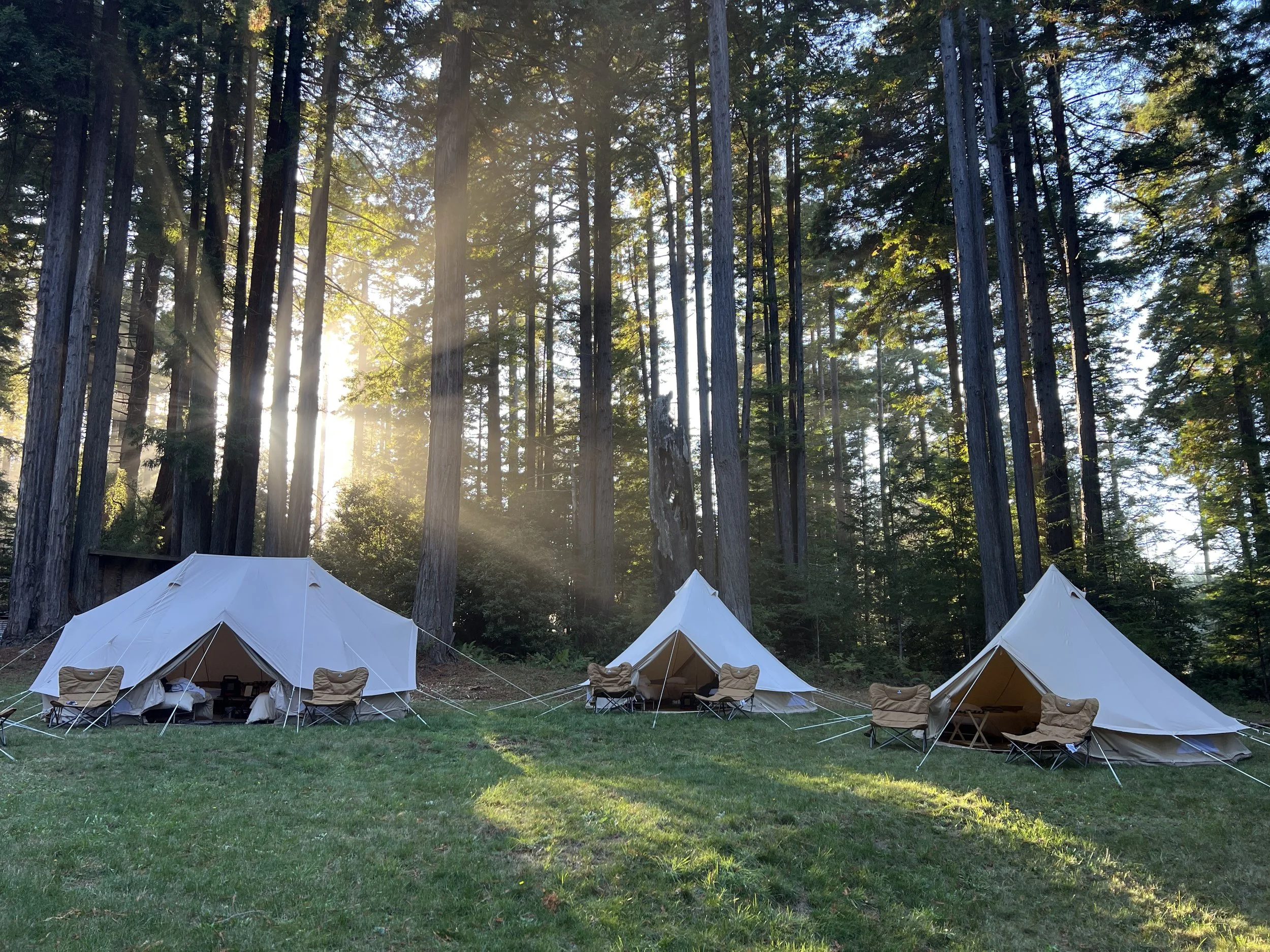
Photo of Group Glamping Tents Setup in Sunset Meadow. We have 10 Glamping Structures that can be added with 1to 3 beds each. This can increase bed capacity of campus to 50 guests across 20 unique accommodation spaces.
Mary Paffard: A Guide Well-Versed in the Sacred Art of Silence
Four Decades of Teaching Experience Including Work on Vipassana Retreats Prepares Mary to Hold Deep Contemplative Space
Mary Paffard's experience teaching yoga on Vipassana retreats—traditional Buddhist silent meditation retreats that can last from days to months—provides the foundation for how she structures and holds contemplative space at this summer gathering. Vipassana (meaning "insight" or "clear seeing") retreats typically maintain complete noble silence throughout, with practitioners rising before dawn for alternating periods of sitting and walking meditation, eating meals mindfully in silence, and spending evenings in meditation or listening to dharma talks. Teaching yoga within this context requires particular sensitivity: you're working with people who are already deeply immersed in silence, whose nervous systems are settling into subtler states, and whose awareness has become heightened to nuances that might go unnoticed in ordinary life. The instruction needs to support rather than disrupt this contemplative quality.
Mary's teaching since the mid-1980s—locally in Mendocino County, nationally throughout the United States, and internationally in Mexico, Costa Rica, and Cuba—has developed her capacity to meet practitioners wherever they are in their journey. Her decade directing Teacher Training at Yoga Mendocino (2000-2010), the nonprofit she co-founded, established her as an educator who understands how to create comprehensive training that goes beyond physical technique to address the mental, emotional, and spiritual dimensions of practice. Her Buddhist Eco-Chaplain credentials reflect formal training in how to hold sacred space, honor spiritual processes, and work skillfully with the vulnerability that arises when people open to deeper layers of themselves. All this experience converges in her ability to guide retreats that balance structure with spaciousness, discipline with kindness, and intensive practice with genuine care for each participant's wellbeing.
Mary's commitment to bringing mindfulness into every aspect of yoga exploration means that even within silence, her teaching remains rich with poetry, imagery, and eco-inquiry. She might invite you to notice how your breath connects to the Redwood forest's respiratory exchange, to sense your feet rooting like tree bases, to observe thoughts arising and passing like clouds—all without speaking a word, using gesture, demonstration, and the occasional soft cue to guide practice. This approach creates what participants describe as "embodied, creative, and engaged" practice even within contemplative silence. Her life on an off-grid farm collective in Mendocino County, where daily rhythms naturally include periods of silence and solitude, informs her understanding that silence isn't something foreign or uncomfortable but rather our natural state when we stop filling every moment with noise.
She currently offers only three in-person retreats annually, with this summer gathering at Spirit Camp being her most treasured. The intimacy of working with a dedicated community over five full days allows the kind of depth that weekend workshops can't provide—time for silence to work its magic, for resistances to surface and be met with compassion, for insights to emerge that would remain hidden in shorter formats. Participants consistently describe Mary's presence as both deeply grounded and spacious, creating safety for vulnerability while maintaining the clarity that keeps practice focused and generative.
Spirit Camp's Sacred Silence: Spaces That Honor Contemplation and the Redwood Forest's Natural Quietude
Experience the Sanctuary's Sun-Drenched Stillness, Morning Forest Walks in Complete Quietude, and the Profound Rest of Shared Silence
Spirit Camp offers physical spaces specifically designed to support contemplative practice and silence. The Sanctuary exemplifies this design intelligence—created by the late Paul Tay with a copper roof featuring central skylight and 20-foot south-facing windows, this space floods with natural light year-round while maintaining the hushed quality that invites inward attention. The floor is covered with cozy cushions, back-jack chairs, and soft couches allowing various body positions during meditation or restorative yoga, and the wood-burning stove provides warmth on cooler Mendocino mornings. Perhaps most remarkably, the copper roof creates distinctive acoustics when rain falls—a gentle patter that many participants describe as one of the most soothing sounds they've ever heard, like nature's own meditation bell inviting deeper presence.
During silent morning hours, the Sanctuary becomes a refuge where you might curl up with a journal processing insights from practice, sit in meditation gazing through south-facing windows at Redwood branches swaying in morning breeze, or simply rest on floor cushions allowing your nervous system to settle into states of deep relaxation that only emerge when stimulation decreases. The skylights bring sky into the interior space—clouds drifting, light shifting, occasional ravens or hawks passing overhead—connecting you to the larger world while maintaining intimate containment. At night, the Sanctuary glows like a lantern visible from anywhere on campus, drawing people to its warmth and stillness for final evening meditation before sleep.
Spirit Camp's private hiking trails offer another dimension of silence practice. During morning quiet hours, you might wander these paths alone or with others maintaining silence, crossing wooden bridges over seasonal streams, winding through fern-filled gullies, and moving beneath second-growth Redwoods that create cathedral-like spaces with their towering trunks and filtered light. Walking in silence transforms hiking from exercise into meditation—you notice the crunch of leaves underfoot, the way your breath adjusts to subtle inclines, how your gaze naturally softens in dappled forest light. You might encounter banana slugs in their various colors moving across the trail with patient determination, hear the distinctive calls of Steller's jays or the drumming of woodpeckers, or simply absorb the Redwood forest's profound quiet—not dead silence but living stillness full of subtle sounds that only become audible when human noise ceases.
Magic Meadow provides yet another contemplative space—this small clearing where Redwood canopy parts to allow sunlight creates conditions for both solitary reflection and communal silent sitting. During morning hours, you might bring a blanket and journal here, lie on grass gazing up at sky through Redwood branches, or simply sit breathing while feeling morning sun on your face and cool forest air at your back. The communal dining after morning silence becomes a gradual, mindful re-entry to speech—people often eat much of the meal still in quiet, then begin speaking softly, testing words after hours without them. This transition period teaches something about the quality of speech that can emerge from silence: more careful, more considered, more genuinely connected to what you actually mean rather than automatic social performance.
The Geography of Silence: Mendocino's Quiet Coastal Forests Three Hours North of Urban Bay Area
Escape to California's North Coast Where Natural Soundscapes Replace City Noise and Ancient Trees Model Deep-Rooted Presence
The journey itself begins the silence practice. Driving approximately three hours North of San Francisco, Oakland, Berkeley, and other Bay Area cities, you gradually leave behind urban intensity—the constant traffic roar, sirens, construction noise, and general din that characterizes metropolitan life. As you wind through Sonoma County and approach the Mendocino coast along Highway 1, the soundscape transforms: traffic thins, buildings disappear, and you enter landscapes where forest and ocean create their own acoustic environment. By the time you arrive at Spirit Camp, the difference is palpable—you can actually hear silence, or more accurately, you can hear the natural sounds that urban noise usually drowns out.
Spirit Camp's location within 27 acres of Redwood forest, bordered by hundreds of acres of undeveloped land, creates significant buffer from highway noise and human activity. The forest itself absorbs and muffles sound—dense vegetation, soft forest floor, and the vertical complexity of multiple canopy layers all dampen noise transmission. What you hear instead is wind moving through Redwood branches (a distinctive sound, deeper than wind through deciduous trees), bird calls from dozens of species, seasonal creek sounds after winter rains, and occasionally ocean breezes when conditions are right. This isn't dead quiet but living silence—a soundscape that invites slowing down, deep listening, and attention to subtlety rather than constant stimulation.
The relative lack of cell service in some areas of Spirit Camp and the complete absence of light pollution support deeper unplugging from the digital connectivity that fragments contemporary attention. At night, the stars appear with clarity rarely visible near cities—Milky Way stretching across the sky, satellites slowly tracking, occasional meteors streaking through darkness. This darkness itself constitutes a form of silence, a visual quietness that allows your nervous system to recognize night as time for rest rather than continued productivity. Morning fog that often blankets Mendocino County's coast creates its own hushed quality, muffling sounds and softening light in ways that participants describe as "mystical" or "otherworldly," perfect for the contemplative atmosphere of silent mornings.
Despite the quiet remoteness, accessibility remains straightforward: major airports including San Francisco International (SFO) and Oakland International (OAK) sit about three hours away, Santa Rosa Airport just two hours distant. The charming town of Mendocino lies only ten minutes from Spirit Camp, providing coffee shops, natural food stores, and coastal access for those who want to extend their contemplative practice through ocean walks during free time. The drive north along Highway 1 itself becomes threshold experience—you're physically traveling toward silence, watching landscapes shift from developed to wild, preparing your nervous system for the quiet depth work ahead. Many participants report that by the time they arrive, they're already beginning to settle, to breathe more deeply, to notice they've been holding tension they didn't even know was there. Ready to explore more retreats with silence in this quiet coastal region? Visit the Spirit Camp retreats calendar to discover additional contemplative offerings throughout the year.
Frequently Asked Questions About Practicing with Silence
Will we be in complete silence for all five days?
No—the silence practice is strategic rather than total. Mornings from waking until lunch are typically held in noble silence, creating a contemplative container that allows awareness to deepen without the constant fragmentation of conversation. This means you practice morning yoga in silence, eat breakfast mindfully without speaking, and have several hours for forest walks, journaling, resting, or personal meditation all while maintaining quiet. Lunch often becomes the first speaking opportunity of the day, and afternoons/evenings welcome conversation during communal meals and optional activities like mandala workshops or yoga philosophy discussions. Evening fire circles in Magic Meadow invite sharing insights, though you're always welcome to simply listen if that serves your practice. This rhythm—silent mornings supporting depth, speaking afternoons/evenings supporting community connection—creates optimal conditions for both intensive contemplative work and the human need for authentic relationship. The structure isn't rigid; if you need to communicate something important during silent periods, you can. The invitation is to notice the difference between necessary communication and the habitual urge to comment on everything, and to practice choosing silence when speech isn't actually needed.What if I find silence difficult or uncomfortable?
Most people do find silence challenging at first—it's completely normal and actually part of the practice. When we stop filling every moment with conversation, music, podcasts, or other noise, we often encounter what we've been avoiding: uncomfortable emotions, repetitive thought patterns, self-criticism, boredom, restlessness, or simply the unfamiliar experience of being alone with ourselves. The retreat structure and Mary's experience holding contemplative space provide support for working skillfully with these difficulties. First, you're not alone—you're practicing within a community of others who are also navigating silence, and there's something profoundly supportive about shared practice even when you're not speaking. Second, Mary understands the challenges of silence from her extensive work on Vipassana retreats and brings both compassion and clarity to guiding people through difficult moments. Third, the silence isn't about achieving perfect stillness or never having thoughts—it's about practicing with whatever arises, developing capacity to be with discomfort without immediately escaping into distraction. Many participants report that what feels unbearable on day one becomes deeply nourishing by day three or four, as the nervous system settles and they discover the rest, creativity, and clarity that silence offers. If you're genuinely concerned about how you'll handle silence, consider it an invitation to explore your edges—the discomfort itself often points toward exactly what needs attention.Can I still ask questions or get assistance during silent periods?
Absolutely—the silence practice doesn't mean ignoring practical needs or safety concerns. If you need assistance finding something, have questions about your cabin or the schedule, feel unwell and need support, or encounter any situation requiring communication, speaking is completely appropriate. The distinction is between unnecessary chatter (commentary, social performance, filling awkward gaps) and necessary communication (addressing genuine needs, ensuring safety, requesting help). Part of the practice involves learning to discern the difference—noticing how often we speak from habit rather than necessity, and discovering that many moments we'd normally fill with words actually hold richness when we allow silence instead. During yoga sessions, Mary might invite questions or offer individual adjustments, and even in silence there's a lot of non-verbal communication happening: eye contact, gentle gestures, the kind of presence that conveys care and attention. Some participants establish buddy systems with friends they're traveling with, agreeing on simple hand signals or practical ways to coordinate without breaking silence. The invitation is to honor the contemplative container while also caring for yourself appropriately—the two aren't in conflict but rather require thoughtful navigation as you learn what genuine needs require speech versus what habitual patterns you can release.
Two Quiet Natural Sanctuaries Near Spirit Camp for Continued Contemplation
Extend Your Silence Practice in Mendocino's Peaceful Coastal and Forest Environments
Chapman Point Trail at Mendocino Headlands: Ocean Meditation in Motion
The Mendocino Headlands State Park wraps around the village of Mendocino like a protective embrace, and the Chapman Point Trail offers one of the most contemplative walks on this dramatic coastline. This easy, accessible path traces coastal bluffs offering expansive Pacific views, and the consistent rhythm of waves crashing against rocks below creates what might be called nature's own sound meditation—repetitive yet ever-changing, powerful yet soothing, inviting your attention while simultaneously allowing your mind to settle into spaciousness. Walking here in silence (particularly in early morning or late afternoon when foot traffic lightens) extends the contemplative quality you've been cultivating at Spirit Camp, allowing ocean's vastness to mirror the inner expansiveness that silence practice reveals.
The trail's relatively flat terrain permits sustained awareness rather than the huffing-and-puffing focus required by steep climbs—you can coordinate breath with footsteps, practice walking meditation techniques, or simply maintain soft presence while your body moves and the landscape unfolds. Seasonal wildflowers dot the headlands in spring and summer, their colors vivid against ocean blue and golden grasses. Benches positioned at scenic points invite pausing to watch fog roll in or out—nature's own meditation on impermanence, as visibility shifts from expansive to intimate and back again within minutes. Many retreat participants visit Chapman Point on their final afternoon, using the ocean walk as integration practice that helps bridge between the intensive silence container of retreat life and the return to everyday speech and activity. The sound of waves, the salt air, the sensation of wind on skin—all engage present-moment awareness while maintaining the quiet quality that silence practice deepens.
Fern Canyon Trail at Van Damme State Park: Walking Meditation Through Hushed Forest Cathedral
Just south of Mendocino town, Van Damme State Park's Fern Canyon Trail offers a completely different contemplative environment—lush, enclosed, and naturally hushed in ways that support continued silence practice. This gentle trail follows Little River through dense vegetation where sword ferns, lady ferns, and five-finger ferns create verdant understory beneath towering Redwoods and Douglas firs. The forest canopy filters light into dappled patterns that shift with breeze and sun angle, creating visual complexity that engages attention without overwhelming. The soft forest floor muffles footsteps, and the overall atmosphere invites the kind of quiet reverence you might feel in an ancient cathedral—a sense that you're moving through sacred space requiring careful attention and respect.
The trail's minimal elevation change makes it ideal for walking meditation where you can maintain steady awareness rather than being pulled into physical exertion. You might practice coordinating breath with steps (breathing in for three steps, out for three steps), or maintain open awareness while noticing everything that arises—the rich earth smell after recent rains, cool forest air on your face, the play of light and shadow, occasional bird calls or rustling that might be squirrel or deer. The seasonal creek sounds provide gentle ambient noise, while the overall environment feels protected, enclosed, and removed from the rushing pace of contemporary life. Many retreat participants visit Fern Canyon on their departure morning, using the forest walk as final immersion in the kind of natural quiet that supports contemplative awareness—a way of carrying Spirit Camp's silence practice forward as they transition back to speech and daily responsibilities. The trail typically receives light foot traffic, especially during weekday mornings, allowing you to move through this lush environment in silence or with only occasional encounters with other hikers who tend to respect the hushed quality and speak softly if at all.
Ready to Discover What Emerges in the Space of Silence?
In our perpetually noisy world—where devices ping constantly, where silence feels uncomfortable enough that we fill it with podcasts or music, where the ability to simply be with ourselves seems increasingly rare—a retreat centered on contemplative silence offers radical medicine. Mary Paffard's Summer Retreat 2026 invites experienced practitioners to explore what becomes possible when you stop narrating experience through constant speech and instead allow awareness to settle into subtler dimensions of reality. From silent morning yoga sessions breathing Redwood-scented air to quiet forest walks where banana slugs and birdsong become your teachers, from meditation periods where you discover how busy your mind actually is to meals eaten with full attention to taste and texture, this retreat creates conditions for the kind of clarity, creativity, and deep rest that only silence reveals.
The five nights allow sufficient time for silence to work its transformative magic—not just the pleasant novelty of quiet but the deeper process of meeting yourself without constant distraction, of discovering what thoughts and emotions arise when you're not pushing them away with noise, of recognizing that genuine connection with others can emerge from shared silence as much as from conversation. Mary's decades of experience teaching yoga on Vipassana retreats means she understands how to hold contemplative space with both rigor and compassion, creating safety for vulnerability while maintaining the clarity that keeps practice focused and generative. The Redwood forest's natural quiet, the Sanctuary's sun-drenched stillness, the community of fellow practitioners committed to this depth work—all converge to support your journey into silence and what waits there to be discovered.
Join Mary and the welcoming sangha July 2-7, 2026 at Spirit Camp for this contemplative exploration North of the Bay Area. Learn more and reserve your space at the Summer Retreat 2026 page, or discover other silent meditation retreats and contemplative offerings at Spirit Camp Retreats. The silence is calling—will you listen?
TOPICS:
Retreats with silence, Silent yoga retreat California, Meditation retreat with silence Northern California, Contemplative silence retreat Mendocino, Silent meditation retreat West Coast, Yoga and silence retreat, Noble silence retreat California coast, Contemplative practice retreat, Silent morning meditation, Quiet contemplative retreat, North of Bay Area silence retreat, Vipassana-style yoga retreat