Nervous System Reset Retreat for Women: Breathwork and Mindfulness in Northern California
You're accomplished, capable, the one everyone counts on—and you're exhausted in a way sleep doesn't fix. Your mind races at night despite your fatigue. Your shoulders carry permanent tension. You startle at sudden sounds. You can't quite relax even during vacation, always scanning for the next thing that needs handling. Your body holds constant vigilance you can't seem to release through willpower alone. This isn't a personal failing or a sign you're not trying hard enough. This is a dysregulated nervous system—and it requires more than positive thinking to heal.
The Catalyst Retreat, taking place April 16-19, 2026, at Spirit Camp in the coastal redwood forests of Mendocino County, Northern California, is specifically designed to help women reset their nervous systems through practices that work directly with your body's stress response systems. This nervous system reset retreat addresses the physiological reality that stress isn't just mental—it's encoded in your tissues, your breathing patterns, your muscle tension, and your autonomic responses. Through holotropic breathwork that shifts you from fight-or-flight into rest-and-digest states, yoga that releases tension patterns and restores flow, sound healing that directly calms the vagus nerve, mindfulness practices that teach you to notice and shift your nervous system in real-time, and immersion in ancient forest that naturally downregulates stress responses, you'll move through a three-part arc: Connect with how your system got stuck, Claim experiences of what regulation actually feels like, and Calibrate practices and life adjustments to maintain balance. Facilitated by Harvard-trained coaches Christine Raschke and Monique Pearson who've navigated their own paths from burnout to sustainable thriving, this breathwork retreat California is limited to 14 women ready to recalibrate. Discover this and other healing experiences at Spirit Camp's retreat calendar.
Recalibrating Your Nervous System: The Catalyst Retreat for Women Living in Chronic Overdrive
Why Smart, Capable Women Need More Than Willpower to Break Free from Constant Stress and Overwhelm
The paradox of being a high-functioning woman in chronic stress is that you continue appearing capable while your internal systems are reaching critical overload. You show up to meetings, meet deadlines, care for family, manage households, maintain friendships—all while your nervous system operates in near-constant emergency mode. You're what's often called "wired and tired"—exhausted yet unable to deeply rest, depleted yet unable to stop scanning for threats or tasks. People see your competence; they don't see the racing thoughts at 3am, the jaw tension you carry constantly, the way your heart rate spikes at minor stresses, or the sense that you're always running on fumes while pretending to have a full tank.
This state isn't a character weakness requiring you to "toughen up" or "manage stress better." It's physiological dysregulation—your autonomic nervous system has become stuck in protective patterns that made sense during actual threats but now persist even in moments of safety. The Catalyst Retreat, beginning Thursday evening April 16th and concluding Sunday afternoon April 19th, 2026, offers something fundamentally different from typical wellness advice about bubble baths and positive affirmations. This nervous system healing retreat women experience works directly with your body's stress response systems through practices grounded in neuroscience and somatic psychology, helping your nervous system recalibrate from chronic overdrive to sustainable capacity.
The retreat's three-part framework specifically addresses nervous system regulation at each stage. During Connect, you'll begin recognizing how your system got stuck in these protective patterns. Perhaps it started with a high-pressure job that demanded constant vigilance. Maybe it traces to childhood experiences where you learned the world wasn't safe unless you stayed alert. Or perhaps it's the cumulative effect of juggling multiple demands year after year with insufficient support or rest. Through guided inquiry and body-based practices, you'll start noticing your habitual patterns—the shallow breathing, the chronic shoulder tension, the hypervigilance masquerading as "being responsible"—with compassion rather than judgment.
The Claim phase offers something many women with dysregulated nervous systems have rarely experienced: sustained moments where your system recognizes "I'm actually safe right now. I can rest." Through practices specifically designed to activate your parasympathetic nervous system (the rest-and-digest branch), you'll have embodied experiences of what regulation feels like. This isn't intellectual understanding; it's your body learning a different baseline. Your shoulders might drop three inches. Your breathing might spontaneously deepen. The constant background anxiety might quiet. These experiences are crucial—your nervous system needs to know regulation is possible before it will release its protective grip.
Finally, the Calibrate phase helps you learn practices and make life adjustments to maintain regulation when you return to daily demands. You'll discover techniques for noticing when stress is building before it reaches crisis point, tools for shifting your state in real-time, and clarity about what in your life actively supports regulation versus what perpetuates dysregulation. This might mean boundary changes, schedule adjustments, or simply building in regular practices that help your nervous system reset daily rather than waiting months or years for your next vacation.
The modalities woven throughout this mindfulness retreat Mendocino County experience work synergistically for nervous system healing. Holotropic breathwork creates profound physiological shifts, moving you from sympathetic (fight-or-flight) dominance into parasympathetic (rest-and-digest) states through controlled breathing patterns that affect blood chemistry and brain activity. Yoga releases chronic tension patterns held in muscles and fascia, restoring the flow and flexibility that stress restricts. Sound healing uses specific frequencies that resonate with the vagus nerve—the primary pathway of parasympathetic activation—directly calming your system. Movement and mindfulness sessions teach you the crucial skill of noticing your nervous system state moment-to-moment and consciously shifting it. And nature walks through the redwood forest naturally downregulate stress responses through mechanisms researchers are only beginning to fully understand.
Your comprehensive support includes three nights at Spirit Camp where the forest environment itself promotes regulation (more on this below), organic meals that nourish without stressing your digestion, complete programming designed to progressively recalibrate your system, a vital pre-retreat 1:1 coaching session to understand your specific stress patterns, and post-retreat integration support to help you maintain changes when returning to daily demands. Limited to 14 participants to ensure adequate individual attention.
Understanding Your Nervous System: The Science of Stress, Regulation, and Resilience
Why Your Body Gets Stuck in Fight-or-Flight and How Breathwork and Somatic Practices Create Lasting Change
Your autonomic nervous system functions as the control center for your body's stress and relaxation responses, operating largely outside conscious awareness. It has two primary branches: the sympathetic nervous system (your accelerator) mobilizes energy for dealing with threats—increasing heart rate, shallow breathing, muscle tension, heightened alertness—preparing you for fight or flight. The parasympathetic nervous system (your brake) promotes rest, digestion, healing, and social connection—slowing heart rate, deepening breathing, releasing muscle tension, supporting immune function. In healthy functioning, you move fluidly between these states based on actual circumstances. You mobilize energy when facing genuine challenges, then return to rest when the challenge passes.
In chronic stress, this fluid movement breaks down. Your sympathetic system becomes overactive while your parasympathetic system becomes underactive—you're essentially driving through life with your foot constantly on the gas pedal, unable to locate the brake even when there's no actual emergency. This isn't willful; it's physiological. Your nervous system has learned that the world requires constant vigilance, so it maintains protective activation "just in case." Over time, this becomes your new baseline—what you experience as "normal" even though it's actually chronic dysregulation.
What creates this nervous system dysregulation? For most women, it's a combination of factors compounding over time: chronic work stress with insufficient recovery periods, relationship difficulties or caregiving demands, past traumatic experiences whose effects linger in the nervous system, constant multitasking that prevents your brain from ever fully resting, insufficient sleep accumulating into sleep debt, inflammatory diets and lack of movement, minimal time in nature, social isolation or lack of genuine connection. Women particularly often face the intersection of professional demands, family responsibilities, financial pressures, and societal expectations that they should handle everything gracefully—all while appearing calm and capable. Your nervous system wasn't designed for this level of sustained activation without adequate rest and recovery.
The symptoms of dysregulation manifest across multiple systems. Sleep disturbances are common—you're exhausted but can't fall asleep, or you wake at 3am with racing thoughts, or you sleep but never feel rested. Digestive issues often emerge because stress redirects blood and energy away from digestion toward immediate survival functions. Chronic pain or tension develops, especially in shoulders, jaw, neck, and back—areas where protective bracing becomes habitual. Emotional reactivity increases—irritability, anxiety, tears that seem disproportionate to triggers—because a dysregulated system interprets minor stressors as major threats. Brain fog and concentration difficulties occur as your overtaxed system struggles to prioritize among constant demands. Immune function weakens, leaving you susceptible to frequent colds or infections. And perhaps most distressing, there's a general sense of disconnection from your body and your life—you're so busy managing stress that you've lost touch with pleasure, presence, and what actually matters to you.
The practices integrated throughout this stress relief retreat Northern California experience work by directly addressing these physiological patterns. Holotropic breathwork creates rapid shifts in blood chemistry and brain activity—increasing oxygen, reducing CO2, and activating specific brain regions—that can move your nervous system from sympathetic dominance into parasympathetic activation within minutes. The experience can be profound: emotions held at bay suddenly release, insights emerge, your entire system seems to recalibrate. Yoga combines mindful movement, breath awareness, and present-moment attention to help release stored tension while teaching your body new patterns of being. Sound healing uses specific frequencies that literally vibrate through your tissues and directly affect the vagus nerve—the primary pathway of parasympathetic activity—promoting regulation at a cellular level. Movement and mindfulness practices teach the crucial skill of noticing your nervous system state in real-time and consciously shifting it—a capacity you can then use throughout daily life. Learn more about nervous system science at the Polyvagal Institute.
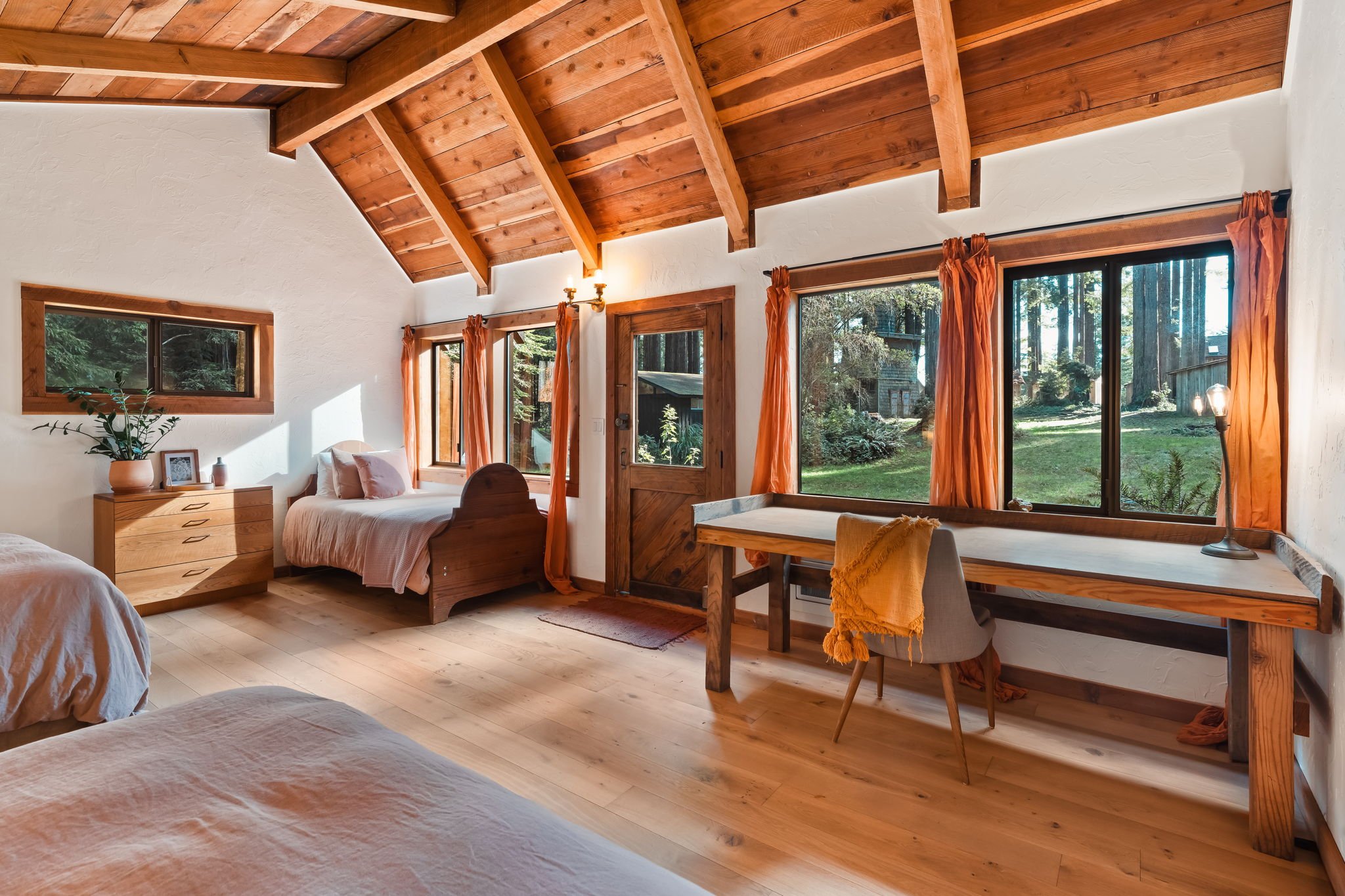
Photo of Deer Haven, one of the our many unique cabin spaces. This cabin has three beds. Cabins have between 1 to 8 beds each and provide several different sleeping arrangements for nervous system reset retreat. All cabin spaces are included in nervous system healing retreat women.
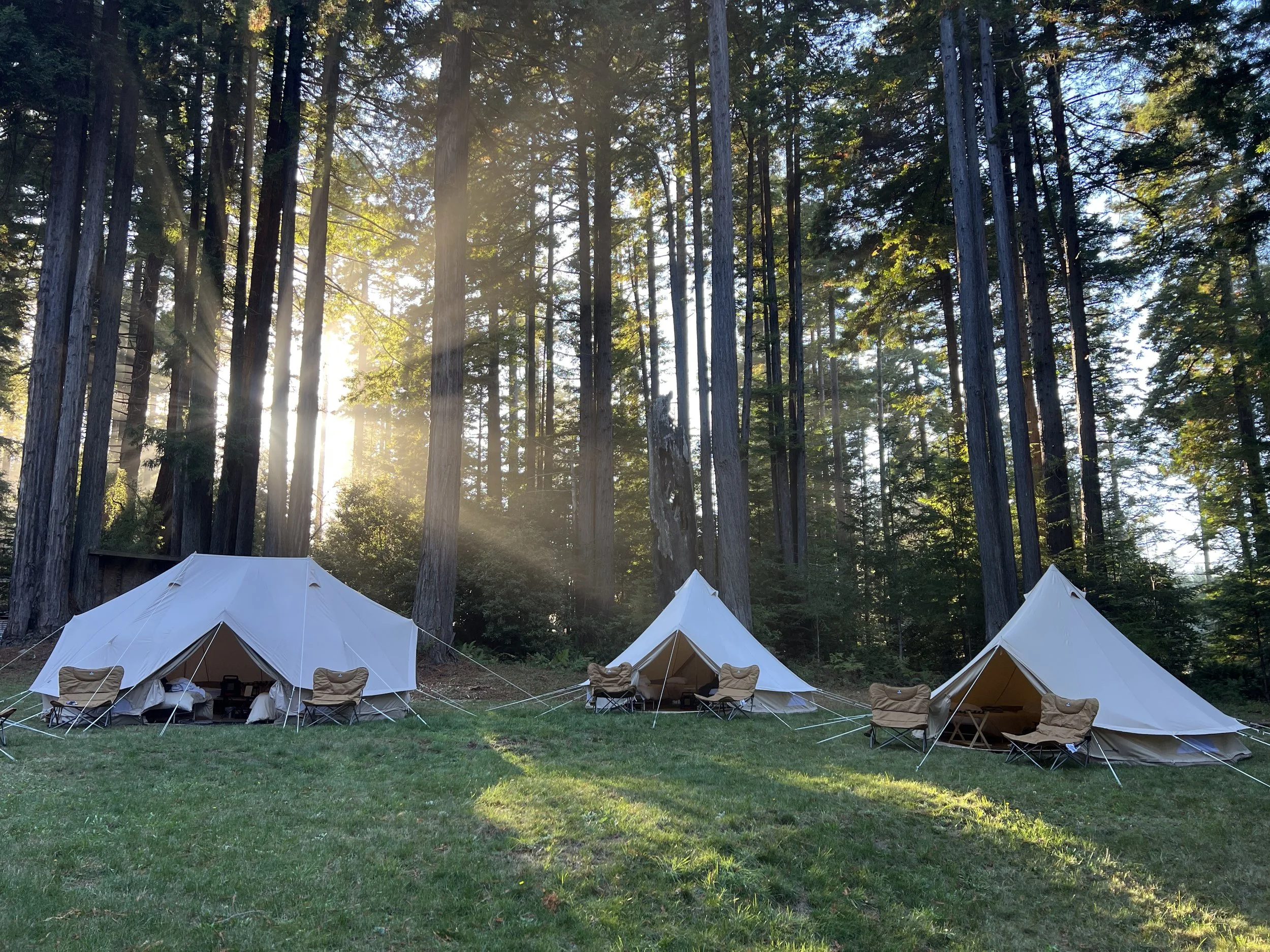
Photo of Group Glamping Tents Setup in Sunset Meadow. We have 10 Glamping Structures that can be added with 1to 3 beds each. This can increase bed capacity of campus to 50 guests across 20 unique accommodation spaces.
Christine Raschke and Monique Pearson: Guides Who Understand Burnout and Recovery
Harvard-Trained Leaders Who've Navigated Their Own Paths from Overdrive to Sustainable Thriving
Christine Raschke and Monique Pearson know intimately the high-achieving lifestyle that leads to nervous system dysregulation because they've lived it. During their years in tech, startups, and consulting—the period following their Harvard Business School training—they inhabited the world of demanding careers, constant travel, back-to-back video calls across time zones, pressure to perform and produce, emails answered at midnight, weekends working on strategic plans. Their education taught them to optimize and excel; their competitive environments rewarded pushing through exhaustion and maintaining constant availability. Like many capable women, they learned to override their bodies' signals, to normalize operating in chronic stress, to view rest as something you earned through productivity rather than a biological necessity.
It was their personal experiences with burnout and their subsequent healing journeys that taught Christine and Monique about nervous system regulation and what sustainable thriving actually requires. They learned that you can't think or willpower your way out of physiological dysregulation—you need practices that work directly with your body's stress response systems. They discovered that many of the "productivity hacks" they'd relied on were actually keeping their nervous systems in overdrive. They experienced firsthand how breathwork, somatic practices, and regular nervous system regulation could shift their baseline from stressed-and-coping to genuinely resourced. These weren't just interesting concepts; they were life-changing discoveries that informed everything about how they now work with clients.
What makes Christine and Monique particularly effective facilitators for this anxiety relief retreat women is their dual capacity to understand both the driven, achievement-oriented mindset that creates dysregulation AND the somatic, body-based approaches that resolve it. They can speak the language of high performers who intellectually understand they need to slow down but physiologically can't access the brake. They bring professional coaching expertise that helps you understand patterns and make strategic life changes, combined with deep somatic training that helps your nervous system actually experience safety and regulation rather than just thinking about it. They create containers where accomplished women finally feel safe enough to let down the hypervigilant guard they've been maintaining for years and allow their systems to reset. Connect with Christine and Monique at @thecatalystretreats to learn more about their approach to nervous system healing.
Spirit Camp: A Sanctuary Designed for Nervous System Healing
How the Redwood Forest Environment Naturally Promotes Regulation and Deep Rest
Before you even begin the structured practices at this nervous system regulation retreat North of Oakland, the environment itself starts working on your system. Research consistently demonstrates that forest environments naturally reduce cortisol (your primary stress hormone), lower blood pressure and resting heart rate, boost immune function through exposure to beneficial compounds released by trees, and shift nervous systems toward parasympathetic states. Spirit Camp's 27 acres of coastal redwood forest in Mendocino County offer these benefits simply through immersion—the phytoncides (aromatic compounds) the trees release, the particular quality of filtered light through the canopy, the soft sounds of wind through branches, the absence of urban stimulation. Many participants report noticing a palpable shift within hours of arrival: thoughts slow, shoulders drop, breathing deepens.
The accommodations are specifically designed to support nervous system regulation for women whose systems have been running in overdrive. You'll stay in cabins—private spacious options, private cozy cabins, or three-to-four person shared cabins—that feel safe and contained. This matters profoundly for dysregulated nervous systems that constantly scan for threats: your space has clear boundaries, a door you control, a bed that's yours alone (unless you're sharing intentionally). The cabins feature comfortable bedding that invites the deep sleep your system desperately needs, personal heating controls so you can regulate your own comfort (autonomy that dysregulated systems crave), and windows framing redwood canopy views that provide what researchers call "soft fascination"—the kind of gentle, non-demanding visual interest that allows overstimulated minds to finally rest without either intense stimulation or complete emptiness.
The practice spaces at Spirit Camp support different aspects of nervous system work. The Sanctuary, with its distinctive copper roof, central skylight, and 20-foot south-facing windows, creates a space that feels simultaneously intimate and expansive—important for helping nervous systems experience both safety (intimate, contained, held) and freedom (spacious, light-filled, open). This is where much of the breathwork and coaching happens, where women gather for practices designed to help their systems recalibrate. The Redwood Lodge, with its stone fireplace, warm wood, and communal dining setup, supports what researchers call "co-regulation"—the phenomenon where being in calm presence with others helps regulate your own system. Sharing meals, witnessing each other's stories, simply sitting together in the lodge's warm atmosphere—all contribute to nervous system healing. The outdoor spaces offer diverse environments for different regulation needs: forest trails for gentle movement and solitude, Magic Meadow's fire circles for connection and community, gardens with benches for quiet contemplation.
Perhaps most importantly for women's wellness retreat redwoods participants, the retreat structure itself is nervous-system-supportive. You don't have to make decisions about what to eat or when—meals are provided on a clear schedule, removing decision fatigue. You're invited (encouraged, really) to put away phones and step back from the usual demands that keep your system activated. The pacing intentionally balances activity with rest—no jam-packed schedule forcing you to rush from one thing to the next. The small group size (maximum 14 participants) prevents the overstimulation that large gatherings create for sensitive systems. Every element has been considered: How does this support or hinder nervous system regulation? The retreat becomes a laboratory where your system can finally experience: "I'm safe. I can rest. I can let go of constant vigilance."
Finding Regulation in Mendocino: Northern California's Healing Forest
Three Hours from Bay Area Stress to Coastal Redwood Serenity
The contrast between your usual environment and Spirit Camp's setting is itself therapeutic. The Bay Area—San Francisco, Oakland, Berkeley, San Jose, Silicon Valley—pulses with a particular energy: fast-paced, achievement-oriented, constantly stimulating, always optimizing. It's exhilarating and exhausting, innovative and relentless. For nervous systems already stuck in overdrive, this environment continuously signals "stay alert, stay ready, stay productive." Mendocino County, by contrast, operates on different rhythms: tide cycles, seasonal changes, the patient growth of ancient trees, the rising and setting of sun determining activity more than deadlines or quarterly goals. For women seeking somatic retreat for stress recovery, this geographic shift itself initiates the regulation process.
Spirit Camp is located approximately three hours north of San Francisco, Oakland, Berkeley, San Jose, and the broader Bay Area communities—far enough to feel genuinely separated from your usual context, close enough to be accessible for a long weekend. The retreat center is about two hours from Sonoma County and reachable from three major airports: San Francisco International (SFO) and Oakland International (OAK), both roughly three hours away, and Santa Rosa Airport, just two hours north. Situated in Mendocino County on California's North Coast, Spirit Camp occupies 27 acres of second-growth redwood forest, positioned just ten minutes from the historic town of Mendocino and one mile inland from the Pacific Ocean—close enough to feel the ocean's influence without the intensity of constant crashing waves.
This specific geography supports nervous system healing through multiple mechanisms. The ancient redwood forest creates what Japanese researchers studying "forest bathing" have documented: exposure to phytoncides (organic compounds released by trees) that boost immune function and reduce stress hormones, negative ions in forest air that improve mood and mental clarity, the particular frequency range of natural sounds (wind, birdsong, rustling leaves) that naturally calm nervous systems unlike the sharp, unpredictable sounds of urban environments, and the visual softness of organic forms that allows your eyes and visual processing centers to relax after constant exposure to screens and hard angles. The nearby ocean adds its own healing properties: more negative ions, the rhythmic sound of waves that can entrain breathing and heart rate toward coherent patterns, and the vast horizon that provides perspective-expanding views. Together, forest and ocean create optimal conditions for burnout recovery retreat near Bay Area participants ready to recalibrate. Continue exploring healing opportunities at the Spirit Camp retreat calendar.
Your Nervous System Questions About The Catalyst Retreat
What to Expect When You're Ready to Reset
How quickly will I feel different, and will the changes last when I return home?
Many participants at this nervous system reset retreat notice initial shifts remarkably quickly—within the first 24 hours, they report sleeping more deeply, experiencing reduced shoulder and jaw tension, noticing their thoughts have slowed and quieted. These early changes come primarily from removing yourself from constant stressors and immersing in a regulation-supportive environment. Your nervous system finally gets permission to downshift without having to maintain vigilance for incoming demands. The deeper, more sustainable changes happen through the structured practices: breathwork sessions that give your system profound experiences of moving from sympathetic activation to parasympathetic rest, yoga that releases chronic holding patterns, mindfulness training that teaches you to notice and shift your state. The key to lasting change is twofold: First, the intensive three-day immersion creates enough repetition that your nervous system begins learning new patterns—it's not just one isolated moment of calm but sustained experiences that help reset your baseline. Second, the post-retreat integration support helps you implement daily practices and necessary life changes that maintain regulation when you return to demands. Think of the retreat as jumpstarting a process—you'll leave with momentum, embodied experiences of regulation, and practical tools, but sustaining changes requires ongoing attention and practice.I'm worried I'm too stressed or anxious to do breathwork—is that possible?
This is an understandable concern, especially for women whose nervous systems are highly sensitized and reactive. Holotropic breathwork can feel activating initially—it's designed to increase oxygen and energy flow—which might seem counterintuitive when you're already overstimulated. However, Christine and Monique are trained to support participants with high anxiety or nervous system sensitivity, and the practice is always conducted in a safe container with experienced facilitators closely monitoring all participants. You maintain control—you can always modify the breathing pattern, slow down, or take breaks if intensity becomes too much. Importantly, this breathwork retreat California includes multiple regulation tools working synergistically. If breathwork feels too activating, the gentle yoga, sound healing, and forest immersion offer more gradual pathways to regulation. Some women need to start with these gentler practices before they're ready for the intensity of breathwork. The pre-retreat 1:1 coaching session exists precisely so you can discuss your specific concerns and sensitivity—Christine or Monique can then ensure you feel adequately supported throughout the weekend and can adjust practices as needed.What should I do to prepare, and what should I expect in the days after the retreat?
Preparation for this nervous system healing retreat is intentionally minimal—your system needs rest from preparing and optimizing, not more tasks. Handle basic logistics (travel arrangements, comfortable clothing, journal), and if possible, arrive reasonably rested rather than racing to tie up loose ends until the last minute. The retreat itself teaches you what you need to know: how to notice your nervous system state, how to use various practices for regulation, how to distinguish genuine rest from merely being inactive. After the retreat, expect some integration challenges that are completely normal. Returning to your usual environment may feel jarring—the pace faster, the demands louder, the stress triggers more obvious now that you've experienced regulation. This contrast is actually valuable information about what in your life supports versus undermines your wellbeing. Many participants report that the first few days home are when they truly appreciate what they learned—they can now notice stress building before it reaches crisis point and have tools to address it proactively. Some make significant life changes to better support regulation: establishing clearer boundaries, restructuring schedules, saying no to commitments that drain without nourishing, building in daily practices. The post-retreat integration session addresses these reentry challenges specifically. The retreat plants seeds of regulation; what grows depends on how you tend them in the weeks and months following.
Two Nervous-System-Soothing Destinations Near Spirit Camp
Extend Your Regulation Journey Through Nature's Healing Environments
Big River Estuary and Beach: Where Fresh Water Meets Salt Water and Systems Find Balance
Just south of Mendocino town, where the Big River meets the Pacific Ocean, you'll find one of the area's most nervous-system-soothing natural environments. This peaceful estuary creates a unique brackish ecosystem—neither fully freshwater nor full ocean—where two different worlds meet and mingle. The relatively protected beach (compared to the dramatic wave-crashed headlands dominating much of California's North Coast) offers gentle sand, driftwood sculptures, and the mesmerizing patterns created where river current meets incoming tide. You can kayak up the estuary into the quiet upstream reaches, walk the beach collecting smooth river stones, or simply sit on the sand watching water meet water in endless exchange.
This specific environment offers particular nervous system benefits for continuing your regulation practice after the retreat. The meeting of fresh and salt water creates especially high concentrations of negative ions—electrically charged molecules that research shows can boost mood, increase energy, and promote feelings of wellbeing. The relatively calm water feels soothing rather than overwhelming—you get ocean's healing properties without the intensity of crashing surf that can overstimulate sensitive systems. The wide beach offers space to walk mindfully, practicing the body awareness you've been cultivating, breathing the ion-rich air deeply. The estuary's abundant bird life—great blue herons standing statue-still in shallows, snowy egrets stalking fish, ospreys diving for meals—provides the kind of gentle, non-threatening wildlife watching that naturally calms anxious systems. There's something about observing other creatures going about their lives, unhurried and present, that helps your own system remember that survival doesn't require constant rushing. Perfect for retreat participants wanting to continue their regulation work in an accessible, peaceful setting.
Caspar Headlands State Beach and Reserve: Bluff Trails and Tide Pools for Continued Integration
A few miles north of Mendocino town, Caspar Headlands State Beach and Reserve offers a lesser-known coastal sanctuary perfect for continuing nervous system regulation work. The reserve features gentle bluff trails with benches positioned for extended ocean gazing—and research consistently demonstrates that watching waves and horizon lines naturally induces meditative brain states, reduces rumination, and promotes what neuroscientists call "default mode network" activity associated with restoration and insight. The rhythm of waves creates what's called "pink noise"—a specific sound frequency spectrum that many find deeply calming and that can help entrain breathing patterns toward slower, deeper rhythms.
The beach below, reached via a short trail, offers tide pooling among rocks during low tide—entire miniature ecosystems revealed in pools left by receding water, where sea stars grip rocks, anemones wave tentacles, hermit crabs scramble about their business. There's something profoundly regulating about crouching beside these pools, bringing your attention to the intimate detail of these small lives, feeling the cool ocean breeze, hearing the distant waves, experiencing the tangible reality that you're part of an ecosystem infinitely larger than your personal concerns. The beach also features driftwood smoothed by years of wave action and stones polished to perfect roundness—many retreat participants bring a small stone back as a touchstone for their regulation practice, something they can hold during stressful moments to remember the possibility of calm. This location specifically supports continued nervous system work because it's quieter than more famous beaches (minimizing sensory overwhelm), the trails are easy and level (no physical stress), and the combination of expansive ocean views with intimate tide pool discoveries offers both the perspective-broadening and focused-attention that help regulate anxious minds. Bringing a journal to the bluff benches and alternating between writing and ocean-watching creates ideal conditions for integration of your retreat insights.
Your Nervous System Is Speaking—Are You Listening?
Your nervous system communicates through exhaustion that sleep doesn't touch, tension that won't release, vigilance you can't shut off, and overwhelm that feels unending. It's not asking you to be stronger, more productive, or better at "handling stress." It's asking you to listen, to slow down, to provide the conditions it needs to recalibrate from chronic emergency response to sustainable capacity for actually living your life rather than just surviving it.
The Catalyst Retreat offers women a structured, deeply supported pathway to nervous system reset through practices grounded in neuroscience—holotropic breathwork, yoga, sound healing, somatic movement, and mindfulness—that work directly with your body's stress response systems. In the healing environment of Mendocino County's ancient redwood forests, surrounded by women on similar journeys, guided by facilitators who've navigated their own paths from burnout to thriving, you'll discover that regulation is possible, rest is available, and sustainable wellbeing is within reach.
Join Christine Raschke and Monique Pearson April 16-19, 2026, for three nights in the coastal redwoods of Northern California. Through the Connect-Claim-Calibrate framework, you'll address the physiological patterns keeping you stuck and learn practices to maintain balance in daily life.
Limited to 14 participants for intimate, well-supported nervous system work.
TOPICS:
nervous system reset retreat, nervous system healing retreat women, breathwork retreat California, mindfulness retreat Mendocino County, stress relief retreat Northern California, anxiety relief retreat women, nervous system regulation retreat North of Oakland, women's wellness retreat redwoods, somatic retreat for stress, burnout recovery retreat near Bay Area, Mendocino County, redwood forest/redwoods, Northern California, Bay Area, California North Coast