Breathwork and Yoga Retreat in Northern California: Exploring Pranayama and Meditation in Mendocino's Sacred Redwood Groves
Your breath is the bridge between body and mind, voluntary and involuntary function, conscious awareness and unconscious patterns—yet how often do you actually pay attention to it? Mary Paffard's Summer Retreat 2026, taking place July 2-7, 2026 (Thursday through Monday) at Spirit Camp in Mendocino County, Northern California, offers experienced practitioners five nights to explore breathwork as profound transformative practice. This integrative retreat weaves pranayama (the yogic science of breath control) throughout every dimension of the experience—preparing your body through long active and restorative asana sessions, deepening your capacity for stillness through meditation, and working directly with traditional breathing practices that access states usually beyond conscious control. Among ancient Redwoods generating exceptional oxygen levels and pristine air quality, you'll discover how conscious breathing regulates nervous system function, shifts brain states, unlocks stored emotions, and literally connects your personal respiration to the forest's photosynthetic exchange. This yoga and mindfulness retreat isn't for beginners but rather practitioners ready for sustained breathwork exploration, comfortable with the intensity that can arise when you work directly with life force energy, and seeking the integration of movement, stillness, and breath that creates genuine transformation. Explore the full calendar of breathwork and conscious breathing experiences at Spirit Camp Retreats.
The Breath as Gateway: Five Days of Integrated Pranayama, Asana, and Meditation Practice
Mary Paffard's Summer Retreat Weaves Breathwork Throughout All Sessions, Creating a Comprehensive Exploration of Life Force Energy
What distinguishes this retreat from casual weekend workshops on breathing is the depth of integration across five sustained days. Pranayama isn't treated as separate module or occasional add-on but rather as foundational thread woven through every aspect of practice. The long active asana sessions (90 minutes or more) consciously work with breath—building heat through specific breathing patterns, learning to maintain steady respiration even in challenging poses, discovering how different breath qualities affect muscular engagement and mental focus. When you're holding Warrior II and your breath becomes shallow and rapid, that's information about your nervous system's response to challenge. When you practice flowing vinyasa coordinating movement with inhales and exhales, you're training the kind of embodied breath awareness that becomes accessible off the mat in daily life.
The restorative portions of practice create completely different relationship with breath. In fully supported poses held for extended periods, you can observe how breath naturally deepens when muscular effort ceases, how the exhale spontaneously lengthens when you feel safe, how subtle holding patterns in the diaphragm and intercostal muscles gradually release over time. This passive observation teaches as much as active manipulation—you learn to sense your breath's baseline patterns, to notice the countless ways that chronic stress, past trauma, and habitual tension literally shape how you breathe, and to recognize when your system is genuinely relaxing versus performing relaxation while staying vigilant.
Dedicated pranayama sessions work directly with traditional techniques, each offering specific physiological and energetic effects. You might practice ujjayi (victorious breath) to build internal heat and focus, nadi shodhana (alternate nostril breathing) to balance left and right hemispheres and calm the nervous system, kapalabhati (skull-shining breath) for energizing and mental clarity, bhastrika (bellows breath) for powerful activation, or sitali (cooling breath) to reduce excess heat. Mary's approach ensures these practices are taught with appropriate safety considerations, clear instruction on contraindications, and emphasis on listening to your body's signals rather than forcing intensity. Breathwork can access deep nervous system patterns and stored emotions—this power requires respect, skill, and the kind of supportive container that this retreat's structure provides.
Meditation periods throughout the day anchor everything in present-moment awareness. Many meditation traditions, including the Vipassana practice Mary teaches within, begin with breath awareness (anapana)—simply observing the natural breath at the nostrils or belly without trying to control it. This foundational practice develops the attention stability and equanimity necessary for deeper insight work. Morning silence until lunch supports this integration—when you're not constantly talking, you naturally become more aware of your breathing, and the continuity of practice from formal sessions into meals, forest walks, and rest periods allows breath consciousness to deepen beyond what weekend workshops can access.
Mary's signature approach of infusing practice with poetry, imagery, and eco-inquiry works beautifully with breathwork. She might invite you to imagine your inhale drawing energy from deep earth up through your roots (feet), or your exhale releasing into the sky through your crown. She connects individual breath to the forest's respiration—recognizing that the oxygen you inhale was just produced by surrounding Redwoods through photosynthesis, while the carbon dioxide you exhale will be absorbed by those same trees. This tangible connection transforms pranayama from isolated technique into embodied ecology, helping you viscerally understand interdependence. Located just three hours North of the Bay Area including San Francisco, Oakland, and San Jose, Spirit Camp offers world-class breathwork training in oxygen-rich forest without requiring international travel.
Pranayama: Ancient Science of Breath Control and Vital Energy Cultivation
From Patanjali's Yoga Sutras to Contemporary Understanding of How Breath Regulates Nervous System and Consciousness
Pranayama—from Sanskrit prana (life force, vital energy) and ayama (expansion, extension, control)—represents the fourth limb in Patanjali's eight-limbed path of classical yoga, positioned between physical postures (asana) and sense withdrawal (pratyahara). This placement isn't arbitrary: the ancient yogis understood that conscious breath work bridges external practices of ethical living and body conditioning with internal practices of concentration and meditation. Pranayama quite literally gives you access to functions usually operating beyond conscious control—you can't directly will your heart rate to change or your nervous system to shift states, but through deliberate breathing patterns, you can influence both. This makes breath uniquely powerful as both diagnostic tool (observe your natural breathing to understand your current state) and intervention (change your breathing to shift your state).
Traditional yogic texts describe prana as the vital energy pervading all existence, with breath being its most tangible manifestation in the human body. The Hatha Yoga Pradipika, a 15th-century text, devotes extensive sections to pranayama techniques, explaining that controlling breath controls prana, controlling prana controls the mind, and controlling the mind leads to liberation. Different techniques target specific effects: ujjayi breath (slight constriction at the back of the throat creating ocean-like sound) builds internal heat and sustained focus perfect for active practice; nadi shodhana (alternate nostril breathing) balances ida and pingala nadis (subtle energy channels associated with lunar-cool and solar-hot qualities), creating equilibrium and calmness; kapalabhati (rapid, forceful exhales through the nose) oxygenates blood, clears nasal passages, and energizes the system; bhastrika (vigorous inhales and exhales like blacksmith bellows) generates substantial heat and can induce altered states; sitali (inhaling through curled tongue or pursed lips, exhaling through nose) cools the body and calms agitation.
Contemporary scientific research increasingly validates what pranayama practitioners have known for millennia. Studies show that conscious breathwork directly affects heart rate variability (HRV)—a key marker of nervous system health and stress resilience, with slower, deeper breathing increasing HRV. Vagal tone (function of the vagus nerve connecting brain to major organs) improves with practices emphasizing long exhales, supporting better emotional regulation, digestion, and inflammation control. The oxygen-carbon dioxide balance in blood shifts with different breathing patterns, affecting blood pH, cellular metabolism, and brain function. Brain wave patterns measurably change: rapid breathwork can increase beta waves (active thinking), while slow rhythmic breathing promotes alpha waves (relaxed awareness) and potentially theta waves (deep meditation, creativity).
Perhaps most remarkably, breathwork bridges voluntary and involuntary nervous system functions. You can't consciously control your spleen or pancreas, but your diaphragm and intercostal muscles respond to both voluntary commands (deliberate breath manipulation) and involuntary reflexes (automatic breathing continuing during sleep). This dual nature means pranayama offers unique access to the autonomic nervous system: want to shift from sympathetic (stress) to parasympathetic (relaxation) dominance? Change your breathing pattern. Want to increase alertness without caffeine? Use stimulating breath techniques. Want to prepare for sleep? Practice calming breath ratios. Explore research on pranayama and nervous system regulation to understand the documented physiological effects of breath control practices.
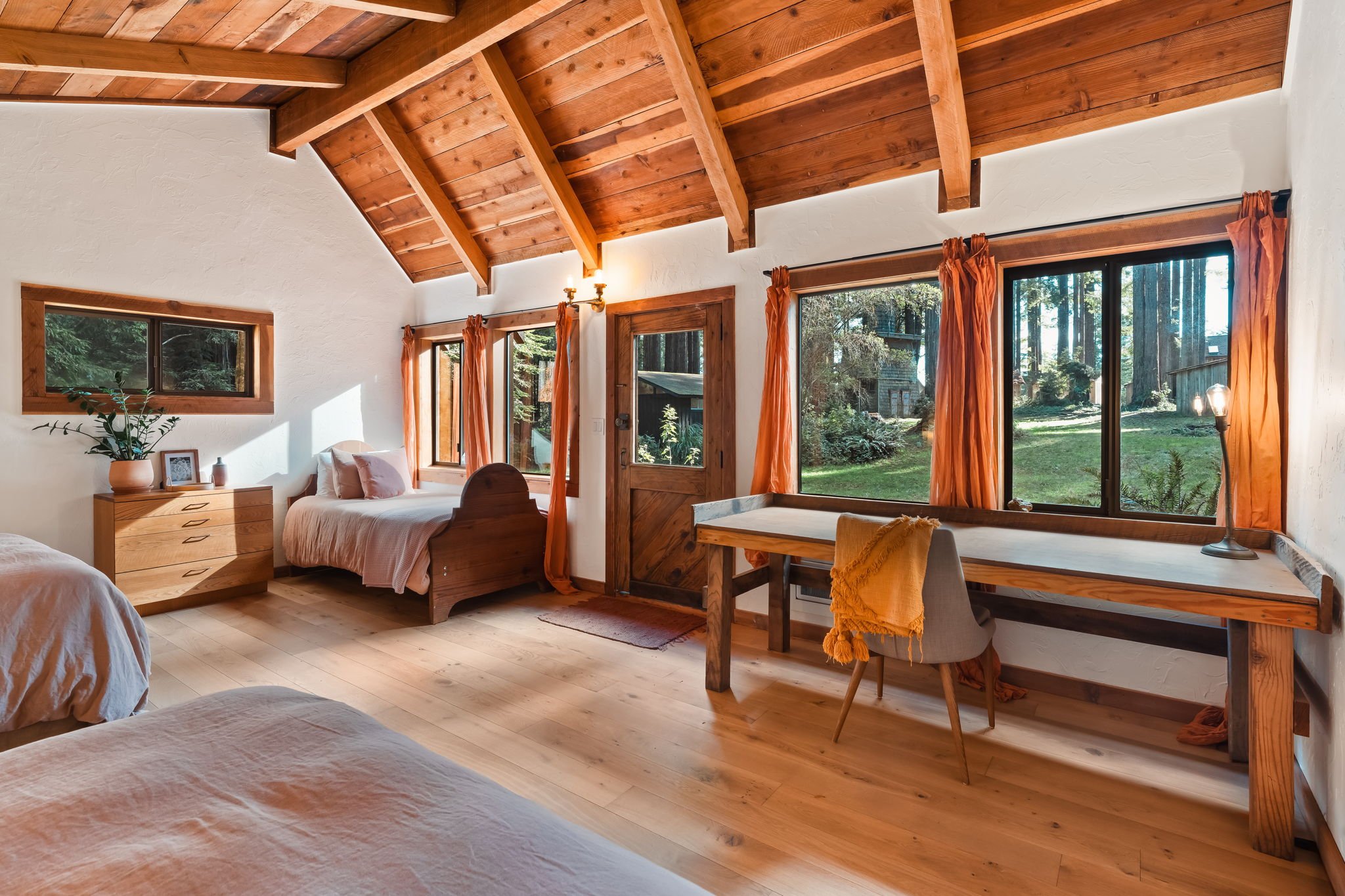
Photo of Deer Haven, one of the our many unique cabin spaces. This cabin has three beds. Cabins have between 1 to 8 beds each and provide several different sleeping arrangements for Yoga and mindfulness retreat. All cabin spaces are included in Breathwork retreat California.
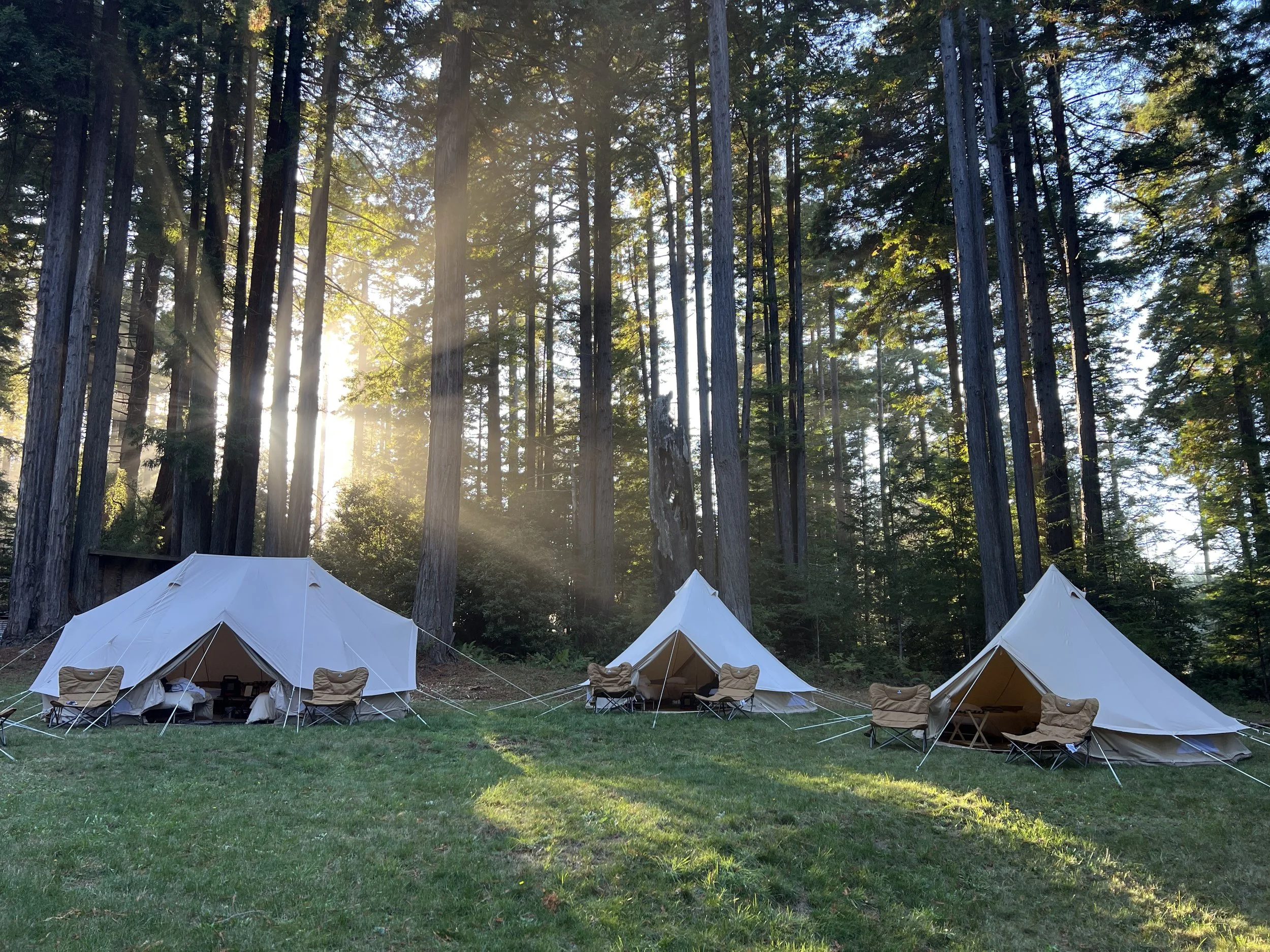
Photo of Group Glamping Tents Setup in Sunset Meadow. We have 10 Glamping Structures that can be added with 1to 3 beds each. This can increase bed capacity of campus to 50 guests across 20 unique accommodation spaces.
Mary Paffard: A Teacher Grounded in Traditional Pranayama and Mindful Breath Awareness
Four Decades of Practice Including Vipassana Training Inform Mary's Skillful, Safe Guidance Through Powerful Breath Practices
Mary Paffard's training since the mid-1980s in comprehensive yoga necessarily included substantial pranayama education—you can't authentically teach traditional yoga without understanding breath work's central role. Her decade directing Teacher Training at Yoga Mendocino (2000-2010) meant directly teaching breathing practices to hundreds of aspiring instructors, ensuring they understood not just the techniques themselves but how to guide students safely through the intensity that breathwork can generate. This teaching experience matters enormously because pranayama isn't risk-free—done improperly or too aggressively, certain techniques can cause dizziness, anxiety, or respiratory dysfunction. Done skillfully with appropriate preparation and attention to individual needs, the same practices become profoundly therapeutic.
Mary's work teaching yoga on Vipassana retreats uniquely informs her breathwork approach. Vipassana meditation begins with anapana—simple, sustained observation of natural breath at the nostrils without trying to control it. This foundation practice develops the equanimity and attention stability necessary for deeper insight work. Mary understands from direct experience how breath awareness serves meditation, and how meditation's non-reactive observation informs safe breathwork—you learn to notice sensations, emotions, and thoughts that arise during pranayama without immediately trying to fix or escape them. This capacity to be with intensity proves essential when breathing practices unlock stored material or generate strong energetic experiences.
Her Buddhist Eco-Chaplain credentials connect breath to mindfulness in daily life, not just formal practice sessions. Buddhist teachings extensively explore breath as anchor for present-moment awareness: when your mind wanders into past regrets or future anxieties, returning attention to breath brings you back to now—the only moment you actually inhabit. Mary's continued training with recognized programs throughout California, Mexico, and Costa Rica demonstrates ongoing refinement of her educational approach rather than resting on decades-old knowledge. The yoga world's understanding of breathwork continues evolving through research and cross-cultural exchange, and Mary's commitment to continued education ensures her teaching reflects current best practices.
The signature elements of her teaching—infusing practice with poetry, imagery, and eco-inquiry—work powerfully with breathwork. She might describe your breath as "tides moving through the body," connecting your personal respiration to ocean rhythms. She draws explicit connections between your exhale and the forest's inhale (trees absorb your CO2), between your inhale and the forest's exhale (you absorb oxygen trees produce)—making interdependence visceral rather than abstract. When you practice pranayama among Redwoods with Mary's guidance, you're not just manipulating air flow but consciously engaging with the planet's respiratory system, recognizing yourself as participant in exchanges that sustain all life. This ecological framing transforms breathwork from self-improvement technique into spiritual practice of recognizing and honoring your place within larger living systems.
Spirit Camp's High-Oxygen Redwood Environment: An Ideal Setting for Breathwork Exploration
Practice Pranayama in 27 Acres of Forest Where Ancient Trees Generate Exceptional Air Quality and Earth's Breath Becomes Tangible
Spirit Camp offers optimal conditions for breathwork practice through both architectural design and natural environment. Coastal Redwood forests rank among Earth's highest oxygen-producing ecosystems—these massive trees, with their enormous leaf surface area and continuous photosynthesis, generate exceptional air quality. When you practice pranayama here, you're literally inhaling oxygen-rich air that surrounding trees just produced, along with phytoncides (organic compounds trees emit) documented to reduce stress hormones, lower blood pressure, and enhance immune function. The air quality difference compared to urban environments proves immediately noticeable: crisp and clean, carrying forest scent and ocean influence, lacking the particulates, pollution, and allergens that burden respiratory systems in cities.
The Sanctuary provides ideal indoor breathwork space with its excellent ventilation system—20-foot south-facing windows and central skylight ensuring fresh forest air circulates freely even during enclosed practice. The copper roof with its distinctive acoustics enhances certain breathing practices: the subtle sound of your ujjayi breath becomes more audible, helping you maintain consistent technique, while any rain on the roof creates natural white noise supporting concentration. The floor cushions, back-jack chairs, and cozy setup allow comfortable seated positions essential for extended pranayama sessions—you need to be physically comfortable enough that your body doesn't become distraction from breath focus, yet alert enough that you don't drift into sleepiness.
Outdoor practice opportunities in Magic Meadow or the gardens create completely different but equally valuable breathwork experiences. Practicing in the meadow where Redwood canopy parts to allow sunlight, you literally breathe in sync with the living forest surrounding you—your exhale feeding the trees' photosynthesis, their exhale providing your inhale's oxygen. This tangible exchange makes the concept of interdependence visceral rather than philosophical. You might practice tree pose while actually communing with a tree, coordinating your breath with swaying branches, recognizing that you and the forest share one respiratory system operating at different scales and speeds.
Even between formal sessions, simply walking Spirit Camp's private trails becomes pranayama practice when approached with conscious awareness. You notice how your breathing naturally adjusts to subtle inclines, how cool forest air feels different in your nostrils than warm meadow air, how the scent of Redwood and Douglas Fir shifts your breath quality. The ephemeral streams (seasonal water flows) provide gentle sound supporting rhythmic breathing, while the overall forest hush creates acoustic environment where you can actually hear your own respiration. The 27 acres of forest plus hundreds of adjacent undeveloped acres mean you can find solitude for personal breathwork exploration, or gather in groups for collective practice, depending on what serves your learning.
The Fresh Air of Mendocino County: A Breathing Paradise Three Hours North of the Bay Area
Escape to California's North Coast Where Marine Air Meets Forest Oxygen and Every Breath Becomes Medicine
The journey itself begins respiratory transformation. Driving approximately three hours North of San Francisco, Oakland, and the Bay Area's urban air, you gradually enter regions of increasing air quality. Urban environments carry particulate matter from traffic, industrial emissions, and countless other sources that burden respiratory systems and contribute to inflammation. Mendocino County's coastal location, extensive forest cover, and minimal industrial development create pristine air conditions—you notice the difference immediately upon arrival, that first deep breath of clean, oxygen-rich air that actually seems to fill your lungs more completely than city breathing typically allows.
The unique microclimate further enhances conditions for breathwork practice. Coastal fog rolling in from the Pacific provides moisture supporting the lush Redwood growth—these trees need that marine influence to thrive at their southern range limit. The fog creates the "mystical, witchy" atmosphere many participants describe, with cool dampness that feels refreshing in lungs and sinuses. Meanwhile, Spirit Camp's ridge location ensures ample sunshine breaks through fog, creating alternating conditions perfect for exploring how different environments affect breath quality. You might notice morning fog invites slower, deeper breathing, while afternoon sun in Magic Meadow naturally energizes respiration.
The sensory experience of breathing Mendocino air becomes practice in itself: cool and fresh on inhale, carrying subtle ocean salt you can taste, infused with Redwood and Douglas Fir aromatics that calm nervous systems, completely lacking the harsh chemical odors or exhaust fumes characterizing urban air. The absence of industrial pollution means fewer irritants triggering respiratory inflammation or allergic responses—many participants with asthma or environmental sensitivities report dramatic improvement in breathing capacity during their stay. The protected forests and pristine coastline maintain these exceptional conditions year-round, though summer offers particularly ideal temperatures and weather patterns for intensive practice.
Accessibility remains straightforward despite the pristine remoteness: San Francisco International (SFO) and Oakland International (OAK) airports sit about three hours away, Santa Rosa Airport just two hours distant. The drive north becomes part of the breathwork preparation—you might practice simple breath awareness while driving, consciously releasing shoulder and jaw tension, noticing how anticipation of the retreat already begins shifting your respiratory patterns. By the time you arrive at Spirit Camp, you're primed for deeper work, your system already responding to cleaner air and the psychological shift toward practice focus. Ready to explore more breathwork and pranayama experiences in this oxygen-rich environment? Visit the Spirit Camp retreats calendar to discover additional offerings throughout the year.
Frequently Asked Questions About Breathwork at This Retreat
What if I'm new to formal pranayama practice?
Mary's retreat assumes intermediate yoga experience—you should have foundation in basic asana and feel comfortable spending extended time in seated positions—but specific pranayama expertise isn't required. Many participants arrive having practiced only the most basic breath awareness taught in typical yoga classes (perhaps some ujjayi breathing during flow, maybe brief breath-of-fire or alternate nostril practice). Mary's skilled instruction meets you where you are, teaching each technique from fundamentals while offering modifications for different intensity levels. If you have respiratory conditions like asthma, are pregnant, or have certain cardiovascular issues, some pranayama techniques may not be appropriate—contact Mary directly before registering to discuss your situation and ensure the retreat suits your needs. The key is approaching breathwork with respect for its power: these aren't just relaxation exercises but practices accessing deep nervous system patterns and potentially generating intense experiences. Mary's decades of experience and her Buddhist training in non-reactive observation ensure she can guide you safely through whatever arises, whether that's profound calm, emotional release, energetic sensations, or simply restlessness and boredom that reveal patterns worth exploring.Can breathwork practice bring up strong emotions or sensations?
Yes, absolutely—and this is actually part of breathwork's therapeutic potential, though it requires appropriate support and preparation. Breathing patterns directly affect nervous system function, and many people unconsciously restrict their breath as way of managing difficult emotions or staying in control. When you practice pranayama that deliberately shifts these patterns—especially techniques involving rapid breathing, extended breath retention, or very slow rhythms—you may access stored emotional material: grief that surfaces during deep exhales, anger that emerges with forceful breathing, anxiety that intensifies with retention practices, or memories and sensations connected to past experiences. Some techniques can generate strong physical sensations including tingling, temperature changes, waves of energy moving through the body, or temporary light-headedness. Mary's experience holding space for intensive practice, combined with the supportive community of fellow practitioners, creates container where these experiences can unfold safely. The morning silence until lunch proves especially valuable here—if breathwork practice brings up material that needs processing, you have time for integration without immediately having to engage socially. The most important aspect is respecting your own boundaries: if a practice feels too intense, you can always return to natural breathing, rest in Child's Pose, or signal Mary that you need support. The power of breathwork deserves respect, and skillful practice means listening to your body's wisdom about appropriate intensity.Will we practice breathwork during asana or separately?
Both—the integration is precisely what creates depth. Breath awareness infuses all asana practice: you'll learn how different breathing patterns affect your capacity to hold challenging poses, how coordinating movement with breath in flowing sequences creates meditative quality, how the exhale naturally supports forward folds while the inhale facilitates backbends. Mary's teaching makes these connections explicit rather than assuming students naturally discover them. Additionally, there will be dedicated pranayama sessions where you're seated or lying down, focusing entirely on breathing practices without the complexity of physical poses. These dedicated sessions allow learning proper technique for each breath practice—the precise mechanics of alternate nostril breathing, the rhythm and intensity of kapalabhati, the ratios of retention practices—which then informs how you work with breath during movement. The meditation periods also work directly with breath, often beginning with simple observation (anapana) as anchor for attention. By the end of five days, you'll have experienced breath as preparation for movement, as companion during practice, as bridge into stillness, and as practice unto itself—this comprehensive integration creates understanding that weekend workshops simply can't provide.
Two Breath-Enhancing Natural Environments Near Spirit Camp
Continue Your Pranayama Practice in Mendocino's Oxygen-Rich Forests and Negative-Ion-Laden Coastline
Hendy Woods State Park: Breathing Earth's Breath Among Thousand-Year-Old Giants
About 20 minutes inland from Spirit Camp via Highway 128, Hendy Woods State Park protects one of the area's finest old-growth Redwood groves, including the Giant Tree standing over 270 feet tall and estimated at 1,000+ years old. Practicing breathwork among these ancient beings offers profound perspective—these trees have been engaged in their own respiration for a millennium, witnessed countless human generations rise and fall, and continue their patient photosynthesis regardless of human concerns. Standing in the grove's quiet cathedral-like atmosphere, you viscerally understand that breath transcends individual life, that the respiratory exchange between plants and animals has sustained Earth's living systems for billions of years, and that your personal breathing participates in something infinitely larger than yourself.
The accessible loop trails (about 2 miles round-trip with minimal elevation change) provide perfect terrain for walking pranayama practices. You might try counted-step breathing—inhaling for four steps, retaining for four steps, exhaling for four steps, empty for four steps—allowing the rhythm to naturally slow your pace and focus your attention. Or practice simple awareness, just noticing how breath adjusts to subtle terrain changes, how cool forest air feels in nostrils, how the scent of Redwood bark and forest floor affect your respiratory experience. The exceptional air quality in old-growth groves, where massive trees produce substantial oxygen through their enormous photosynthetic capacity, means every breath delivers maximum benefit. Many retreat participants visit Hendy Woods on a free afternoon, using the forest immersion as continuation of retreat practices in an awe-inspiring setting. Simply standing still in the grove, breathing slowly and consciously, feeling your own impermanence against these trees' longevity, becomes powerful meditation on the preciousness of each breath we're given.
Mendocino Headlands State Park at Sunset: Ocean Breath and Coastal Air
The dramatic coastal bluffs of Mendocino Headlands State Park, wrapping around the village like natural amphitheater, offer completely different but equally valuable breathwork environment. The Pacific air here carries exceptional concentrations of negative ions—particularly abundant near breaking waves and surf—documented to improve mood, enhance respiratory function, and create the sense of mental clarity and wellbeing many people associate with ocean environments. The expansive views—horizon stretching infinitely where sky meets sea—naturally support pranayama practices cultivating spaciousness: perhaps viloma breathing (interrupted breath with pauses), or simply extended exhales imagining releasing into ocean's vastness, or retention practices while gazing at the unchanging yet ever-changing seascape.
Finding a spot on the grassy headlands as afternoon transitions toward evening, you can practice pranayama with the rhythmic sound of waves below creating natural metronome for your breathing. The waves' consistent yet varied rhythm—sometimes gentle swells, sometimes larger sets crashing against rocks—teaches something about working with breath's natural variations rather than forcing rigid patterns. As sunset approaches, the sky's transformation from blue to gold to pink to purple provides visual accompaniment to practices exploring transition and impermanence. You might practice gentle breath retention while watching the sun hover at horizon, feeling the day's suspension between fullness and release, then practicing deep exhales as the sun disappears—embodying the day's own breath cycle of inhalation (dawn), suspension (midday), exhalation (dusk), and the empty pause (night) before the next cycle begins. The combination of negative ions, ocean sounds, expansive views, and the simple presence of sunset's beauty creates optimal conditions for breathwork that opens heart and mind while grounding you in the elemental reality of constant change.
Ready to Discover What Shifts When You Truly Master the Bridge Between Body and Mind That Is Your Breath?
Every moment of your life, from first gasp after birth through final exhalation at death, involves breathing—yet how much attention do you actually give this fundamental act? Mary Paffard's Summer Retreat 2026 offers experienced practitioners five nights to explore breath as profound gateway to transformation, physical health, emotional regulation, mental clarity, and spiritual depth. From yoga sessions where breath awareness enhances every movement, to dedicated pranayama practices accessing states usually beyond conscious control, to meditation periods anchored in respiratory observation, to morning silence allowing integration, to the forest environment itself teaching about the respiratory exchange sustaining all life—every element conspires to deepen your relationship with breath.
The ancient Redwoods of Mendocino County provide optimal setting for this exploration: their exceptional oxygen production, the pristine air quality, the tangible connection between your exhale feeding their photosynthesis and their exhale providing your oxygen—all making interdependence visceral rather than abstract. Mary's four decades of teaching experience, her training in traditional pranayama and Buddhist breath awareness, her skill at holding space for the intensity that breathwork can generate, and her signature approach of connecting practice to poetry and ecology—all create conditions for genuine mastery to emerge.
Join Mary and the welcoming sangha July 2-7, 2026 for this comprehensive breathwork journey among the oxygen-rich Redwoods. Learn more and reserve your space at the Summer Retreat 2026 page, or explore other breathwork and pranayama experiences throughout the year at Spirit Camp Retreats. Your next breath awaits—will you meet it with awareness?
TOPICS:
Yoga and mindfulness retreat, Breathwork retreat California, Pranayama retreat Northern California, Yoga and breathwork retreat Mendocino, Conscious breathing retreat West Coast, Breathwork meditation retreat, Pranayama yoga retreat California coast, Breath control practice, Nervous system breathing, Life force energy cultivation, North of Bay Area breathwork, Oxygen-rich forest retreat