Restorative Yoga and Meditation Retreat on California's North Coast: Deep Rest and Renewal Among the Redwoods
In a culture that glorifies constant productivity and treats rest as weakness, restorative yoga offers radical medicine—the recognition that deep healing requires surrender, not effort, and that nervous system restoration is as essential as cardiovascular fitness. Mary Paffard's Summer Retreat 2026, taking place July 2-7, 2026 (Thursday through Monday) at Spirit Camp in Mendocino County, Northern California, masterfully balances both dimensions of practice. This transformative retreat includes long active asana sessions that challenge and invigorate your system alongside restorative yoga practices where you remain in fully supported poses for extended periods, allowing profound nervous system reset and tissue release. Over five nights among ancient Redwoods, experienced practitioners discover what becomes possible when you honor the full spectrum from dynamic effort to supported stillness, from sympathetic activation to parasympathetic rest, from doing to being. The retreat also integrates breathwork, meditation, optional mandala workshops, and morning silence until lunch—creating comprehensive conditions for the kind of deep integration that only emerges when you give yourself sustained time to both challenge and restore. Whether you're recovering from burnout, seeking balance in your practice, or simply recognizing that transformation requires both stimulation and rest, this yoga and mindfulness retreat delivers medicine for our overstimulated times. Explore the full calendar of healing experiences at Spirit Camp Retreats.
The Art of Deep Rest: Balancing Active and Restorative Practices in a Five-Night Redwood Immersion
Mary Paffard's Summer Retreat Offers Experienced Practitioners Both Vigorous Practice and Profound Restoration for Complete Integration
What distinguishes Mary's Summer Retreat from many contemporary yoga experiences is her refusal to privilege one dimension over another—she understands that genuine health requires both capacity for vigorous effort and profound rest, both the ability to activate your system and to allow complete downregulation. Each day unfolds with this balance carefully woven throughout: long active asana sessions (90 minutes or more) that build cardiovascular health, muscular strength, flexibility, and the kind of heat that releases stored tension and stagnation. These active practices might include flowing vinyasa sequences linking breath and movement, sustained standing poses that develop endurance and mental focus, or more challenging shapes that invite you to work at your authentic edge rather than staying in comfortable territory.
Paired with this activation comes equally substantial time in restorative yoga practice—fully supported passive poses held for 5-20 minutes where your only job is to surrender weight into props, breathe consciously, and allow your nervous system to recognize that it's safe to rest. In these longer holdings, transformation happens not through muscular effort but through the body's own healing intelligence when given conditions of safety, support, and time. Chronic holding patterns maintained by protective muscle tension can finally release. The fascia (connective tissue) that becomes rigid from repetitive movement or static postures can gradually hydrate and regain elasticity. The organs receive enhanced circulation as compression releases and breath deepens. Most importantly, the autonomic nervous system shifts from sympathetic dominance (fight-or-flight, stress response) into parasympathetic activation (rest-and-digest, healing mode).
The retreat's additional elements support this restorative quality: daily breathwork practices that directly regulate nervous system function, meditation periods that train your attention to rest in present-moment awareness rather than perpetually planning or reviewing, morning silence until lunch that reduces stimulation and allows deeper integration, and optional evening offerings including mandala creation workshops that engage creative expression without performance pressure. Simple, nourishing vegetarian meals by chef James Sant provide easily digestible fuel that doesn't tax your system, while the Redwood forest environment itself creates conditions for parasympathetic activation through documented effects of phytoncides (organic compounds trees emit), negative ions, and the visual complexity of natural beauty.
This retreat isn't for beginners but rather experienced practitioners who already understand that yoga involves more than achieving impressive shapes—people who recognize that sometimes the hardest practice is allowing yourself to do absolutely nothing, to rest completely, to receive rather than constantly giving. The five-night commitment proves essential because genuine restoration needs time: your nervous system doesn't fully downregulate in 24 hours, fascial tissues don't release chronic patterns over a weekend, and the psychological permission to truly rest often takes days to develop as you prove to yourself that the world continues even when you stop pushing. The dedicated community that forms—many participants returning year after year to this 20+ year tradition—creates safety for the vulnerability that deep rest requires. There's something profoundly supportive about resting alongside others who also value this work, who won't judge you for lying still while they're moving, who understand that supported Child's Pose held for ten minutes can be as challenging as any arm balance.
Located just three hours North of the Bay Area—including San Francisco, Oakland, and San Jose—Spirit Camp offers accessible yet profound restorative practice without requiring international travel to distant wellness destinations.
Restorative Yoga: The Practice of Supported Stillness and Parasympathetic Activation
Understanding How Passive Poses Held for Extended Periods Create Profound Physiological and Emotional Healing
Restorative yoga emerged from the teaching of B.K.S. Iyengar, whose emphasis on precise alignment and extensive prop use created conditions for students to experience poses without strain. Judith Lasater, who studied with Iyengar and also trained in physical therapy, developed restorative yoga as a distinct practice in the 1970s, recognizing that many students (and teachers) desperately needed counterbalance to the increasingly athletic, achievement-oriented yoga becoming popular in the West. She created sequences of fully supported passive poses—supported reclining, supported forward folds, supported backbends, supported inversions—each held for substantial duration (typically 5-20 minutes) with enough props (bolsters, blankets, blocks, sandbags, eye pillows) that muscular effort becomes unnecessary. The body learns it can completely surrender.
The physiological benefits of this approach are profound and well-documented. When you remain in supported stillness for extended periods while breathing consciously, your autonomic nervous system shifts from sympathetic (stress response) to parasympathetic (relaxation response) activation. This isn't just subjective feeling—it's measurable change including decreased cortisol (stress hormone) levels, lowered blood pressure and heart rate, improved heart rate variability (a marker of nervous system health), enhanced digestion and elimination as blood flow shifts from limbs back to organs, reduced muscle tension and pain as protective holding patterns release, and improved sleep quality as your system remembers how to truly rest. The immune system functions more effectively in parasympathetic states, inflammation markers decrease, and the body's natural repair processes accelerate.
It's crucial to understand that restorative yoga isn't "easier" than active practice—it's differently challenging and accesses different dimensions of healing. Many people find supported stillness incredibly difficult precisely because it removes all the usual distractions and strategies for avoiding what they're actually feeling. When you can't move, can't fidget, can't escape into the next pose or the mental problem-solving that vigorous practice sometimes allows, you're left with whatever emotions, sensations, and thoughts are actually present. The restlessness that arises, the constant urge to adjust something, the mental chatter insisting you "should" be doing something productive—all this reveals how uncomfortable many of us have become with simply being rather than constantly doing. Restorative practice teaches surrender, acceptance, and the profound recognition that your worth isn't determined by productivity.
Contemporary research on chronic stress helps explain why restorative practices have become essential medicine for modern life. Many people exist in states of chronic sympathetic nervous system activation—always slightly (or severely) in fight-or-flight mode, constantly producing stress hormones, never fully resting even during sleep. This chronic activation contributes to countless health problems including cardiovascular disease, autoimmune conditions, digestive disorders, insomnia, anxiety, depression, chronic pain, and premature aging. Restorative yoga provides accessible intervention: by consciously creating conditions for parasympathetic activation through supported poses, conscious breath, and extended time, you literally retrain your nervous system's baseline state. Explore research on restorative yoga and parasympathetic activation to understand the documented physiological benefits of supported passive practices.
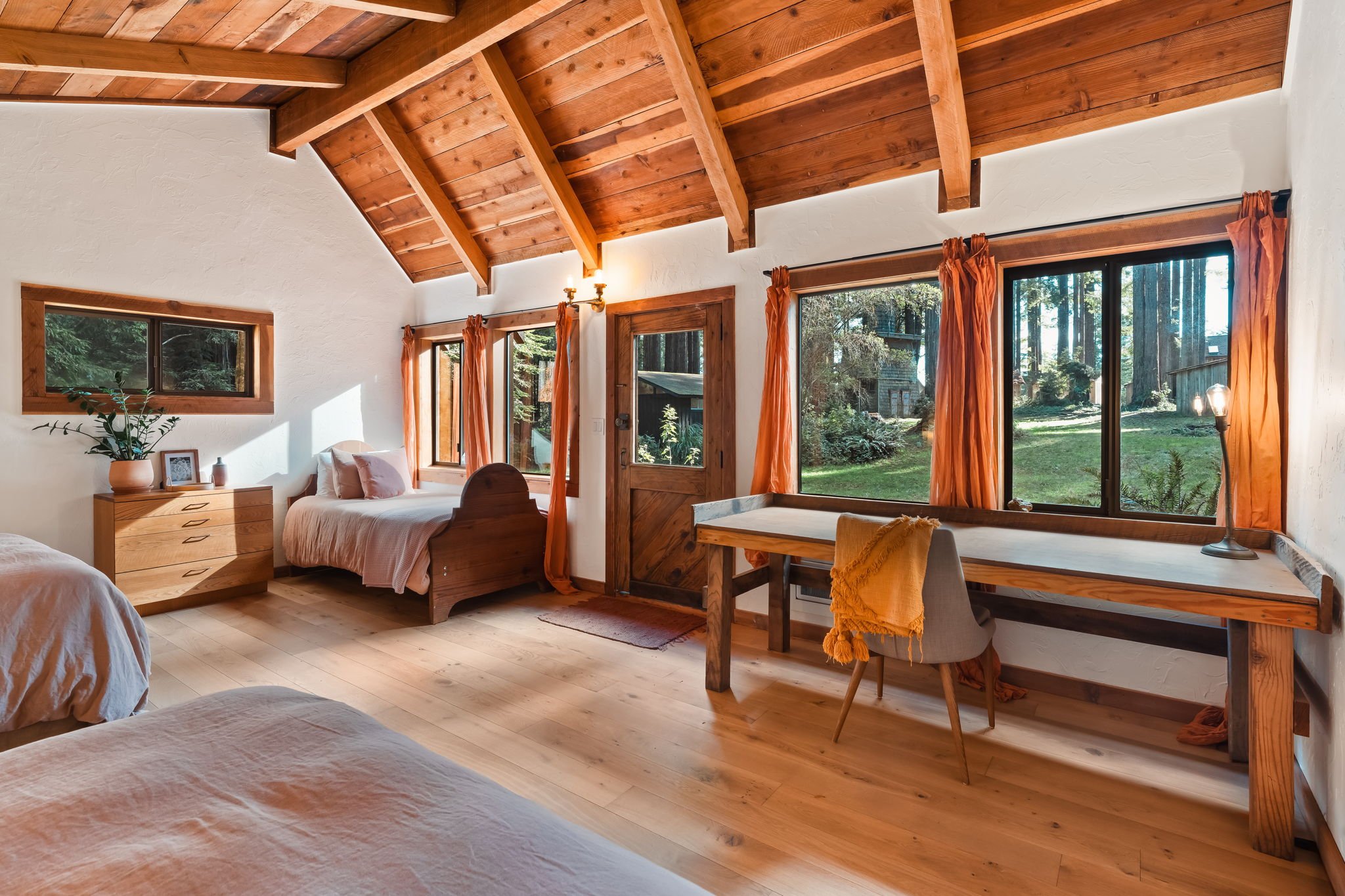
Photo of Deer Haven, one of the our many unique cabin spaces. This cabin has three beds. Cabins have between 1 to 8 beds each and provide several different sleeping arrangements for Yoga and mindfulness retreat. All cabin spaces are included in Restorative yoga retreat California.
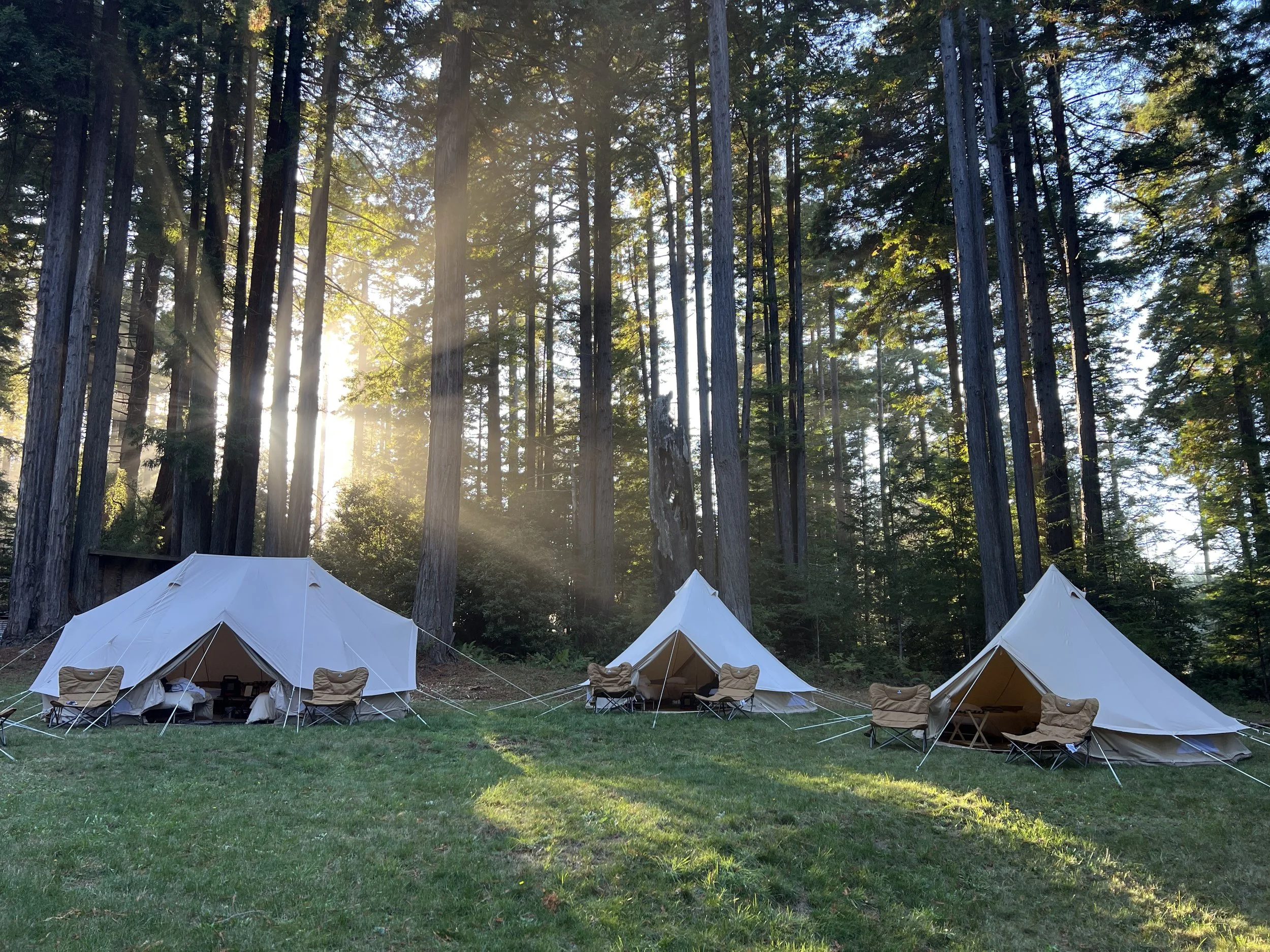
Photo of Group Glamping Tents Setup in Sunset Meadow. We have 10 Glamping Structures that can be added with 1to 3 beds each. This can increase bed capacity of campus to 50 guests across 20 unique accommodation spaces.
Mary Paffard: A Teacher Who Understands the Wisdom of Both Effort and Ease
Four Decades of Experience Shape an Educator Who Honors the Full Spectrum of Practice from Dynamic Flow to Supported Stillness
Mary Paffard's teaching since the mid-1980s has cultivated deep understanding that authentic practice honors the full spectrum from vigorous effort to complete rest, from yang activation to yin receptivity, from doing to being. Her decade directing comprehensive Teacher Training at Yoga Mendocino (2000-2010) required teaching the complete range of methodologies—not just active vinyasa or alignment-focused practices but also restorative approaches, breathwork, meditation, philosophy, and how to skillfully work with students at various stages of health, flexibility, and emotional readiness. This breadth means she doesn't approach practice from dogmatic attachment to one style but rather meets practitioners where they are and guides them toward balance.
Her experience teaching yoga on Vipassana retreats—traditional Buddhist silent meditation retreats—uniquely informs her understanding of the relationship between movement and stillness. Vipassana practice involves long periods of seated meditation (stillness, receptivity, being) alternating with walking meditation and sometimes yoga sessions (movement, activation, doing). This rhythm demonstrates that both dimensions serve the ultimate goal of clear seeing and liberation from suffering—neither is superior, both are necessary. When Mary brings this understanding to her teaching, she honors restorative practice not as "lesser than" active asana but as accessing different and equally valuable dimensions of healing and self-knowledge. Her Buddhist Eco-Chaplain credentials further ground this perspective: contemplative traditions across cultures understand rest as sacred, not lazy, and recognize that deep spiritual insight often emerges from stillness rather than constant activity.
Mary's life on an off-grid collective farm in Mendocino County embodies this balance daily. Working the land requires substantial physical effort—hauling water, tending orchards, managing infrastructure, participating in the manual labor that sustainable living demands. But farm life also includes rhythms of rest built into seasonal cycles, the necessity of pausing during winter when growth slows, the wisdom of lying fallow. This lived experience informs her teaching in ways that purely studio-based teachers might miss—she genuinely understands in her body that health requires both vigorous work and profound rest, that pushing constantly leads to depletion, and that honoring rest isn't indulgence but necessity for long-term sustainability.
The signature elements of Mary's teaching—infusing practice with poetry, imagery, and eco-inquiry—work beautifully in both active and passive practices. During vigorous sequences, poetic imagery might help you access strength or fluidity ("feel your spine as a river of energy"). During restorative holdings, similar invitations support surrender ("imagine your bones heavy as stones sinking into earth, while your breath rises light as morning mist"). The eco-inquiry dimension connects both effort and rest to the natural world: trees demonstrate both reaching toward sunlight (yang, effort) and deep rooting (yin, receptivity); the forest engages constant photosynthesis (activity) while appearing serenely still; tidal rhythms model the necessity of both fullness and emptiness. By weaving these threads throughout all dimensions of practice, Mary helps participants understand rest not as absence or failure but as essential aspect of the cycle that includes growth, effort, harvest, and renewal.
Spirit Camp's Restful Sanctuary: Where Every Space Invites You to Pause, Breathe, and Simply Be
From the Sanctuary's Cozy Floor Cushions to Redwood Grove Hammocks—An Environment Designed for Deep Nervous System Reset
Spirit Camp functions as comprehensive restorative environment where every element supports your nervous system's capacity to downregulate. The Sanctuary exemplifies this design intelligence: created by the late Paul Tay with a copper roof featuring central skylight and 20-foot south-facing windows, this space captures warmth from winter sun and provides abundant natural light year-round—both factors that support circadian rhythm regulation and mood enhancement. The floor is covered with thick cushions, back-jack chairs that support the spine while allowing reclined positions, and soft couches perfect for restorative poses or simply resting between more active sessions. The wood-burning stove provides cozy ambient heat that helps muscles release and creates the kind of safe, warm container that signals to your nervous system that it's okay to rest. When rain falls on the copper roof—a common occurrence in Mendocino—the gentle patter creates natural white noise that many participants describe as profoundly soothing.
The Redwood Lodge offers different but complementary restorative qualities: 1,500 square feet with six skylights ensuring brightness even during fog, a lounge couch where participants can curl up with blankets and journals during breaks, and large communal tables where meals become ceremonies of nourishment and connection rather than rushed refueling. The sauna facilities provide another restorative modality—gentle heat therapy that increases circulation, promotes detoxification through sweating, releases muscle tension, and when alternated with cool-down periods, teaches your system how to regulate between activation and rest. Many participants establish evening sauna rituals, using the heat to process the day's practices and then cooling under star-scattered skies while feeling the Redwood forest's night energy.
Accommodation options support different restorative needs and preferences. Private cabins with oak floors, electric heaters, and cozy bedding offer maximum solitude for introverts who restore best with ample alone time between group sessions. Shared cabins provide middle ground—community without constant interaction. Even the camping options support restoration in their own way: sleeping directly on earth (even through tent floor), hearing night sounds without walls muffling them, waking to bird calls and morning light—for some people, this direct contact with natural elements provides the most profound rest possible. The communal bathhouse facilities, while initially seeming like potential stressor, actually support restoration through simplicity and shared humanity—there's something democratizing and relaxing about releasing the performance of perfection and just being humans with bodies that have needs.
The nourishing vegetarian meals created by chef James Sant using organic, farm-to-table ingredients exemplify nutrition as restorative medicine. The food is designed to be easily digestible—not taxing your system with heavy proteins, inflammatory ingredients, or excessive processing—while providing abundant phytonutrients, fiber, and balanced macronutrients that support steady energy rather than spikes and crashes. Eating together in the Lodge or garden spaces, you're invited to practice mindful eating as restorative act: actually tasting food, noticing textures and flavors, feeling nourishment entering your body, sharing meals with community in unhurried atmosphere. Even the Redwood forest environment itself creates conditions for parasympathetic activation through multiple mechanisms: the phytoncides (organic compounds) that trees release measurably reduce stress hormones and blood pressure, the fractal patterns and visual complexity of forest environments restore attention without depleting it, the natural aromatherapy of Redwood and Douglas Fir scents calm the nervous system, and the simple presence of ancient organisms creates what researchers are only beginning to understand as profound physiological and psychological benefits of time in nature.
Mendocino's Naturally Restorative Landscape: A Healing Environment North of the Bay Area
Three Hours from San Francisco Lies a Geography That Slows Time and Invites Your Nervous System into Deep Repair
Spirit Camp's location in Mendocino County functions as restorative resource in itself—the geography supporting downregulation from the moment you begin the journey north. Situated approximately three hours North of San Francisco, Oakland, San Jose, and other urban Bay Area centers, this distance creates essential psychological separation from work demands, family logistics, and the general intensity of metropolitan life. The drive itself becomes transition: leaving behind freeways and traffic density, winding through increasingly wild landscapes, arriving in a bioregion where human development thins and natural systems dominate. By the time you reach Spirit Camp, your nervous system has already begun shifting—shoulders dropping, breath deepening, the constant low-level vigilance required by city life gradually releasing.
The coastal Redwood ecosystem itself generates inherently restorative qualities. These forests produce exceptional oxygen levels through massive photosynthesis, meaning the air you breathe carries higher oxygen content that supports cellular function, energy production, and mental clarity. The natural aromatherapy of Redwood and Douglas Fir—that distinctive scent you notice immediately upon arrival—contains compounds documented to reduce stress hormones and promote relaxation responses. The filtered sunlight beneath Redwood canopy creates gentle, dappled illumination rather than harsh direct light—easier on eyes and nervous system alike. The constant presence of the forest—its steady, slow growth, its patient cycles, its unhurried rhythms spanning centuries rather than minutes—offers stability and grounding that contrast sharply with the rapid pace and constant change characterizing most contemporary lives.
Spirit Camp's proximity to the Pacific Ocean (just minutes away) adds another restorative dimension. Ocean environments generate high concentrations of negative ions—particularly around breaking waves and surf—that research associates with mood enhancement, mental clarity, and sense of wellbeing. The rhythmic sound of waves provides natural sound therapy that can entrain brain waves toward relaxation states similar to meditation. The expansive ocean views offer the kind of awe experiences that research shows support perspective-taking, reduce self-absorption, and enhance psychological health. Even when you're not directly at the coast, the marine influence moderates temperatures and brings fog that creates the "mystical, witchy" atmosphere many participants describe as perfect for contemplative work.
The environmental conditions further support restoration: clean air free from industrial pollution and urban particulates (better respiratory function, reduced inflammation), minimal light pollution allowing genuine darkness at night (circadian rhythm regulation, improved sleep), low ambient noise compared to cities (reduced stress, enhanced ability to hear subtle sounds), and the general absence of the visual clutter and constant stimulation that depletes attention and energy in developed areas. Accessibility remains straightforward despite the restorative remoteness—major airports including San Francisco International (SFO) and Oakland International (OAK) sit about three hours away, Santa Rosa Airport just two hours distant. The charming town of Mendocino lies only ten minutes from Spirit Camp, providing coffee shops, natural food stores, and coastal access for those wanting to extend their restorative practices through ocean walks. Ready to explore more restorative experiences in this healing landscape? Visit the Spirit Camp retreats calendar to discover additional offerings throughout the year.
Frequently Asked Questions About Restorative Practice at This Retreat
How much of the retreat is restorative versus active yoga?
Mary's retreat thoughtfully balances both dimensions throughout the five days, though the exact ratio varies based on what the group needs and how practices unfold organically. You can expect substantial time in both active asana sessions (building heat, strength, cardiovascular health) and restorative practices (fully supported poses held for extended periods allowing nervous system reset). A typical day might include 60-90 minutes of more vigorous practice in the morning after the period of silence ends, with afternoon or evening sessions incorporating more restorative elements, though this isn't rigid formula. The beauty of Mary's approach is that she reads the group's energy and adjusts accordingly—if everyone seems depleted and wired, more restoration; if the group is sluggish and needs activation, more dynamic practice. Additionally, modifications are always available within any session: if the group is working vigorously and you need rest, you're welcomed to take supported Child's Pose; if the practice is predominantly restorative and you need movement, you can flow gently on your own mat. The emphasis throughout is on honoring what your particular nervous system needs for balance rather than forcing everyone into identical experiences. The five-night duration allows you to experience the full arc from initial activation through deep integration and rest.Do I need special equipment for restorative poses?
Spirit Camp provides the essential props for restorative yoga practice including bolsters, blankets, blocks, and straps—enough equipment that everyone can set up supported poses comfortably. That said, if you have personal items that enhance your restorative experience, you're welcome to bring them: many practitioners travel with a special eye pillow (perhaps lavender-scented or weighted), a favorite blanket that feels like home, or small comfort objects like crystals or essential oils that support their relaxation. Some people find that using their own props creates familiarity that helps them settle more quickly into stillness. However, these personal items are completely optional—you can fully participate in all restorative practices using the provided equipment. If you're flying in and trying to minimize luggage, don't worry about bringing props; if you're driving and have space, feel free to bring items that support your rest. The Sanctuary and Redwood Lodge have ample storage for personal belongings during sessions, so whatever you bring can be kept organized and accessible.Can restorative practice be physically challenging?
Absolutely—though the challenges are quite different from active asana. Restorative yoga doesn't demand flexibility, strength, or cardiovascular endurance; instead, it challenges your capacity to surrender control, to remain still when your mind wants to fidget and move, to face whatever emotions or sensations arise when you're not distracting yourself with activity. Many people discover that holding supported Child's Pose for ten minutes feels harder than flowing through fifty Sun Salutations because the stillness removes all escape routes—you're left with your actual experience, which might include restlessness, boredom, grief that's been pushed down, anxiety that constant activity usually masks, or simply the profound discomfort of doing "nothing" in a culture that equates worth with productivity. Physical challenges can arise too: sometimes deep tissue release brings temporary discomfort as chronic holding patterns let go, or you might encounter the surprising difficulty of allowing your body to be completely supported by props rather than maintaining subtle muscular tension "just in case." Mary's experience and the supportive community help you work skillfully with these challenges—learning to breathe with discomfort rather than immediately escaping, developing capacity to tolerate stillness, and discovering the profound healing that becomes possible when you finally give yourself permission to rest completely.
Two Restful Natural Settings Near Spirit Camp for Continued Restoration
Extend Your Practice of Rest Through Mendocino's Peaceful Beaches and Gentle Trails
Navarro River Redwoods State Park: Riverside Restoration in Ancient Groves
About 30 minutes inland from Spirit Camp along Highway 128, Navarro River Redwoods State Park offers a completely different but equally restorative environment than the coastal setting. This peaceful park features the Navarro River winding through second-growth Redwood groves, with several access points including the Paul Dimmick Campground area that provides easy entry to river beaches perfect for extended rest. Finding a spot by flowing water ranks among nature's most restorative experiences—the constant movement and sound create natural white noise that helps quiet mental chatter, the negative ions generated by moving water enhance mood and mental clarity, and the visual focus on river current can induce meditative states similar to flame-gazing or wave-watching. The water's patient persistence, its ability to gradually shape stone and carve canyons through simple consistency over time, offers powerful metaphor for the kind of gradual transformation that restorative practice supports.
The trails here are gentle and mostly flat, allowing relaxed walking without cardiovascular effort—perfect for extending the restorative quality cultivated during retreat sessions rather than shifting into hiking mode. You might bring a yoga mat or blanket and find a quiet spot for a few supported poses: legs-up-the-tree-trunk instead of legs-up-the-wall, supported reclining on a grassy riverbank, or simply lying back watching Redwood canopy sway overhead while listening to water sounds and bird calls. The forest floor's softness, the dappled light through multiple canopy layers, the cool air even on warm days—all create conditions for continued parasympathetic activation and nervous system rest. Many retreat participants visit Navarro River on a free afternoon, using the excursion as gentle integration practice that maintains the restorative container while offering change of scenery. Pack a light snack, bring water, and allow several hours to truly settle into river time rather than rushing through.
Agate Beach near Bolinas: Sheltered Cove for Oceanside Restoration
About 90 minutes south of Mendocino near the town of Bolinas, Agate Beach offers a relatively secluded coastal setting known for calmer conditions than many North Coast beaches—making it ideal for restorative rather than dramatic ocean experiences. The sheltered cove geography creates gentler wave action compared to exposed headlands, so instead of the powerful crashing surf that can feel activating or even overwhelming, you encounter more rhythmic, soothing waves that support relaxation. The beach's name comes from the smooth agate stones mixed with sand, and many visitors find tide pool observation here to be profoundly restorative practice: moving slowly along rocky outcrops at low tide, peering into small pools teeming with anemones, starfish, hermit crabs, and other marine life requires patience, soft focus, and the kind of sustained attention that quiets mental loops while engaging genuine curiosity.
The restorative potential of simply lying on warm sand or smooth stones, listening to rhythmic waves, and breathing salt air continues the parasympathetic activation cultivated during your retreat while offering a different sensory environment than forest. Ocean air's high negative ion content enhances the mood-boosting and relaxation effects, while the visual expanse of horizon and sky provides the spaciousness that some people need after intensive time in the enclosed Redwood groves. The sound of waves creates natural pacing for conscious breathwork—you might coordinate your inhales and exhales with wave sets, or simply allow the ocean's rhythm to gradually entrain your own breathing and heart rate toward slower, deeper patterns. Many retreat participants visit Agate Beach on their departure morning, using the ocean time as closing ceremony and final restorative practice before returning to everyday life. The combination of forest healing at Spirit Camp followed by oceanside rest at Agate Beach offers complete restoration: earth element grounding and water element cleansing, forest enclosure and ocean expanse, mountain stillness and oceanic flow—all supporting your nervous system's return to balanced, resilient health.
Ready to Experience the Profound Healing That Comes from Honoring Both Effort and Rest?
The transformation available through restorative yoga practice isn't flashy or immediately obvious—you won't post impressive photos of supported Supta Baddha Konasana the way you might of a handstand. But the changes run deeper: a nervous system that finally remembers how to rest, chronic muscle tension that releases after years of holding, the discovery that your worth isn't determined by constant productivity, and the radical recognition that surrender isn't weakness but wisdom. Mary Paffard's Summer Retreat 2026 offers experienced practitioners five nights to explore the full spectrum from vigorous effort to profound rest, guided by a teacher whose four decades of practice inform every instruction.
From active yoga sessions that challenge your edges and build capacity, to restorative practices where you learn the difficult art of doing absolutely nothing, to breathwork and meditation that bridge activity and stillness, to morning silence that allows integration, to nourishing meals and forest walks and fire circles—every element conspires to support both dimensions of health. The ancient Redwoods model this balance themselves: reaching skyward with dynamic growth while simultaneously rooting deeply with patient persistence, demonstrating that true strength includes both effort and receptivity, both doing and being.
Join Mary and the welcoming sangha July 2-7, 2026 for this restorative journey among the Redwoods. Learn more and reserve your space at the Summer Retreat 2026 page, or explore other restorative and healing yoga experiences throughout the year at Spirit Camp Retreats. Your nervous system will thank you.
TOPICS:
Yoga and mindfulness retreat, Restorative yoga retreat California, Gentle yoga retreat Northern California, Yoga restoration retreat Mendocino County, Passive yoga retreat West Coast, Healing yoga retreat North of Bay Area, Yin and restorative retreat, Parasympathetic activation practice, Nervous system healing retreat, Deep rest yoga retreat, North Coast restorative yoga, Supported stillness practice