Eco-Oriented Yoga Retreat on California's North Coast: Where Environmental Consciousness Meets Spiritual Practice
Can your yoga practice become an act of environmental love? At Mary Paffard's Summer Retreat 2026, taking place July 2-7, 2026 (Thursday through Monday) in Mendocino County's coastal Redwood forest, the answer is a resounding yes. This five-night eco-oriented yoga retreat at Spirit Camp explores how deepening your relationship with your own body and breath naturally expands into deeper connection with the living earth. This transformative retreat isn't just located in nature—it actively weaves environmental consciousness into every dimension of the experience, from yoga sessions infused with eco-inquiry to plant-based meals sourced from local organic farms, from morning silence that attunes you to bird calls and rustling leaves to evening fire circles where participants share insights about their place within larger ecological systems. Led by Buddhist Eco-Chaplain Mary Paffard, who lives on an off-grid collective farm and brings four decades of teaching wisdom, this sustainable yoga retreat invites experienced practitioners to explore how contemplative practice and earth-based spirituality support both personal transformation and our collective awakening to environmental responsibility. Discover more eco-conscious experiences throughout the year at the Spirit Camp retreats calendar.
Yoga as Environmental Practice: A Five-Day Eco-Oriented Immersion Among Northern California's Towering Redwoods
How Mary Paffard's Summer Retreat Weaves Ecological Awareness Into Every Breath, Movement, and Moment of Silence
What distinguishes an eco-oriented yoga retreat from simply practicing yoga in a beautiful natural setting? At Mary's Summer Retreat 2026, environmental consciousness isn't an add-on or side theme—it's woven into the fundamental structure of how practice unfolds. Each day includes long asana sessions combining active sequences that build strength and heat with restorative postures that invite deep release, and throughout these practices Mary infuses what she calls eco-inquiry: invitations to notice how the Redwood trees surrounding you model rootedness while remaining flexible, how your breath connects you to the forest's photosynthetic exchange, how the interdependence you cultivate with fellow practitioners mirrors the mycorrhizal networks linking tree root systems beneath the forest floor.
This approach recognizes that we aren't separate observers of nature but rather nature observing itself, and that healing our relationship with the earth begins with healing our relationship with our own animal bodies. The retreat's structure supports this integration beautifully—mornings until lunch are typically held in silence, allowing you to attune to the more-than-human soundscape of raven calls, wind moving through Redwood branches, and the subtle shifts in forest energy as fog burns off to reveal afternoon sun. Daily breathwork practices connect your personal respiration to the larger respiratory system of the forest, while meditation periods invite you to sense yourself as part of the living web rather than standing apart from it.
Mary's background as a Buddhist Eco-Chaplain profoundly shapes her teaching—this isn't intellectual environmentalism but lived ecological spirituality emerging from decades of daily practice both on the mat and in the dirt of her off-grid apple farm collective in Mendocino County. She understands sustainability not as sacrifice but as right relationship, and brings that understanding into how she guides students through challenging poses, facilitates group dynamics, and helps participants notice the countless ways that earth-based awareness enriches every dimension of life. Optional evening offerings include mandala creation workshops that work with natural materials and yoga philosophy discussions exploring ancient wisdom about our place in the natural order.
This retreat continues a 20-year tradition of summer celebrations, with many participants returning annually and newcomers always welcomed into the fold. The community that forms when people gather with shared commitment to both personal growth and environmental responsibility creates remarkable synergy—you'll find yourself inspired by others' dedication, supported in your own exploration, and part of something larger than individual transformation. This isn't a beginner's retreat; it's designed for practitioners with some established yoga foundation who feel comfortable with extended practice periods and silence, and who value the integration of contemplative discipline with ecological awareness. Partial registrations aren't possible—the five full nights allow processes to unfold at their own pace and group bonds to deepen organically.
Located just three hours North of San Francisco, Oakland, and throughout the Bay Area, Spirit Camp offers world-class eco-conscious programming without requiring international travel to distant wellness destinations. This is California's North Coast at its most magical—where ancient Redwoods create microclimates that support exceptional biodiversity, where you can practice earth-based yoga among trees that were saplings when your grandparents were born, where environmental consciousness isn't abstract philosophy but immediate, sensory, transformative reality.
The Intersection of Yoga and Ecology: Ancient Wisdom for Contemporary Environmental Consciousness
Understanding Yoga's Ecological Roots From the Vedic Relationship with Nature to Modern Eco-Dharma Movements
Long before contemporary environmental movements emerged, yoga philosophy articulated profound insights about the interconnection of all life. The ancient Vedic texts that form yoga's foundation express reverence for natural elements—earth, water, fire, air, and space—recognizing them not as resources to be exploited but as sacred manifestations of consciousness itself. The principle of ahimsa (non-harming), often translated simply as nonviolence, extends far beyond human relationships to encompass all living beings and ecosystems. When we understand ahimsa ecologically, it becomes clear that practices causing environmental degradation—whether through overconsumption, pollution, or habitat destruction—fundamentally contradict yoga's ethical foundation, regardless of how flexible or peaceful we become on our mats.
The Yoga Sutras, Patanjali's classical text outlining the eight-limbed path, emphasizes pratipaksha bhavana—the practice of cultivating opposite thoughts when caught in harmful patterns. Applied to our environmental crisis, this principle suggests that when we notice ourselves slipping into despair, disconnection, or destructive consumption, we can intentionally cultivate awareness of our belonging to the earth, our capacity for regenerative action, and the resilience of both human communities and natural systems. The eco-oriented approach recognizes that personal liberation and ecological healing aren't separate projects but dimensions of the same awakening—as we free ourselves from the illusion of separation, we naturally act with greater care for all life.
Contemporary eco-yoga and eco-dharma movements have made these connections explicit, with teachers and activists demonstrating how contemplative practice supports environmental awareness and action. Concepts like "interbeing"—coined by Buddhist teacher Thich Nhat Hanh—articulate the reality that nothing exists independently; you literally breathe air that trees exhale, drink water that's cycled through countless organisms, and consist of elements forged in ancient stars. Your body is ecosystem, your breath is exchange, your life is relationship. When this understanding moves from intellectual concept to embodied knowing—which happens through sustained practice rather than thinking alone—it naturally shifts how you make choices, what you value, and how you participate in collective life.
<u>Eco-oriented yoga</u> practices invite this shift through various doorways: nature-basedmeditation that develops intimate familiarity with local ecosystems, asana sequences that mimic animal movements and plant forms, breathwork that connects personal respiration to photosynthesis and ocean currents, and philosophy discussions that explore how ancient wisdom addresses contemporary environmental challenges. Mary Paffard's approach brings all these elements together while grounding them in the actual landscape of Mendocino's coastal Redwood forest—you're not just learning concepts about interconnection but directly experiencing it as you practice among trees whose root systems share nutrients, observe banana slugs recycling forest detritus, and notice how your own nervous system responds to the forest's particular energetic signature. Explore contemporary eco-dharma perspectives on the integration of spiritual practice and environmental action.
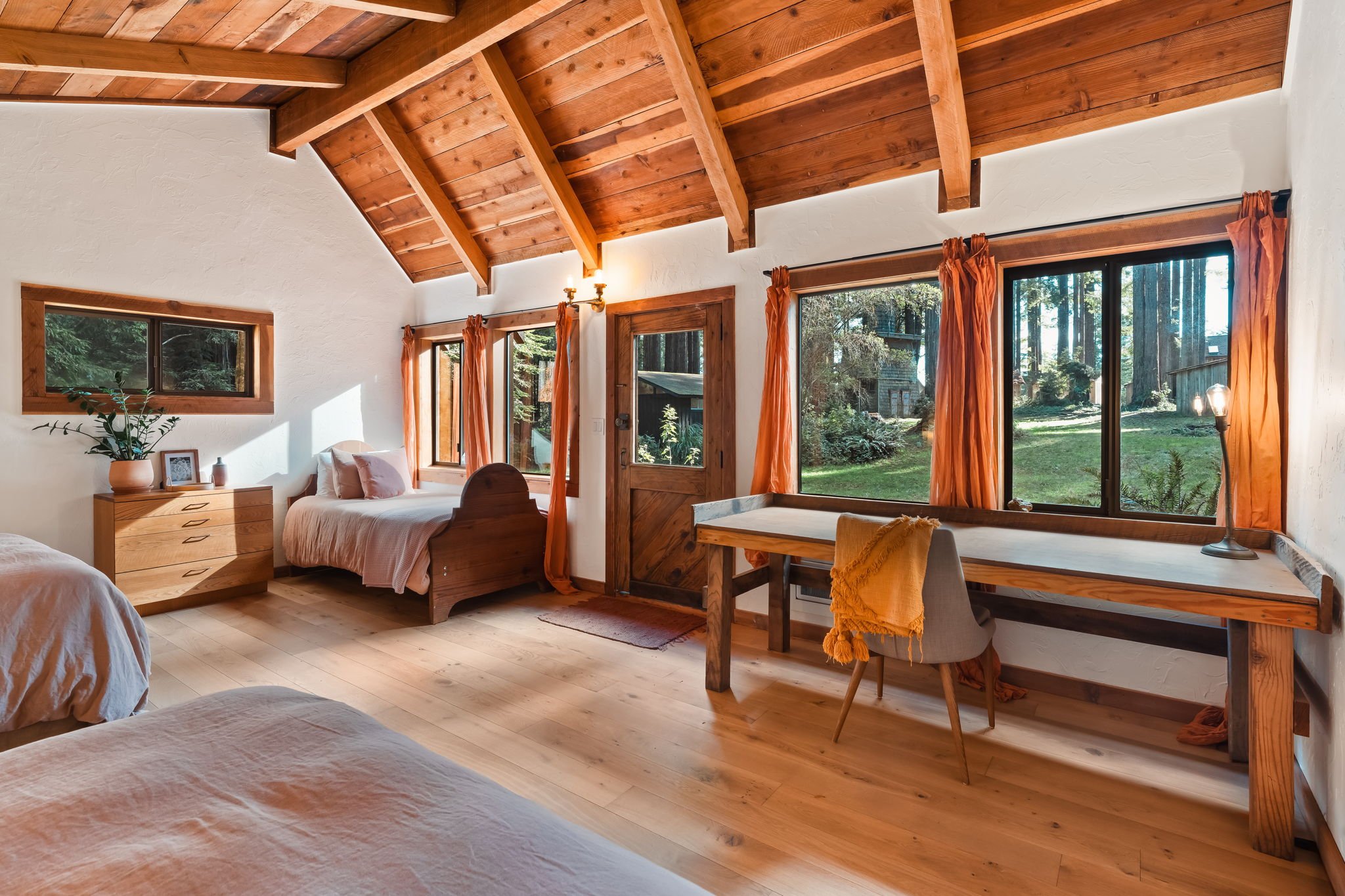
Photo of Deer Haven, one of the our many unique cabin spaces. This cabin has three beds. Cabins have between 1 to 8 beds each and provide several different sleeping arrangements for Eco-oriented yoga retreat. All cabin spaces are included in Sustainable yoga retreat California.
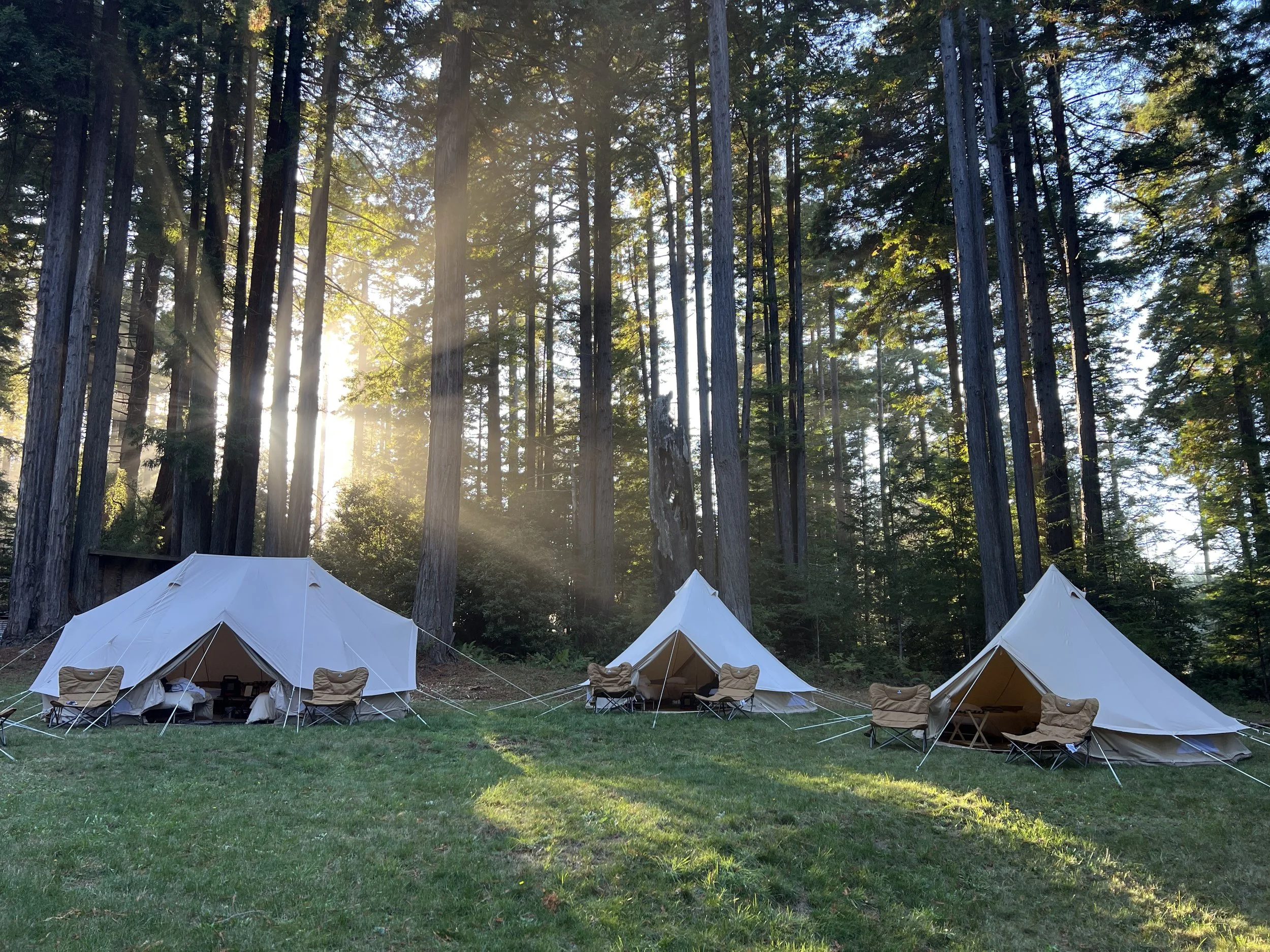
Photo of Group Glamping Tents Setup in Sunset Meadow. We have 10 Glamping Structures that can be added with 1to 3 beds each. This can increase bed capacity of campus to 50 guests across 20 unique accommodation spaces.
Mary Paffard: Buddhist Eco-Chaplain and Off-Grid Practitioner
A Teacher Whose Four-Decade Journey From International Studios to an Apple Farm Collective Embodies Ecological Living
Mary Paffard's identity as a Buddhist Eco-Chaplain isn't a credential she holds alongside her yoga teaching—it's the lens through which she understands practice itself, the foundation informing how she moves through the world. Since the mid-1980s, she's been developing an approach that refuses to separate contemplative discipline from ecological responsibility, personal healing from collective care for the earth, or spiritual insight from the gritty work of actually living sustainably. Her decade serving as Director of Teacher Training at Yoga Mendocino (2000-2010), the nonprofit studio she co-founded, established her as a significant voice in Northern California's yoga community, while her ongoing contributions to training programs throughout California, Mexico, and Costa Rica have spread her earth-based approach to hundreds of teachers who now carry forward this integration in their own communities.
What makes Mary's teaching particularly authentic is how her life and practice interweave. She lives on a collective off-grid apple farm in Mendocino County—not as a weekend retreat from urban life, but as daily reality involving tending orchards, managing solar power systems, participating in cooperative decision-making, and navigating the challenges that arise when you choose to live lightly on the land. This isn't romanticized simplicity; it's the actual work of aligning actions with values, making countless small choices that prioritize ecological integrity over convenience, and discovering how much richness emerges when you slow down enough to notice the seasonal rhythms, the soil's needs, the weather's patterns. When Mary teaches about interdependence or sustainable living or our belonging to the earth, she speaks from embodied knowledge rather than abstract philosophy.
Her volunteer work leading educational exchanges with yoga and meditation groups in Cuba since 1998 (through Yogava, yogava.org) demonstrates another dimension of her eco-oriented practice—the recognition that grassroots, community-based approaches often model more sustainable and equitable relationships than top-down interventions. These exchanges bridge political divides while honoring Cuban practitioners' creativity in maintaining practice under conditions of scarcity, offering profound lessons about resilience, resourcefulness, and what truly matters. Mary teaches yoga on Vipassana retreats, bringing the precision of meditation awareness into physical practice and the embodied intelligence of asana into sitting practice, creating seamless integration that serves practitioners at all levels.
She currently limits herself to just three in-person retreats annually, with this summer gathering at Spirit Camp being her most cherished offering—the one that allows her to work with a dedicated community in the Redwood forest setting that so perfectly mirrors the principles she lives by. Participants often comment on Mary's genuine embodiment of what she teaches: she's not performing ecological consciousness or adopting it as trendy packaging, but genuinely lives from the understanding that we are nature, that our wellbeing depends on the earth's wellbeing, and that contemplative practice naturally flowers into care for all life. Her presence as an "active grandma" who brings decades of practice, lived wisdom, and authentic commitment to both personal and planetary healing offers rare medicine in a world full of environmental lip service but short on the patient, long-term dedication that real change requires.
Spirit Camp's Commitment to Sustainability: An Ecologically Conscious Sanctuary in the Redwood Forest
From Plant-Based Meals and Communal Living to Forest Stewardship and Low-Impact Accommodations
Spirit Camp operates from explicit commitment to maintaining what they describe as an "ecologically sustainable, safe and inspiring environment"—words that translate into practical choices at every level of operation. The food served during Mary's retreat exemplifies this ethos: simple, nourishing vegetarian cuisine created by local chef James Sant (plantfoodculinary.com) using organic, farm-to-table ingredients sourced from Mendocino County producers. This plant-based approach significantly reduces the retreat's environmental footprint compared to meat-centered meals while supporting local food systems, shortening supply chains, and ensuring participants taste the terroir of this particular place. The meals aren't ascetic or punishing—they're genuinely delicious, thoughtfully prepared, and designed to support the physical demands of practice without weighing you down or requiring digestive energy better directed toward inner work.
Accommodation options reflect similar environmental consciousness. The most low-impact choice involves bringing your own tent and camping in designated areas like Sunset Meadow—minimal infrastructure, maximum connection to the elements, and the satisfaction of knowing your presence leaves barely a trace. Glamping setups available May through October offer slightly more comfort while maintaining the camping ethos, using well-designed canvas structures with plush bedding but no permanent construction. Shared cabins allow multiple people to utilize the same built space and resources, while private cabins provide more solitude when that serves someone's needs—and even these feature thoughtful design with natural materials, electric heaters rather than fossil fuel systems, and careful attention to energy efficiency through excellent insulation and strategic placement of windows for passive solar gain.
The communal bathroom facilities, rather than being a compromise, actually embody sustainable principles: sharing five toilets and four showers among retreat participants conserves water and energy compared to individual en-suite bathrooms, while the renovations balance modern comfort with resource efficiency. There's something democratizing and humanizing about the shared bathhouse experience—it breaks down the isolation and perfectionism that often characterize contemporary life, reminding us that we're animals with bodies that have needs, and that meeting those needs communally rather than individually can actually feel more connected and authentic. The wood-burning stoves that heat gathering spaces use sustainable forestry byproducts, while extensive skylights and south-facing windows in both the Sanctuary and Redwood Lodge maximize natural light, reducing electrical demand even during Mendocino's foggy seasons.
Spirit Camp stewards 27 acres of second-growth Redwood forest, fern gullies, and ephemeral streams, with adjacency to hundreds of undeveloped acres that ensure wildlife corridors and ecological continuity. The hosts approach land management with reverence rather than domination—maintaining trails for human access while protecting sensitive habitats, allowing natural succession processes to unfold, and making decisions that prioritize long-term ecological health over short-term convenience. The gardens designed to attract pollinators—honeybees, hummingbirds, butterflies, bats, moths—demonstrate how human cultivation can support biodiversity rather than diminishing it, mixing native species with well-adapted non-natives and deer-resistant plants that thrive without pesticides or excessive water inputs. This eco-conscious retreat center models what sustainable operations actually look like: not perfect or purist, but thoughtful, adaptive, and genuinely committed to minimizing harm while maximizing benefit for both human and more-than-human communities.
Mendocino's Unique Coastal Redwood Ecosystem: A Biodiversity Hotspot North of the Bay Area
Discover California's Endangered Old-Growth Forest Remnants and Thriving Second-Growth Communities
Spirit Camp's location within Mendocino County's coastal Redwood ecosystem places you in one of Earth's most remarkable ecological contexts. Coast Redwoods (Sequoia sempervirens) rank among the planet's tallest living organisms, with mature specimens reaching over 350 feet—heights that create dramatic vertical structure supporting exceptional biodiversity. The Redwood canopy hosts its own distinct community of ferns, lichens, and salamanders that never touch the ground, while mid-story layers provide nesting sites for endangered northern spotted owls, marbled murrelets, and countless other bird species. The forest floor, perpetually shaded and moisture-rich even during California's dry summers, supports lush understories of sword ferns, redwood sorrel, trillium, and fungi of astounding variety—golden chanterelles, boletes, and delicate mycorrhizal species that form symbiotic relationships with tree roots.
These Redwood forests function as keystone ecosystems—their presence enables the existence of countless other organisms that couldn't survive without the particular conditions Redwoods create. The trees' thick, fire-resistant bark allows them to survive periodic wildfires that actually benefit forest health by clearing understory competition and releasing nutrients. Their shallow but extensive root systems, often intertwined with neighboring trees in family groupings, stabilize steep slopes and prevent erosion while efficiently capturing the fog drip that provides significant moisture during summer months. When you walk Spirit Camp's private trails, you're moving through a living system of extraordinary complexity where every organism participates in cycles of nutrient exchange, energy transfer, and mutual support—a visceral demonstration of the interdependence that yoga philosophy describes.
The coastal influence creates microclimates within the Mendocino Redwood forests that shift dramatically across short distances—Magic Meadow's sunny clearings support entirely different plant communities than the dense, shaded groves just yards away, while ephemeral streams create riparian corridors where water-loving species thrive. You might encounter banana slugs in their various color morphs (green, yellow, brown, spotted) serving as essential decomposers, ravens and Steller's jays calling from the canopy, deer browsing in meadow edges at dawn or dusk, or the distinctive drumming of pileated woodpeckers excavating nest cavities in snags. Each observation opportunity invites the kind of attentive presence that meditation cultivates—slowing down enough to notice, care enough to wonder, stay present enough to let relationship form.
Located approximately three hours North of San Francisco, Oakland, San Jose, and the broader Bay Area, this biodiversity hotspot remains surprisingly accessible from major Northern California airports including SFO, Oakland International, and Santa Rosa (just two hours distant). Just ten minutes from Spirit Camp, the town of Mendocino offers coastal access where dramatic headlands meet the Pacific, providing opportunities to observe marine ecological communities—tide pools teeming with anemones and sea stars, kelp forests visible from shore supporting diverse fish populations, seasonal whale migrations that demonstrate the epic journeys creatures undertake through our shared oceans. The broader Mendocino County region protects some of California's last remaining old-growth Redwood stands alongside recovering second-growth forests like those surrounding Spirit Camp, offering hope that with care and time, these ecological treasures can persist for generations to come. Explore more earth-based experiences in this remarkable ecological setting at the Spirit Camp retreats calendar.
Frequently Asked Questions About This Eco-Conscious Yoga Experience
What makes this retreat eco-oriented beyond just the forest setting?
The eco-oriented dimension of Mary's retreat operates at multiple levels beyond simply being located in beautiful nature. First, Mary's teaching actively infuses eco-inquiry into yoga practice itself—she might invite you to observe how Redwood trees model resilience and adaptation, to notice how your breath connects you to the forest's photosynthetic exchange, or to explore what embodied interdependence feels like when you're moving in relationship with both other practitioners and the living landscape surrounding you. As a Buddhist Eco-Chaplain who lives on an off-grid collective farm, Mary brings lived ecological wisdom to her teaching rather than just intellectual concepts—she genuinely understands sustainable living and helps participants explore how contemplative practice naturally deepens environmental consciousness. Second, Spirit Camp itself operates with environmental responsibility as a core value, from plant-based organic meals that support local food systems to sustainable accommodation options to thoughtful land stewardship practices. Third, the retreat creates space for conversations about the relationship between inner work and outer ecological action, recognizing that personal transformation and environmental healing aren't separate pursuits but dimensions of the same awakening. The integration of these elements—eco-conscious teaching, sustainable operations, and explicit exploration of how contemplative practice supports environmental awareness—makes this genuinely eco-oriented rather than simply nature-adjacent.Are the meals organic and locally sourced?
Yes, chef James Sant creates the retreat's vegetarian cuisine using organic, farm-to-table ingredients sourced primarily from Mendocino County producers. This commitment to local, sustainable food systems reduces the environmental impact of transportation while supporting regional farmers and ensuring meals reflect the seasonal abundance of this particular place. The plant-based focus significantly lowers the carbon footprint compared to meat-centered menus while aligning with yoga's principle of ahimsa (non-harming) and the retreat's broader ecological values. James's cooking emphasizes whole foods that are both nourishing and easy to digest—important when you're engaged in intensive physical practice and don't want meals that make you feel sluggish or heavy. If you have specific dietary requirements beyond vegetarian (vegan, gluten-free, allergies), you're encouraged to communicate these to your retreat facilitator early in the registration process so accommodations can be made. The kitchen can work with virtually any dietary need given sufficient notice, ensuring everyone can fully participate in the communal meals that form such an important part of the retreat experience.What kind of wildlife might I encounter during the retreat?
Spirit Camp's Redwood forest ecosystem supports remarkable biodiversity, and you'll likely encounter various species during your stay. Banana slugs are perhaps the most visible—these remarkable hermaphroditic mollusks come in different color variations (green, yellow, brown, spotted) and play essential roles as decomposers, breaking down fallen leaves and returning nutrients to the soil. The bird life is exceptional: ravens and Steller's jays frequent the canopy, hummingbirds visit flowering plants in gardens and meadows, and the forest hosts endangered northern spotted owls whose distinctive calls you might hear at dusk or dawn. Pileated woodpeckers, acorn woodpeckers, and various songbird species also inhabit the area. Deer occasionally browse in meadow edges during early morning or evening hours. Less commonly observed but present in the broader ecosystem are river otters in nearby waterways, and very occasionally bobcats or gray foxes moving through the forest. The retreat encourages respectful observation—watching from distance without disturbing animals' natural behaviors, moving quietly on trails, and approaching wildlife encounters as opportunities for the kind of attentive presence that meditation cultivates. Your yoga practice will attune you to notice subtle movements and sounds, potentially revealing wildlife presence you might otherwise miss.
Two Ecological Treasures Near Spirit Camp Worth Exploring
Deepen Your Environmental Connection Through Mendocino's Protected Natural Areas
Mendocino Coast Botanical Gardens: Celebrating Plant Biodiversity and Sustainable Horticulture
Just south of Mendocino town, the Mendocino Coast Botanical Gardens sprawls across 47 acres of coastal bluff and canyon, showcasing an extraordinary collection of plants from around the world alongside native California species. This living museum demonstrates how thoughtful horticulture can celebrate biodiversity while maintaining sustainable practices—the gardens use organic methods, capture rainwater, create habitat for pollinators and beneficial insects, and educate visitors about the importance of plant conservation in our rapidly changing world. Walking the gardens' winding paths, you move through distinct microclimates and themed areas: a rhododendron collection exploding with color in spring, Mediterranean plantings demonstrating drought-adapted beauty, native plant sections highlighting California's botanical treasures, and ornamental displays that inspire home gardeners to cultivate more ecologically.
The coastal bluff trail that runs through the gardens offers spectacular ocean views and seasonal whale watching opportunities—gray whales migrate south November through January and return north March through May, while humpback whales feed in nearshore waters throughout summer and fall. This combination of cultivated beauty and wild coastline creates perfect conditions for extending the eco-oriented awareness developed during your retreat—you might practice walking meditation along garden paths, observe how different plant families have adapted to coastal conditions, or simply sit on a bench overlooking the Pacific while integrating insights from your time at Spirit Camp. The gardens also host educational programs about native plant restoration, sustainable gardening techniques, and the ecological relationships between plants and their pollinators—topics that deepen the understanding of interdependence that Mary emphasizes in her teaching. Consider visiting early morning when the gardens open to experience the space in relative solitude, allowing for contemplative observation of how light moves through different plant structures and how morning fog creates its own microclimate on the coastal bluff.
Big River Estuary and State Park: Witnessing Thriving Ecological Communities in a Protected Watershed
Big River represents one of California's last remaining undeveloped river mouths—a rare ecological treasure where freshwater meets saltwater, creating the brackish conditions that support exceptional biodiversity. The estuary and its watershed, now protected as a state park, offer a counterpoint to the more common story of California waterways degraded by development, demonstrating what thriving ecological communities look like when given space to function without human interference. The river system supports populations of harbor seals that haul out on sandbars to rest and birth pups, river otters that play in the shallows and hunt for fish, and over 90 bird species including great blue herons, egrets, ospreys, and countless migrating waterfowl that use the estuary as crucial stopover habitat.
The best way to experience this ecological wonder involves kayaking or canoeing—rentals are available in Mendocino town, and the calm waters make the estuary accessible even for beginners. Paddling quietly upstream, you become part of the ecological community rather than observing from outside: you notice how the water's salinity creates distinct vegetation zones, observe fish jumping and birds diving, hear the calls of seals echoing off the water, and feel how your own breathing synchronizes with the rhythm of paddling. This non-motorized, low-impact exploration perfectly extends the eco-oriented principles of your retreat—moving through the landscape with attention and respect, minimizing disturbance, allowing yourself to be present with what unfolds rather than forcing predetermined experiences. The tidal fluctuations create constantly changing conditions, with different aspects of the estuary visible at high versus low tide—a reminder of the dynamic, ever-shifting nature of ecological systems and the importance of timing and patience in observation. Many retreat participants choose to paddle Big River on their final day, using the quiet time on the water to reflect on their week's experiences and set intentions for how they'll carry ecological awareness back into their daily lives. The combination of physical activity, natural beauty, and opportunities for both solitude and wildlife observation makes this pristine watershed a perfect conclusion to an eco-oriented yoga retreat that has been training your attention, deepening your presence, and reconnecting you to your place within the larger web of life.
Ready to Deepen Both Your Practice and Your Connection to the Earth?
Environmental consciousness and spiritual practice aren't separate pursuits—they're dimensions of the same awakening to our fundamental interconnection with all life. Mary Paffard's Summer Retreat 2026 offers experienced practitioners five nights to explore this integration in depth, guided by a Buddhist Eco-Chaplain whose four decades of teaching and decades of sustainable living inform every instruction. From yoga sessions infused with eco-inquiry to plant-based meals supporting local food systems, from morning silence that attunes you to the forest's rhythms to evening discussions exploring how contemplative practice supports environmental awareness, this eco-oriented retreat delivers transformation rooted in the recognition that we are nature, not separate from it.
The ancient Redwoods of Mendocino County model the resilience, interdependence, and patient growth that our world urgently needs. The sustainable operations at Spirit Camp demonstrate that ecological responsibility doesn't mean deprivation but rather right relationship and genuine care. The community of practitioners who gather for this beloved summer tradition creates a supportive container where personal growth and planetary healing intertwine naturally. Whether you're seeking to deepen your understanding of yoga's ecological roots, develop practical skills for sustainable living, or simply spend five days in intimate relationship with one of Earth's most remarkable ecosystems while being guided by a master teacher, this retreat offers rare medicine for both personal and collective transformation.
Join Mary and the welcoming sangha July 2-7, 2026 at this eco-conscious sanctuary on California's North Coast. Learn more and reserve your space at the Summer Retreat 2026 page, or explore other earth-based experiences throughout the year at Spirit Camp Retreats. The forest is calling—will you answer?
TOPICS:
Eco-oriented yoga retreat, Sustainable yoga retreat California, Environmental yoga retreat Northern California, Earth-based yoga retreat Mendocino County, Eco-conscious retreat West Coast, Nature-based yoga retreat, Green yoga retreat California coast, Ecological consciousness yoga, Plant-based retreat, Environmental awareness practices, North Coast California retreat, Biodiversity hotspot yoga