Retreat for Self-Reflection with Movement and Mindfulness on California's North Coast
When did you last pause long enough to truly reflect on who you're becoming? Not the hurried self-assessment squeezed between meetings, not the anxious 3am rumination that spirals without resolution, but genuine self-reflection—curious, compassionate inquiry into who you are now, what you truly want, whether your life aligns with your values. Modern life keeps us constantly moving, doing, achieving, responding. Yet without regular reflection, we risk living on autopilot—making decisions based on outdated patterns rather than current truth, saying yes to commitments we've outgrown, pursuing goals that no longer resonate, becoming strangers to ourselves.
The Catalyst Retreat, taking place April 16-19, 2026, at Spirit Camp in Mendocino County, California, offers women something increasingly rare: dedicated time and structured support for the kind of deep self-reflection that actually changes how you live. This self-reflection retreat California experience isn't navel-gazing or self-indulgence—it's essential practice for living intentionally. Through the Connect-Claim-Calibrate framework, you'll reflect on your patterns and their origins (How did I become who I am?), your present reality (Who am I now? What brings me alive?), and your becoming (Who am I growing into? What do I want to create?). The modalities woven throughout—curated coaching exercises that spark insight, guided visualizations inviting intuitive knowing, movement and mindfulness sessions cultivating embodied self-awareness, yoga creating space between thoughts for clarity to emerge, breathwork accessing non-verbal wisdom, nature walks providing reflective solitude, and group sharing offering mirrors—create comprehensive conditions for knowing yourself more deeply. Facilitated by Harvard-trained coaches Christine Raschke and Monique Pearson, this contemplative retreat women North of San Francisco is limited to 14 participants. Discover this and other reflective experiences at Spirit Camp's retreat calendar.
The Gift of Reflection: Creating Space to Know Yourself More Deeply
Why Self-Reflection Requires More Than Occasional Journaling—The Power of Dedicated Time, Structured Practice, and Supportive Community
The paradox of contemporary life is that we've never had more information about ourselves—fitness trackers monitoring our steps and sleep, social media showing us who we present to the world, personality assessments categorizing our types, endless content about self-improvement and optimization—yet many of us feel increasingly disconnected from genuine self-knowledge. We know our metrics but not our meaning. We understand our patterns intellectually but struggle to shift them. We can describe who we should be but have lost touch with who we actually are beneath the adaptations, the performance, the endless doing.
Self-reflection creates the space between stimulus and response where conscious choice becomes possible. Without it, we're reactive—automatically following the grooves of habit, responding from conditioning rather than consciousness, living someone else's definition of a good life rather than discovering our own. Viktor Frankl wrote that between stimulus and response there is a space, and in that space is our power to choose our response. Self-reflection is the practice of expanding that space, of noticing your automatic reactions before you're swept away by them, of seeing your patterns clearly enough to decide whether to continue or shift them.
The Catalyst Retreat structures three nights specifically for this essential work through its deliberate framework. The Connect phase invites reflection on your patterns and their origins: How did I become who I am? What experiences shaped me? What beliefs did I absorb from family, culture, early relationships? What coping mechanisms served me once but constrain me now? This archaeological dig into your own becoming isn't about assigning blame but about understanding with compassion how you've adapted, what you've been carrying, and what might be ready to release. Many women arrive with vague dissatisfaction—"something feels off"—and through structured reflection gain precise understanding of what specifically needs to shift.
The Claim phase supports reflection on your present reality: Who am I now, separate from who I was or who others expect me to be? What do I genuinely value when I stop performing for others' approval? What brings me alive versus what drains me? What capacities have I developed that I'm not fully recognizing? What desires have I been suppressing as impractical or selfish? This present-moment reflection is perhaps most challenging because it requires honesty about gaps—between who you present and who you are, between what you say matters and where you actually invest time and energy, between the life you're living and the life that's calling you.
The Calibrate phase facilitates reflection on your becoming: Who am I growing into? What wants to emerge through me? What do I want to create in this next chapter? What practices will support my evolution? What changes need to happen for my life to align with my truth? This future-oriented reflection isn't fantasy or wishful thinking but grounded visioning based on the self-knowledge gained through Connect and Claim phases. You're not imagining becoming someone else; you're clarifying the next iteration of yourself.
Multiple modalities throughout this mindfulness retreat Mendocino County experience support different types of reflection. Curated coaching exercises use powerful questions that cut through surface answers to core truth—not "What do you do?" but "Who are you when you're not doing anything?" Guided visualizations invite symbolic and intuitive knowing beyond rational analysis—accessing wisdom that doesn't speak in words but in images, sensations, and felt sense. Movement and mindfulness sessions cultivate embodied self-awareness—noticing how you hold your body, where tension lives, how you move through space, what your body knows that your mind hasn't articulated. Yoga creates literal and figurative space between thoughts, allowing clarity to emerge in stillness. Breathwork accesses non-verbal emotional and somatic wisdom held in your tissues and nervous system. Nature walks in the redwood forest provide reflective solitude where insights arrive unbidden. And group sharing offers the irreplaceable gift of being witnessed—seeing yourself reflected in others' responses, discovering how you're perceived, recognizing patterns you couldn't see alone.
Your comprehensive container for reflection includes three nights at Spirit Camp where the quiet redwood forest naturally induces contemplative states, organic vegetarian meals that nourish without overstimulating, spacious scheduling that balances guided practices with unstructured reflection time, small group size of 14 maximum allowing depth over breadth, pre-retreat 1:1 coaching to begin the reflective process before you arrive, and post-retreat integration to continue applying insights when you return to daily life.
Mindfulness and Movement: Embodied Practices for Self-Awareness
Why Reflection Requires Body Awareness—Integrating Mind, Sensation, and Emotion for Complete Self-Understanding
Mindfulness has become a buzzword in wellness culture, sometimes diluted to mere stress reduction or productivity enhancement. But at its essence, mindfulness is the practice of paying attention to present-moment experience with curiosity and without judgment. Rooted in Buddhist meditation traditions spanning 2,500 years and adapted into secular practices used in psychology, education, and personal development, the core remains: developing capacity to observe your own thoughts, emotions, sensations, and reactions without being swept away by them. This observing capacity is fundamental to meaningful self-reflection—you cannot reflect on what you don't notice, and you cannot change what you cannot see.
Mindful movement represents a specific practice combining physical activity with present-moment awareness. Unlike exercise focused on achieving physical goals (strength gains, flexibility improvements, weight loss), mindful movement uses physical activity as a vehicle for self-awareness. You might move slowly and deliberately, noticing how each gesture feels in your body. You might explore unfamiliar movements to discover habitual patterns you'd never consciously recognized. You might dance freely to access emotional expression that words cannot capture. The movement becomes a practice field for noticing: How do I respond to physical challenge? Where do I habitually hold tension? What does freedom feel like in my body? Do I move rigidly when trying to control outcomes, or can I find ease even in effort?
Why does embodied reflection matter beyond mental reflection? Cognitive reflection, while valuable, can only access what you consciously know and can articulate in language. Much of your self—your fears, desires, patterns, trauma responses, creativity, intuition—lives in your body at pre-verbal, subconscious levels. Your mind might tell one story while your body tells another. You might say "I'm fine" while your shoulders are up by your ears, your jaw is clenched, your breath is shallow. Mindful movement and somatic practices help you notice and reflect on these embodied dimensions of self that thinking alone cannot reveal.
Through movement and body awareness, you might discover that you habitually hold your breath when facing uncertainty—a pattern of literally not allowing yourself to receive support (breath) when you need it most. You might notice that you collapse your chest when feeling vulnerable—a protective mechanism that worked once but now prevents you from showing up fully. You might recognize that you move with rigid control when anxious—trying to manage outcomes through physical tension that actually limits your effectiveness. These embodied insights inform your self-understanding far beyond what pure cognition could access, revealing not just what you think but how you actually live in and through your body.
At this movement retreat Northern California, Christine and Monique integrate mindfulness and movement throughout the weekend in ways that deepen your reflective capacity. Yoga sessions invite you to notice habitual movement patterns and experiment with alternatives—what happens if you soften where you usually tense, or engage where you usually collapse? Breathwork helps you reflect on how you regulate (or dysregulate) your emotional states—do you breathe shallowly to avoid feeling, or can you breathe fully even through discomfort? Movement and mindfulness sessions are designed specifically for embodied self-exploration—dancing freely, moving slowly, noticing impulses and resistances without judgment. Walking meditations in the redwoods combine natural beauty with contemplative practice—the rhythm of walking, the sensory richness of forest, the solitude allowing your own thoughts and feelings to surface. Coaching exercises weave together cognitive reflection and somatic awareness—not just "What do you want?" but "Where do you feel that wanting in your body? What happens in your body when you imagine having it?" The result is comprehensive self-reflection engaging your whole being—mind, body, emotion, and spirit. Learn more about mindfulness practices at Mindful.org.
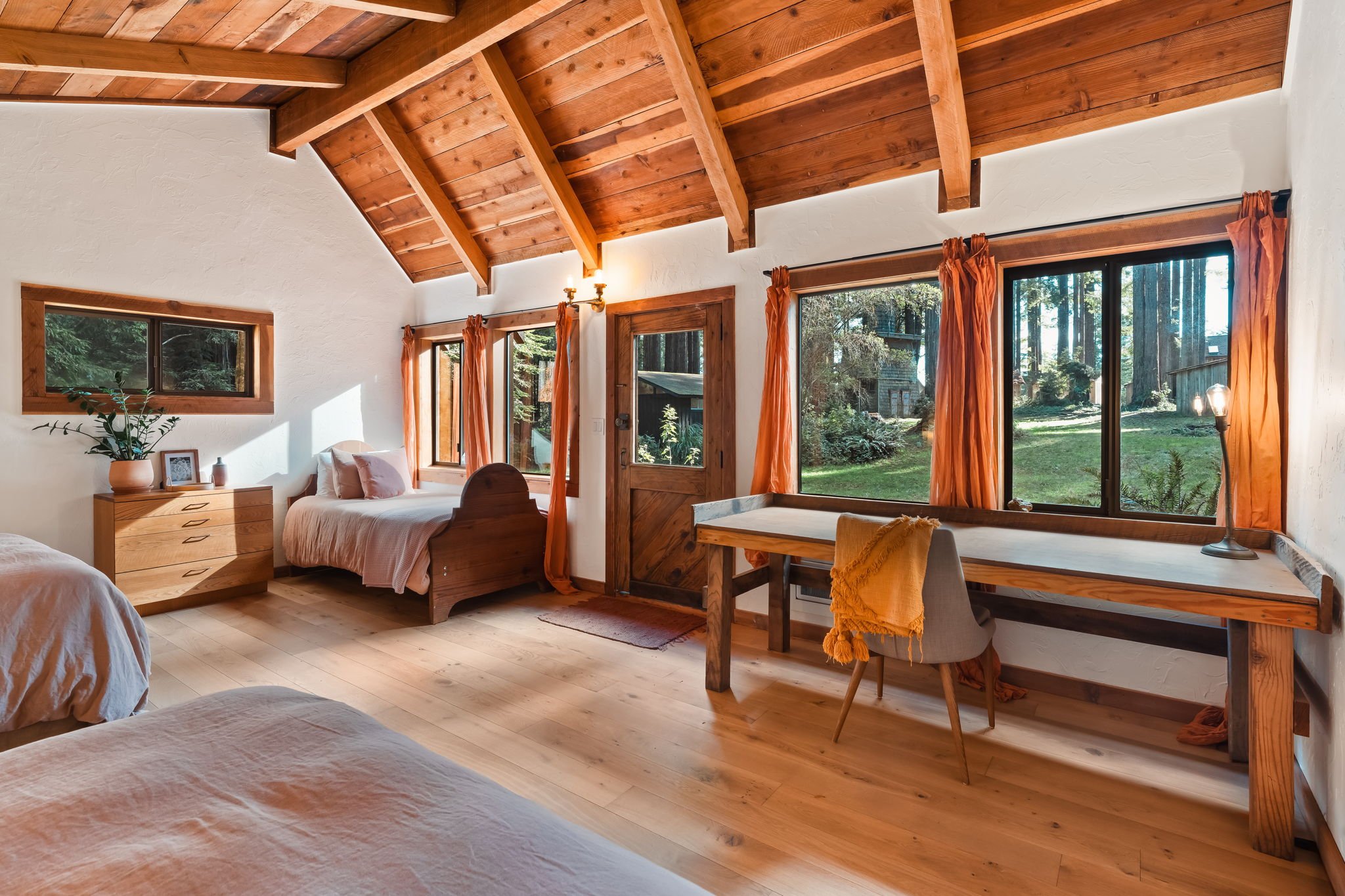
Photo of Deer Haven, one of the our many unique cabin spaces. This cabin has three beds. Cabins have between 1 to 8 beds each and provide several different sleeping arrangements for retreat for self-reflection. All cabin spaces are included in self-reflection retreat California.
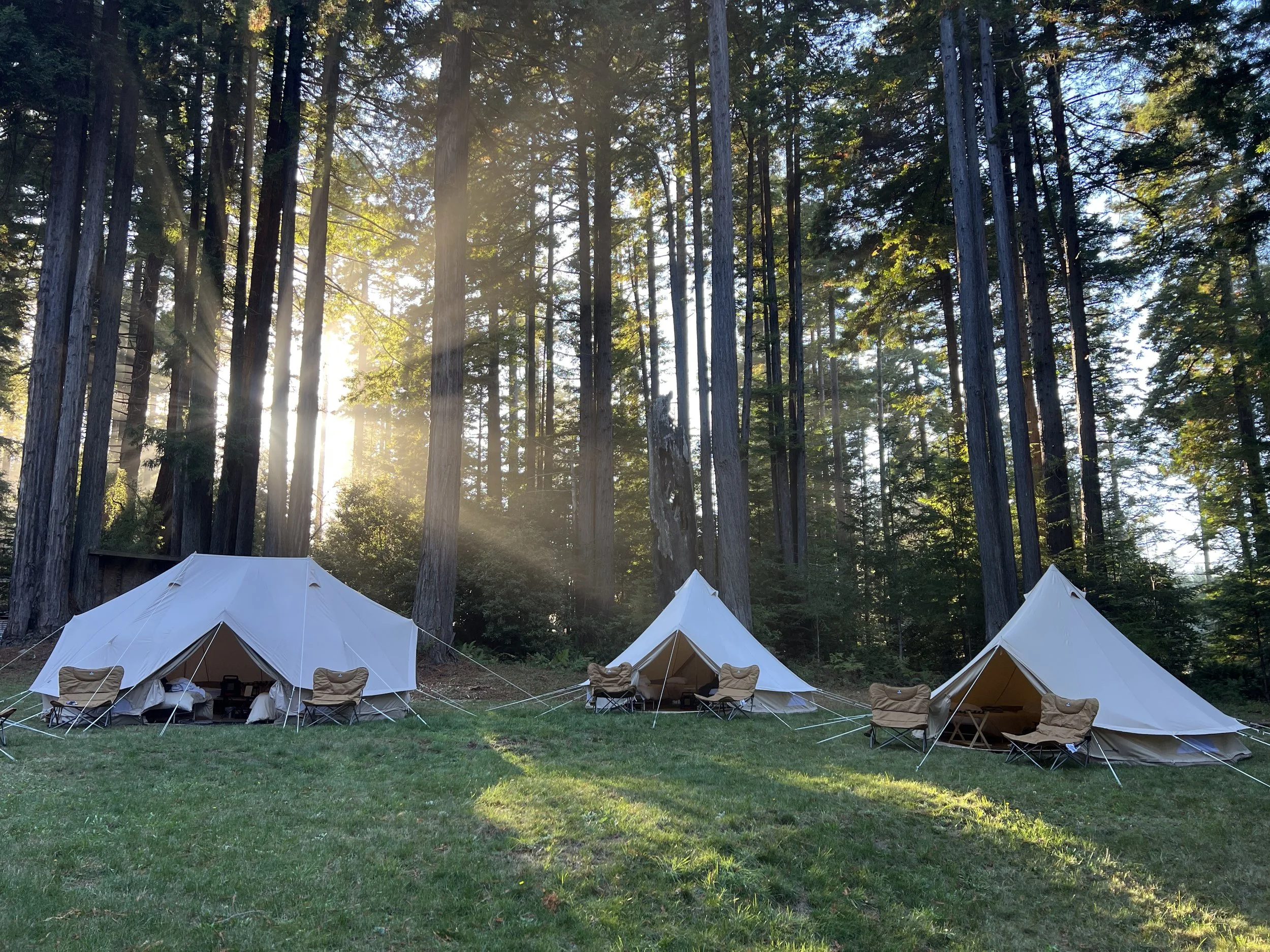
Photo of Group Glamping Tents Setup in Sunset Meadow. We have 10 Glamping Structures that can be added with 1to 3 beds each. This can increase bed capacity of campus to 50 guests across 20 unique accommodation spaces.
Christine Raschke and Monique Pearson: Guides for Your Reflective Journey
Skilled Facilitators Who Create Containers Where Deep Self-Reflection Can Safely Unfold
Christine Raschke and Monique Pearson value reflection not as occasional luxury squeezed into busy schedules but as regular practice essential to living with integrity and intention. Their Harvard Business School training taught them strategic analysis and planning—valuable skills that served them well in corporate roles. But their subsequent journeys taught them something more fundamental: the most important planning requires reflecting deeply on who you are and what truly matters. All the strategic brilliance in the world cannot compensate for pursuing goals that don't align with your actual values or building a life that looks impressive but feels empty.
Their coaching training equipped them with the art of asking questions that cut through surface answers to core truth—not the questions that allow comfortable responses but the ones that create productive discomfort, that invite you deeper than you've gone before, that challenge assumptions you didn't know you were making. Their somatic and breathwork training taught them to support reflection that engages body and emotion, not just analytical mind, recognizing that your fullest self-knowledge requires listening to all the ways you know, not just the verbal-cognitive channel we're taught to privilege.
What makes Christine and Monique effective guides for this self-discovery retreat redwoods is their understanding that meaningful reflection requires both structure and spaciousness, both guidance and freedom. Too much structure and you're simply answering their questions rather than discovering your own truth, following a prescribed path rather than finding your way. Too much spaciousness and you drift without gaining traction, circling the same patterns without breakthrough. They've learned to balance guided exercises with unstructured time, direct questions with silence for processing, individual reflection with group sharing—creating containers where your own wisdom can emerge.
They've also learned through their own practices that self-reflection isn't always comfortable. Sometimes you discover things about yourself that challenge your self-concept, that require difficult changes, that bring up grief or anger or fear you've been avoiding. Sometimes the truth is that you've been living someone else's life, or that you've hurt people you care about, or that you need to leave situations you've invested years building. Christine and Monique can hold space for whatever emerges—the beautiful and the difficult, the inspiring and the painful—without trying to fix, comfort prematurely, or redirect you from necessary discomfort. They trust your capacity to handle your own truth when you're properly supported, and they know that authentic reflection sometimes hurts before it heals. Connect with them at @thecatalystretreats to learn more about their approach to facilitating deep reflection.
Spirit Camp: A Reflective Sanctuary in the Redwoods
How Natural Beauty, Intentional Design, and Sacred Silence Create Optimal Conditions for Self-Knowing
Environment profoundly affects our capacity for reflection. Busy, stimulating environments keep us externally focused and reactive—responding to inputs, managing demands, navigating complexity. Spirit Camp's 27 acres of coastal redwood forest in Mendocino County offer the opposite: a quiet, beauty-filled environment that naturally turns attention inward and invites contemplation. The scale of the ancient trees—hundreds of feet tall, centuries old—puts human concerns in perspective while simultaneously making you feel held by something larger. The play of light through layered canopy creates ever-shifting patterns that invite visual meditation. The forest's essential hush, punctuated only by birdsong and wind through branches, allows you to hear your own thoughts without competing noise. All conspire to support the reflective state this mindful movement retreat near Bay Area cultivates.
The accommodations are designed to support both solitary and communal reflection. You'll stay in cabins—private spacious options, private cozy cabins, or three-to-four person shared spaces—that provide personal sanctuary for journaling, processing, and integrating insights between group sessions. These aren't luxury suites competing for your attention with amenities and entertainment, nor are they bare-bones accommodations where discomfort distracts. They're beautiful enough to feel honoring of the sacred work you're doing—oak hardwood floors, comfortable bedding, personal heaters, thoughtful design—yet simple enough to keep focus on internal rather than external experience. The forest views from every window offer ongoing visual contemplation: watching light shift through trees as day progresses, noticing birds and banana slugs going about their lives, simply being present with natural rhythms so different from human urgency. The comfortable beds support the deep sleep necessary for processing and integrating reflective insights at subconscious levels—much of the real work happens while you're sleeping, your mind sorting and consolidating what you've discovered during waking reflection.
The spaces specifically designed for reflection each serve unique functions. The Sanctuary, with its copper roof, central skylight, and abundant natural light flooding through 20-foot south-facing windows, becomes the primary venue for guided reflection. The skylight naturally draws eyes upward, inviting more expansive thinking beyond the immediate and practical. The circle seating configuration means everyone sees everyone, supporting the mirroring that happens when we reflect in community—you see aspects of yourself in others' stories, and their responses to your sharing reveal how you're perceived in ways you cannot see alone. The hiking trails through redwoods offer perfect opportunity for walking meditation and solo contemplation. Many participants report that their deepest insights arrive not during formal sessions but while walking alone among the trees—something about the rhythm of walking, the beauty surrounding you, the solitude creating safety for difficult truths to surface.
Magic Meadow with its two fire circles facilitates evening reflections where women share what they're discovering. There's something about gathering around fire under redwood canopy under stars that calls forth deeper sharing than happens in everyday contexts. Fire has always been humanity's gathering place for storytelling, truth-telling, and collective reflection—the dancing flames seem to invite us into more honest relationship with ourselves and each other.
The retreat's emphasis on simplicity itself supports reflection. Meals are provided—no decisions about what to eat or when or where. The daily structure is clear—no planning required about how to use your time. Digital connectivity is naturally limited—the forest's spotty cell service becomes a gift rather than frustration, freeing you from the constant pull of email, news, and social media. With your mental energy not consumed by logistics and digital distractions, it becomes available for the important questions that finally get the sustained attention they deserve. The absence of luxury amenities—no spa, no fancy cocktails, no entertainment—means you're not distracted from the inner work by external pleasures. Even the "summer camp" aesthetic of communal bathhouses, simple cabins, and fire circles evokes a time when we were more naturally reflective and curious about ourselves and the world, before the roles and responsibilities of adulthood created layers of conditioning and defense.
California's North Coast: Spirit Camp's Contemplative Location in Mendocino
Three Hours North of San Francisco to a Landscape That Naturally Induces Reflection and Wonder
California's North Coast represents one of the state's most contemplative landscapes—a place where massive redwood forests meet the dramatic Pacific coastline, where fog and sunshine alternate throughout the day creating constant play of light and shadow, where the pace naturally slows and the mind naturally quiets. This isn't the sun-soaked, tourist-packed southern California coast, nor is it the urban intensity of San Francisco Bay. This is the coast that has drawn seekers, artists, and contemplatives for generations—people sensing that something about this particular confluence of forest and ocean, earth and water, ancient and ever-changing creates optimal conditions for creative work and inner exploration.
Spirit Camp sits in the heart of this reflective territory in Mendocino County, offering immediate immersion in environments conducive to self-reflection. The retreat center is located approximately three hours north of San Francisco, Oakland, Berkeley, San Jose, and the broader Bay Area communities. It's about two hours from Sonoma County and accessible from San Francisco International Airport (SFO), Oakland International Airport (OAK), or Santa Rosa Airport (just two hours away). Positioned on California's North Coast, Spirit Camp occupies 27 acres of second-growth redwood forest, just ten minutes from the historic town of Mendocino and one mile inland from the Pacific Ocean.
This specific geography supports self-reflection in tangible ways. The redwood forest's cathedral-like quality naturally evokes wonder and puts human concerns in perspective. These trees have witnessed centuries of human drama—births and deaths, loves and losses, wars and peace—while maintaining their essential nature, offering both grounding and perspective for your own reflections. When you're anxious about a decision or caught in rumination about a relationship, standing beside a tree that's been growing for 300 years helps you recognize that your current concern, while real to you, is tiny in the grand scheme. This isn't minimizing your experience but providing perspective that allows you to hold it more lightly.
The Pacific Ocean just a mile away offers complementary teaching. The ocean's constant transformation—waves eternally arriving and departing, tides rising and falling, water taking infinite forms yet remaining essentially water—mirrors the insights of deep reflection. Nothing is permanent. Everything flows. What seems solid is actually always changing. Yet beneath the constant change, something essential remains. You are not the same person you were ten years ago, yet you're still fundamentally you. The ocean teaches this paradox viscerally.
The relative remoteness from major cities creates necessary separation from your usual context and roles. When you're in your everyday environment, you're embedded in complex systems—work demands, relationship dynamics, household responsibilities, social expectations. It's nearly impossible to see these systems clearly from inside them. The three-hour journey to Spirit Camp creates psychological and emotional distance that allows you to reflect on your life from outside rather than from within its demands. You can ask questions you don't allow yourself in daily life: Is this career path actually serving me? Does this relationship support my growth or constrain it? Am I living my values or performing someone else's idea of success?
The drive itself becomes a transition—leaving behind who you've been, arriving open to discovering who you're becoming. Many participants report that by the time they arrive at Spirit Camp, they're already in a different state of consciousness than when they left home. Continue exploring reflective practices at the Spirit Camp retreat calendar.
Reflections on Reflection: Your Questions About The Catalyst Retreat
Understanding What Self-Reflection Requires and What It Reveals
I'm an introvert and worry about the group aspect—can I still have plenty of alone time for reflection?
This concern deserves honoring—introverts often need solitude to process and integrate experiences, and the thought of intensive group interaction can feel depleting rather than nourishing. The good news is that this reflective retreat women California coast is specifically designed to honor both communal and solitary reflection, recognizing that both serve essential functions. The schedule deliberately balances structured group sessions with generous unstructured personal time.
A typical day might include 3-4 hours of group activities—perhaps morning yoga, a mid-morning coaching circle, and evening sound healing—and 4-5 hours of personal time for solo walks in the redwood forest, journaling in your cabin or the Sanctuary, napping if your body needs rest, or simply sitting with what's emerging without any agenda. The group sessions themselves are designed with introverts in mind: small size (14 maximum) prevents the overstimulation of large group dynamics, there's no pressure to perform or entertain, silence is valued and invited, and you're never forced to share if you're not ready.
Many introverts actually report that the group sessions enhance rather than detract from their reflection. Hearing others' insights and questions illuminates their own—someone else's story triggers recognition of a pattern you hadn't seen, or a question asked to another participant resonates with something you've been circling. Being witnessed as you tentatively share truths you've kept private helps those truths solidify and become real rather than remaining vague internal murmurings. That said, if you need to retreat to your cabin or the forest for extended solitude, that's always respected and honored as part of your reflective process.What if I discover things about myself during reflection that are uncomfortable or difficult?
This possibility is real, and worth acknowledging directly: meaningful self-reflection often does surface uncomfortable truths. You might recognize patterns you'd rather not see—ways you've been complicit in your own unhappiness, relationships where you've accepted unacceptable treatment, choices driven by fear rather than desire, years spent pursuing goals that were never actually yours. You might acknowledge desires you've been suppressing as impractical or selfish. You might confront fears or grief you've been avoiding. You might realize that significant changes need to happen and you're the only one who can make them.
Here's what's important to understand: these difficult realizations are actually signs that the reflection is working, not problems to avoid. The discomfort means you're seeing clearly rather than maintaining comfortable delusions. And you're not alone with these discoveries. Christine and Monique are skilled at supporting participants through difficult realizations without trying to fix, comfort prematurely, or redirect you from necessary discomfort. They create safe space for whatever emerges and help you process discoveries without becoming overwhelmed. The group also provides unexpected comfort—when you share something difficult and others respond with recognition and acceptance rather than judgment, the shame or fear often diminishes dramatically. You discover you're not uniquely broken, just human.
The post-retreat integration session specifically addresses this concern—it helps you continue processing discoveries after you return home, ensuring you're not left alone with challenging insights. Many participants find that what felt overwhelming during the retreat becomes more manageable with time and continued support.How is this different from therapy or from just journaling on my own?
All three practices—retreat-based reflection, therapy, and solo journaling—serve valuable functions, and they can complement rather than replace each other. Therapy (especially depth therapy) supports self-reflection but typically happens in weekly 50-minute sessions over months or years. While this gradual pace allows sustainable integration, it also means limited time in each session and many days between sessions when life's demands crowd out reflection. Solo journaling is valuable and can be done regularly, but it lacks external input—you can only reflect within the limits of what you already know and what questions you think to ask yourself. There's no one to challenge your blind spots or offer perspectives you haven't considered.
This introspection retreat Mendocino offers concentrated, immersive reflection with multiple advantages: three consecutive days away from usual triggers and demands, creating sustained space for deep work rather than interrupted fragments. Skilled facilitators ask questions you wouldn't think to ask yourself, challenge assumptions you don't realize you're making, and hold you accountable to your own stated values and desires. Diverse practices—coaching, movement, breathwork, visualization—access different dimensions of self-knowledge, ensuring that if one pathway doesn't resonate, others will. And community reflection adds irreplaceable value: others' journeys illuminate your own through resonance and contrast, their perceptions offer new perspectives on who you are, and their witness makes your insights more real and accountable.
Think of retreat-based reflection as intensive work that jumpstarts or accelerates what therapy and journaling accomplish more gradually. It's not either/or but both/and—the retreat creates breakthrough and momentum that you then sustain through regular journaling and, if appropriate, ongoing therapy.
Two Reflective Destinations Near Spirit Camp
Continue Your Contemplative Journey Through Mendocino's Inspiring Landscapes
Chapman Point and Spring Ranch Headlands: Where Ocean Vastness Meets Contemplative Silence
Just north of Mendocino town, Chapman Point and Spring Ranch Headlands offer some of California's most spectacular yet relatively uncrowded ocean views—wide, grassy headlands perfect for the kind of prolonged sitting, walking, or simply being that deep reflection requires. Unlike more famous coastal viewpoints crowded with tourists and photo-seekers, these headlands maintain a contemplative quality that invites genuine engagement rather than quick snapshots. Multiple paths wind through coastal prairie dotted with wildflowers—especially vibrant in April and May when retreat participants will visit—leading to dramatic cliff edges and sheltered coves where you can sit for hours watching waves crash against offshore rocks and sea stacks.
This location specifically supports continued self-reflection for several reasons. The vastness of the Pacific horizon naturally expands perspective beyond immediate concerns—when you're staring at an ocean that stretches 6,000 miles to Asia, your relationship drama or career uncertainty, while still real, becomes smaller and more manageable. The constant wave rhythm creates a meditative soundscape that quiets mental chatter without requiring you to try—your brainwaves naturally entrain to the rhythmic arrival and departure of waves. The absence of structures or significant human activity allows projection of your own inner landscape onto the external environment—the ocean becomes whatever you need it to be: vast possibility, constant change, emotional depth, cleansing power. Many retreat participants report bringing journals here and alternating between writing and ocean-gazing, finding that insights emerge precisely in the space between focused attention and diffuse awareness. The headlands are also excellent for sunset watching—a natural contemplative practice as day transitions to night, light transforms to darkness, and the mind naturally reflects on endings, transitions, and new beginnings.
Heritage House Ruins: Impermanence Made Visible and the Beauty of Letting Go
South of Mendocino town along the coastal bluffs, you'll find the remains of the historic Heritage House—once an elegant inn and restaurant featured in films like "Same Time, Next Year" and beloved by generations of visitors for its dramatic oceanside setting and romantic atmosphere. The property closed years ago and fell into disrepair, with nature slowly reclaiming the structures. Walking around the ruins (respectfully, as it's private property viewable from adjacent public trails), you'll see empty windows framing perfect ocean views, walls overtaken by ivy and wildflowers, the footprint of what was once beautiful hospitality now returning to earth.
These ruins invite profound reflection on impermanence—the temporary nature of all our constructions, the question of what actually lasts beyond material form, the beauty that can exist even in decay and dissolution. For women fresh from reflective work at The Catalyst Retreat—questioning what to preserve and what to release, what to build and what to allow its natural conclusion, how to honor the past while moving toward the future—these ruins offer powerful teaching. They demonstrate that endings aren't always failures. Sometimes the most beautiful and appropriate ending isn't restoration or resurrection but surrender to organic change, allowing what was human-made to become natural again, what was structured to become wild, what was controlled to become free.
The ruins also suggest that your past constructions—the identity you built, the life you structured, the roles you performed—can be honored for their time while also being released when their time has passed. The Heritage House served its purpose beautifully for decades. Now it serves a different purpose: teaching about impermanence, demonstrating transformation, offering a different kind of beauty. Your past serves you even as you move beyond it. Perfect for retreat graduates contemplating what in their lives needs honoring for its season while also allowing its natural conclusion without guilt or resistance.
Self-Reflection: Not Luxury but Essential Practice
Self-reflection isn't a luxury reserved for people with unlimited free time and no responsibilities. It's an essential practice for anyone who wants to live with intention rather than autopilot, who seeks to grow toward their potential rather than remain constrained by unconscious patterns, who desires to know themselves deeply enough to make choices that genuinely serve their flourishing rather than merely maintaining comfort or meeting others' expectations.
The Catalyst Retreat offers you three nights to step out of your usual life and into profound self-reflection, supported by skilled guides who ask powerful questions, diverse practices that access different dimensions of knowing, conscious community that offers witness and mirror, and the wisdom-inducing presence of ancient redwood forest on California's North Coast.
Join Christine Raschke and Monique Pearson April 16-19, 2026, in Mendocino County for this consciousness retreat North of Oakland. Through mindfulness, movement, coaching, breathwork, and contemplative immersion in nature, discover who you are beneath the doing, and who you're becoming.
Limited to 14 women ready for genuine self-reflection.
Give yourself the gift of reflection at The Catalyst Retreat
TOPICS:
retreat for self-reflection, self-reflection retreat California, mindfulness retreat Mendocino County, movement retreat Northern California, contemplative retreat women North of San Francisco, self-discovery retreat redwoods, mindful movement retreat near Bay Area, reflective retreat women California coast, introspection retreat Mendocino, consciousness retreat North of Oakland, Mendocino County, redwood forest/redwoods, Northern California, California North Coast, Bay Area/Oakland/San Francisco